They are linked wonderfully, when I remember not to ignore or disregard their connection. They work together to anchor my writing in a reality that is both hyper and realistic--as most fiction and good nonfiction are. It's that fortunate way of "hearing" a character's voice or the nonfiction POV voice that's perfect in character subtext.
My present project has been fleshing out a reality-based romantic novel that takes place in mainland China, along with a huge language barrier. I was given a major character's description and the reaction him, and came up with an overtly effusive manner for him to speak.
Bingo. I was told that she laughed at the pleasure of hearing him come alive, as she recalls him. I've never met him, nor heard him.
Intuition is listening and perceiving the subtleties around and within you, creativity is doing it, expressing it outwardly and not assuming it's frivolous, or hard.
Tuesday, April 27, 2010


Sunday, April 18, 2010
Neale Sourna in WVIZ TV25 PBS 2010 AUCTION
04-2010 Neale Sourna's Participating in WVIZ-TV25 (PBS) AUCTION--Watch Us. Make a Bid. It's Fun!
CLEVELAND'S CITY CLUB FORUM--Slavery by Another Name: The Re-Enslavement of Black Americans from...
CLEVELAND'S CITY CLUB FORUM
April 16, 2010 featuring Douglas A. Blackmon, Author and Pulitzer Prize Winner.
Douglas A. Blackmon [not Blackman], Author and Winner of the 2009 Pulitzer Prize in the General Nonfiction category, speaks about his award winning book "Slavery by Another Name: The Re-Enslavement [Reenslavement] of Black Americans from the Civil War to World War II.
Download Duration:
00:56:31 Published: Fri, Apr 16, 2010 12:00:00 -0500
Character: Doctor Who Series 5, Next Doctor
You know your character's written tightly and well if, as in the "Doctor Who" Series 5 character trailer, when the Doctor is seen shooting a gun, and you immediately think, "He doesn't do that!"
Friday, April 16, 2010
PRESS RELEASE: "Neale Sourna's CuntSinger" Cunnilingus Manual 1/2 Off
PRESS RELEASE: "Neale Sourna's CuntSinger" Cunnilingus Manual 1/2 Off in Mobipocket

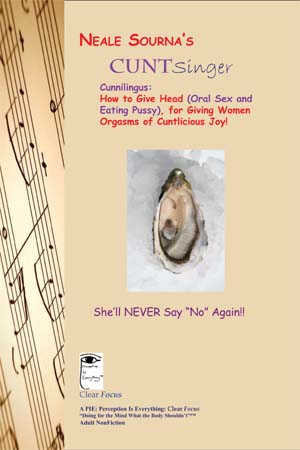
HALF OFF so you can BUY A COPY FOR FRIEND'S PDA, IPOD, or IPAD! Only until the END OF APRIL, so GET HIM (or HER) A COPY OF THEIR OWN--It's for your own good.
HALF OFF so you can BUY A COPY FOR FRIEND'S PDA, IPOD, or IPAD! Only until the END OF APRIL, so GET HIM (or HER) A COPY OF THEIR OWN--It's for your own good.
Monday, April 12, 2010
Online portfolios (script, novel, story excerpts, client article links):
http://profile.guru.com/667152
http://nealesourna.elance.com/
http://www.Neale-Sourna.com
http://www.Writing-Naked.com
http://www.neale-sourna.com/games.htm
http://www.orchidgames.com/heartwild_solitaire ,
http://www.orchidgames.com/heartwild_solitaire_book_two ,
http://www.orchidgames.com/heartwild_solitaire_classic/quiz
[Heartwild Solitaire, Heartwild Solitaire: Book Two games and Quiz Game]
http://www.margravemanor.com/ ,
http://www.margravemanor2.com/gameinfo.php
[The Secret of Margrave Manor, Margrave Manor 2: The Lost Ship 2 games]
http://www.weddingnight.com/ Short stories
http://www.romantic4ever.com/romantic-fiction/index.html Short stories
http://www.romantic4ever.com/d_how_we_met/100408-five-and-dime-store.html
Search Google, Amazon, etc for "Neale Sourna"
Booksellers: http://www.ingrambook.com/ [Neale's Distributor/Printer: http://www.LightningSource.com ]
http://nealesourna.elance.com/
http://www.Neale-Sourna.com
http://www.Writing-Naked.com
http://www.neale-sourna.com/games.htm
http://www.orchidgames.com/heartwild_solitaire ,
http://www.orchidgames.com/heartwild_solitaire_book_two ,
http://www.orchidgames.com/heartwild_solitaire_classic/quiz
[Heartwild Solitaire, Heartwild Solitaire: Book Two games and Quiz Game]
http://www.margravemanor.com/ ,
http://www.margravemanor2.com/gameinfo.php
[The Secret of Margrave Manor, Margrave Manor 2: The Lost Ship 2 games]
http://www.weddingnight.com/ Short stories
http://www.romantic4ever.com/romantic-fiction/index.html Short stories
http://www.romantic4ever.com/d_how_we_met/100408-five-and-dime-store.html
Search Google, Amazon, etc for "Neale Sourna"
Booksellers: http://www.ingrambook.com/ [Neale's Distributor/Printer: http://www.LightningSource.com ]
Sunday, April 04, 2010
LinkedIn Neale Sourna's Game Writer Exchange Group
WANTED: Established writers, rank beginners and working in-betweeners. Share your latest job and career notice finds, give information and advice, or submit education hookups concerning game story writing, interactive fiction, & requests for short to long fiction/scripts for games or comics.
By registering to be a member of the Game Writer Exchange group, you consent to have your name and your email address be accessible by the official representative of the Game Writer Exchange group, and to be identified as a Game Writer Exchange group member in your profile and the LinkedIn search results. If you do not wish to give such consent, please do not register.
Friday, April 02, 2010
Thursday, March 25, 2010
About Character: Your Beliefs About Yourself are Controlling Your Destiny By Harrison Barnes
[More "Controlling Your Destiny" ]
Most people in the world are literally operating on auto pilot, based on beliefs about themselves they do not even know that they have. Everyone has an internal map of reality and this map is creating life and experiences. These beliefs are affecting us on a daily basis whether we want them to or not. We all have internal maps of reality and these maps operate primarily unconsciously and on automatic. We hold many beliefs to be true that end up creating our experience of life. Something that can change your entire life and career is when you realize the following:
[More "Controlling Your Destiny" ]
Most people in the world are literally operating on auto pilot, based on beliefs about themselves they do not even know that they have. Everyone has an internal map of reality and this map is creating life and experiences. These beliefs are affecting us on a daily basis whether we want them to or not. We all have internal maps of reality and these maps operate primarily unconsciously and on automatic. We hold many beliefs to be true that end up creating our experience of life. Something that can change your entire life and career is when you realize the following:
You are the creator of whatever happens to you. Whatever happens to you is coming from inside of you. Everything that is happening to you is being generated inside of yourself–even if you cannot see this. The key to a successful career and life is to stop resisting what is happening to you and start choosing what to believe about the world to create the life you want.Once you understand this statement your life as you know it and your ability to control what happens to you in your life will change. Understanding this statement and working with this statement is something the most successful people in the world are able to do and the least successful people in the world are not. In effect, the most successful people in the world choose what to believe about themselves and the world. I would estimate that less than 1 in 1,000 people understand this. Even fewer people are able to make this work for there own benefit.
[More "Controlling Your Destiny" ]
Friday, March 19, 2010

Sunday, February 28, 2010
From Beyond Romance Blog: Flaws versus Foibles By Misty Malone (Guest Blogger)
http://lisabetsarai.blogspot.com/2010/02/flaws-versus-foibles.html
Jane Smith is perfect. She’s funny, witty, sings like an angel, and gorgeous. Though she can be a bit too nice at times, and has a tendency to be a bit clumsy.
Mary Johnson is also popular, but she’s known for her hot temper and often acts without thinking of the consequences first.
So, which one of these characters would you rather read about?
Mary, right? Bet I know why.
Mary has a character flaw. Jane has a character foible.
Merriam-Webster defines character foibles as, “a minor flaw or shortcoming in character or behavior.” These “quirks” don’t impact the character’s life in any significant way and rarely have the power to carry a main character through a plot. Being clumsy, like Jane, may make a reader identify with the trait, but rarely with the character herself.
On the other hand, Mary’s anger and impetuousness open up a whole world of plotlines because of the fatal character flaw at the core of her personality. Whatever situation she gets in, her fatal flaw will make it worse. The reader will cringe when Mary makes yet another mistake, but that’s what you want as an author: character flaws are what make readers care about your characters.
Here are some tips and tricks: [http://lisabetsarai.blogspot.com/2010/02/flaws-versus-foibles.html]
Jane Smith is perfect. She’s funny, witty, sings like an angel, and gorgeous. Though she can be a bit too nice at times, and has a tendency to be a bit clumsy.
Mary Johnson is also popular, but she’s known for her hot temper and often acts without thinking of the consequences first.
So, which one of these characters would you rather read about?
Mary, right? Bet I know why.
Mary has a character flaw. Jane has a character foible.
Merriam-Webster defines character foibles as, “a minor flaw or shortcoming in character or behavior.” These “quirks” don’t impact the character’s life in any significant way and rarely have the power to carry a main character through a plot. Being clumsy, like Jane, may make a reader identify with the trait, but rarely with the character herself.
On the other hand, Mary’s anger and impetuousness open up a whole world of plotlines because of the fatal character flaw at the core of her personality. Whatever situation she gets in, her fatal flaw will make it worse. The reader will cringe when Mary makes yet another mistake, but that’s what you want as an author: character flaws are what make readers care about your characters.
Here are some tips and tricks: [http://lisabetsarai.blogspot.com/2010/02/flaws-versus-foibles.html]
Saturday, February 27, 2010
Character in Song Lyrics: Fiona Apple Criminal Lyrics
Fiona Apple Criminal Lyrics

I've been a bad bad girl
I've been careless with a delicate man
And it's a sad sad world
When a girl will break a boy
Just because she can
Don't you tell me to deny it
I've done wrong and I want to
Suffer for my sins
I've come to you 'cause I need
Guidance to be true
And I just don't know where I can begin
What I need is a good defense
'Cause I'm feelin' like a criminal
And I need to redeemed
To the one I've sinned against
Because he's all I ever knew of love
Heaven help me for the way I am
Save me from these evil deeds
Before I get them done
I know tomorrow brings the consequence
At hand
But I keep livin' this day like
The next will never come
Oh help me but don't tell me
To deny it
I've got to cleanse myself
Of all these lies till I'm good
Enough for him
I've got a lot to lose and I'm
Bettin' high
So I'm beggin' you before it ends
Just tell me where to begin
What I need is a good defense
'Cause I'm feelin' like a criminal
And I need to redeemed
To the one I've sinned against
Because he's all I ever knew of love
Let me know the way
Before there's hell to pay
Give me room to lay the law and let me go
I've got to make a play
To make my lover stay
So what would an angel say
The devil wants to know
What I need is a good defense
'Cause I'm feelin' like a criminal
And I need to redeemed
To the one I've sinned against
Because he's all I ever knew of love
What I need is a good defense
'Cause I'm feelin' like a criminal
And I need to redeemed
To the one I've sinned against
Because he's all I ever knew of love
[more lyrics and ringtones at http://www.lyricsfreak.com/f/fiona+apple/criminal_20053670.html
I've been careless with a delicate man
And it's a sad sad world
When a girl will break a boy
Just because she can
Don't you tell me to deny it
I've done wrong and I want to
Suffer for my sins
I've come to you 'cause I need
Guidance to be true
And I just don't know where I can begin
What I need is a good defense
'Cause I'm feelin' like a criminal
And I need to redeemed
To the one I've sinned against
Because he's all I ever knew of love
Heaven help me for the way I am
Save me from these evil deeds
Before I get them done
I know tomorrow brings the consequence
At hand
But I keep livin' this day like
The next will never come
Oh help me but don't tell me
To deny it
I've got to cleanse myself
Of all these lies till I'm good
Enough for him
I've got a lot to lose and I'm
Bettin' high
So I'm beggin' you before it ends
Just tell me where to begin
What I need is a good defense
'Cause I'm feelin' like a criminal
And I need to redeemed
To the one I've sinned against
Because he's all I ever knew of love
Let me know the way
Before there's hell to pay
Give me room to lay the law and let me go
I've got to make a play
To make my lover stay
So what would an angel say
The devil wants to know
What I need is a good defense
'Cause I'm feelin' like a criminal
And I need to redeemed
To the one I've sinned against
Because he's all I ever knew of love
What I need is a good defense
'Cause I'm feelin' like a criminal
And I need to redeemed
To the one I've sinned against
Because he's all I ever knew of love
[more lyrics and ringtones at http://www.lyricsfreak.com/f/fiona+apple/criminal_20053670.html
Friday, February 12, 2010
Matt Costello and Vanessa Franklin/Ninjagirl82 on Game Writing and more at Youtube.com
The writer of loads of games like Pirates of the Caribbean: World's End for X box 360 !!!!! and written novels and screenplays and loads. [And yes, he, too, despite what job HR types ask about, says he has LITTLE TIME TO PLAY games, since he's CREATING them.]
Matt Costello How 2 write video games, 2009
http://www.youtube.com/watch?v=QgzzQKYLHqE
The Game of Writing Games (Story and Games) with Matt Costello Pt 1/3, 2008
http://www.youtube.com/watch?v=syY3XY3LJgo
The Game of Writing Games with Matt Costello Pt 2/3, 2008
http://www.youtube.com/watch?v=RjL_1M-ZITI
The Game of Writing Games with Matt Costello Pt 3/3, 2008
http://www.youtube.com/watch?v=wfLv-NDFyoU
==========================
Writing for a video game part 1 by Vanessa Franklin/Ninjagirl82, 2007
http://www.youtube.com/watch?v=nw1KpoFMrNI
Writing for a Video Game Part 2, 2007
http://www.youtube.com/watch?v=YewxKtxsoV4
Writing for a Video Game Part 3, 2007
http://www.youtube.com/watch?v=BV4IspRB5KQ
===========================
Video Game Industry : How to Write Video Game Scripts from GameRecruiter
http://www.youtube.com/watch?v=0W_ImokXCUQ
Video Game Industry : Job Descriptions for a Video Game Designer
http://www.youtube.com/watch?v=AYzMAplBYhc
Video Game Industry : Qualifications for a Video Game Designer
http://www.youtube.com/watch?v=5LxE2iiEKpY
Video Game Industry : About Game Design Software
http://www.youtube.com/watch?v=RkmlWJQZUzs
[Steam is a digital distribution, digital rights management, multiplayer and communications platform developed by Valve Corporation. It is used to distribute a large number of games and related media entirely over the internet, from small independent efforts to larger, more popular games. Steam is set apart from similar services primarily by its community features, completely automated game update process, and its use of in-game functionality.
There are over 1,000 games available on Steam, and in January 2010 Valve announced that it had surpassed 25 million active user accounts.[3] It regularly services in excess of two million concurrent users.[4] Although Valve never releases sales figures, Steam is considered by its competitors and clients to be the market leader, controlling an estimated 70% of the digital distribution market.[5]
Many major publishers have catalogues on Steam, including Electronic Arts, Activision, 2K Games, Ubisoft, THQ, Sega, Codemasters, LucasArts, id Software, and BioWare.--Wikipedia http://store.steampowered.com/]
Matt Costello How 2 write video games, 2009
http://www.youtube.com/watch?v=QgzzQKYLHqE
The Game of Writing Games (Story and Games) with Matt Costello Pt 1/3, 2008
http://www.youtube.com/watch?v=syY3XY3LJgo
The Game of Writing Games with Matt Costello Pt 2/3, 2008
http://www.youtube.com/watch?v=RjL_1M-ZITI
The Game of Writing Games with Matt Costello Pt 3/3, 2008
http://www.youtube.com/watch?v=wfLv-NDFyoU
==========================
Writing for a video game part 1 by Vanessa Franklin/Ninjagirl82, 2007
http://www.youtube.com/watch?v=nw1KpoFMrNI
Writing for a Video Game Part 2, 2007
http://www.youtube.com/watch?v=YewxKtxsoV4
Writing for a Video Game Part 3, 2007
http://www.youtube.com/watch?v=BV4IspRB5KQ
===========================
Video Game Industry : How to Write Video Game Scripts from GameRecruiter
http://www.youtube.com/watch?v=0W_ImokXCUQ
Video Game Industry : Job Descriptions for a Video Game Designer
http://www.youtube.com/watch?v=AYzMAplBYhc
Video Game Industry : Qualifications for a Video Game Designer
http://www.youtube.com/watch?v=5LxE2iiEKpY
Video Game Industry : About Game Design Software
http://www.youtube.com/watch?v=RkmlWJQZUzs
[Steam is a digital distribution, digital rights management, multiplayer and communications platform developed by Valve Corporation. It is used to distribute a large number of games and related media entirely over the internet, from small independent efforts to larger, more popular games. Steam is set apart from similar services primarily by its community features, completely automated game update process, and its use of in-game functionality.
There are over 1,000 games available on Steam, and in January 2010 Valve announced that it had surpassed 25 million active user accounts.[3] It regularly services in excess of two million concurrent users.[4] Although Valve never releases sales figures, Steam is considered by its competitors and clients to be the market leader, controlling an estimated 70% of the digital distribution market.[5]
Many major publishers have catalogues on Steam, including Electronic Arts, Activision, 2K Games, Ubisoft, THQ, Sega, Codemasters, LucasArts, id Software, and BioWare.--Wikipedia http://store.steampowered.com/]
Monday, February 08, 2010
My Guilty Romances with Keanu Reeves, Lovers, and Writing
My Guilty Romances with Keanu Reeves, Lovers, and Writing
By Neale Sourna (Guest Blogger)
I write erotic fiction, both soft and hardcore, and sensuous and romantic game texts, and do so boldly. And even call my writing consulting site Writing-Naked.com, because I love writing, love to write, and love to have written—and yet I find, repeatedly, a middle class, middle American, Midwest, working class vibe of, “Hm, writing, that’s not REAL work, a REAL job you can do with pride, tell your grandma, and pay all your bills with.”
Like I had total pride and all my bills paid back when I was a secretary / executive assistant / office manager or retail salesperson or whatever. Absolutely not.
And my mom and grandma know what I write, even if they don’t read it.
“They” never leave you alone, nor does the noise in your own head, except unless you can prove you can afford to live in Anne Rice’s mansion, Stephen King’s gothic estate, or give the forever waving and REAL jobless Queen of England a run for her pound Sterling by being “Harry Potter’s” multimillion, writing mum.
And, probably, even then, you’ll have to tell yourself—until you believe it, too, and then some—that sitting on your bum, writing “little stories,” especially “little, romantic and erotic stories” IS REAL. And a guilt-free occupation.
That it’s more than okay.
That it’s really a breath of air filling your lungs, and a thing that keeps you sane.
Or, maybe, that’s just me.
And what does this have to do with Keanu...? http://lisabetsarai.blogspot.com/2010/01/my-guilty-romances-with-keanu-reeves.htmlWednesday, January 27, 2010
The First ProjectKeanu.com Audio Commentary by author Neale Sourna
The First ProjectKeanu.com Audio Commentary by author Neale Sourna (play along with your DVD): AWalkInTheClouds--1995.mp3
Fun, opinion, insightful, Free!
Fun, opinion, insightful, Free!
Friday, January 15, 2010
Legal Battles Over E-Book Rights to Older Books
Legal Battles Over E-Book Rights to Older Books
By MOTOKO RICHWilliam Styron may have been one of the leading literary lions of recent decades, but his books are not selling much these days. Now his family has a plan to lure digital-age readers with e-book versions of titles like “Sophie’s Choice,” “The Confessions of Nat Turner” and Mr. Styron’s memoir of depression, “Darkness Visible.”


But the question of exactly who owns the electronic rights to such older titles is in dispute, making it a rising source of conflict in one of the publishing industry’s last remaining areas of growth.
Mr. Styron’s family believes it retains the rights, since the books were first published before e-books existed. Random House, Mr. Styron’s longtime publisher, says it owns those rights, and it is determined to secure its place — and continuing profits — in the Kindle era.
The discussions about the digital fate of Mr. Styron’s work are similar to the negotiations playing out across the book industry as publishers hustle to capture the rights to release e-book versions of so-called backlist books. Indeed, the same new e-book venture Mr. Styron’s family hopes to use has run into similar resistance from the print publisher of “Catch-22” by Joseph Heller.
On Friday, Markus Dohle, chief executive of Random House, sent a letter to dozens of literary agents, writing that the company’s older agreements gave it “the exclusive right to publish in electronic book publishing formats.”
Backlist titles, which continue to be reprinted long after their initial release, are crucial to publishing houses because of their promise of lucrative revenue year after year. But authors and agents are particularly concerned that traditional publishers are not offering sufficient royalties on e-book editions, which they point out are cheaper for publishers to produce. Some are considering taking their digital rights elsewhere, which could deal a financial blow to the hobbled publishing industry.
The tussle over who owns the electronic rights — and how much the authors should earn in digital royalties — potentially puts into play works by authors like Ralph Ellison and John Updike.
Some publishers have already made agreements with authors or their estates to release digital editions. All of Ernest Hemingway’s books, for example, are available in electronic versions from his print publisher, Scribner, a unit of Simon & Schuster.
But with only a small fraction of the thousands of books in print available in e-book form, there are many titles to be fought over.
“This is a wide open frontier.....[more at http://www.nytimes.com/2009/12/13/business/media/13ebooks.html#]A version of this article appeared in print on December 13, 2009, on page A1 of the New York edition.
========
And people ask why I publish my own works. Yes, it's work and like a voice crying in the wilderness all alone; but, it's my voice. And autonomy and independence and knowing my titles aren't ignored or pulled out of rotation for no apparent reason except boredom in waiting for the BIG NUMBERS by "my publisher" for a huge, star customer other than myself--I'm my own star!--is worth the sleep at night.--Neale Sourna
Sunday, January 10, 2010
Visualize Where You Are Going: Think Big
Visualize Where You Are Going: Think Big |  | ||
| By Harrison Barnes | | |
| |||
|
A famous book quoted in The Secret is Think and Grow Rich by Napoleon Hill. Anthony Robbins and many other motivational gurus often talk about these same topics and inspirational ideas. There is a lot to be said about clearly visualizing where you are going. You have to know where you want your life to go and set high goals to get there. When I was in my mid-20s I lived in Hollywood, and for a time I would pal around with some people who were really interested in being actors. After I had spent several months in the Hollywood scene, I began to notice that everyone who was interested in show business talked a big game; they always seemed to be talking about where they were going to be in a few years. Moreover, most of these people could tell you every last detail about their favorite actors and movies. In many cases, these wannabe actors and actresses littered their apartments with pictures of their idols and of the movies they liked. Every social move they made was always geared towards getting to know people in the business. At night most of these people were only interested in going to places and seeing people who could potentially further their acting careers. They all seemed to have this common underlying belief that they needed to bring their efforts to a fever pitch in order to succeed in Hollywood. They needed to eat, breathe, think, and do everything within their power at all times in order to accelerate their careers. In at least two cases I know of, these people became very famous. At least once a week, I see them gracing a magazine cover or on television. Looking back, I know that what made these people so successful, ultimately, was a burning desire to achieve their dreams of being what they wanted to be. While not everywhere is like Hollywood, your career is something that needs to be treated with a massive amount of passion and a burning desire to succeed. In order to succeed, you need to visualize where your career is going and keep a fire burning within you. The further you visualize your career going, the more success you are likely to have. I have noticed some things that really do seem to work when visualizing yourself succeeding. The first is surrounding yourself with people who are likely to assist you in reaching your goals. For example, the actors I knew spent their time with other actors. I am sure this was not only due to what they shared in common, but also so they could share information about job opportunities. Furthermore, the actors also made sure that they structured their social lives around meeting people who could assist them in reaching their goals. They also surrounded themselves with pictures, posters, and other paraphernalia in their homes that helped them visualize their successes. While not everyone wants a job in television or in movies, we all want to be someone and to achieve a successful career somewhere. Perhaps we are seeking a job with a major corporation, or a position in the medical profession, or in any other number of fields of interest. Regardless of the type of job you are seeking, the career advice is the same, I encourage you to aim high, you need to make sure you visualize the outcome of your search in order to become what you are seeking. It is hard to state how to “become what you are seeking” and “visualize who you want to be” without describing in brief what happens in a typical job interview. If you are interviewing candidates for a blue-collar position, they are likely to show up to the interview dressed in a fairly average sort of attire. They may be wearing jeans and will most likely look like a blue-collar worker. They will look and act the part that the job requires in most cases. If you are interviewing someone for an executive position, on the other hand, that person will likely show up wearing a suit. They, too, will look the part. Study the sorts of people you want to become and the sorts of jobs you are interested in having. You need to look the part and eat, breathe, and act like the sort of person you are interested in becoming. Understanding who you want to become and studying those above you will help you rise to new levels in your career and life. I want to bring up an important final point, one that needs to be clearly understood: It is not easy to rise up when those around you are not also rising. I have seen this happen countless times. If you are truly trying to better yourself, your career and your life, you need to ensure that you do not let others hold you back. This is crucial. You need to have the power to really become the person you want to be, and this needs to come from inside, without any external distractions. A few years ago, I ran into one of my old actor friends who had not made it in Hollywood. The people he knew and once ran with who became famous no longer associated with him or any of the others who had not become famous. They had fallen out of touch, which is a nice way of saying that the people who had become famous had simply moved on. I noticed that my old friend who had not found fame had somehow become much more negative than I remembered him being. He now spoke negatively about others and about Hollywood in general. He no longer had that spark and enthusiasm that could have made him a successful actor. I knew that no one of major success would probably want to spend time with this person. His outlook and his overall attitude had taken a turn for the worse, which unfortunately could only beget more negativity and despair. You must try to avoid feeling down or turning negative, even in the face of adversity or missed opportunities. Hold on to your dreams and stay positive. When it comes to your career, do everything in your power to ensure that you do not give up on your dreams. Continue to focus on what you want to become until you become it. Related posts:  To your success, To your success,  Harrison Barnes | | |
| Click here to read more of such interesting articles from our CEO Harrison Barnes. | | |
|
| | |
| | ||
Wednesday, December 30, 2009
Pierre-Alexandre Garneau's "Unforgettable" Game Design Blog
Unforgettable
by Pierre-Alexandre Garneau
I’ve played pen & paper role-playing games quite a bit in the past. Being a game master is great training for game design: you have to create an exciting and entertaining experience for your friends on a regular basis.
by Pierre-Alexandre Garneau
I’ve played pen & paper role-playing games quite a bit in the past. Being a game master is great training for game design: you have to create an exciting and entertaining experience for your friends on a regular basis.
One thing a game master must do is create a lot of non-player characters. The challenge is to create memorable characters on a regular basis. After creating what must be a few hundred characters, I figured a few simple tricks. These tricks are useful whenever you’re creating new characters, whether they’re for a pen & paper RPG, a video game or even a novel.
The key to a memorable character is distinctiveness. The character must stand out from others — nobody remembers the average Joe. If your character is distinctive in multiple ways, that’s even better. I try to create characters that are distinctive in 3 different aspects:
- Appearance: The character should be obviously different by simply looking at her. This is particularly important for characters that are not actually seen, only described — like in a novel. A character with a peculiar haircut might be good enough for a movie or a comic book, but it would probably be hard to describe memorably in a novel.
- Actions: The character should act in ways that are different from the norm. This can take the form of special abilities (like a superpower or a peculiar weapon the character always uses) or the way the character acts (a weird way of speaking or is she’s paranoid, for example).
- Background: The character’s past should be interesting, to somehow hook into whatever you’re creating. A character could be an orphan, or have trained with a secretive order of ninjas for example (or both, like Bruce Wayne).
Let’s take Captain Jack Sparrow as an example of a memorable character. He has a distinctive appearance, what with the thick black eye-liner, the dreadlocks and the bandanna, he most definitely acts in a memorable way, thanks to Johnny Depp’s wonderful acting, and he has a distinctive past, having been the captain of a mutinous pirate crew turned undead.
Another good example is Darth Vader. Vader’s apperance is definitely unique, with his black outfit that doesn’t show a single inch of skin. His mastery of the force gives him unique abilities that make his actions distinctive. As for his past, it’s interesting enough that it spawned a whole trilogy of hit movies.
Of course these guidelines aren’t the most subtle thing in the world, so they’re probably not ideal for stories with very realistic characters. The broad strokes these guidelines create are very good at creating memorable larger than life characters however, and that’s a type of character that’s useful in a lot of games.
Thursday, December 24, 2009
Writing Consistancy: Vatican paper says 'The Simpsons' are okely dokely
Writing Consistancy: Vatican paper says 'The Simpsons' are okely dokely
That's my Homer. Whether climbing the Himalayas to talk to the Lama, being chased by Ganesha's representative, or taking a baptism for Bart, Homer is searching and fumbling his way through spirituality much better than some who go to church/temple, or whatever every week or day. --Neale Sourna
To put it as the devout Ned Flanders would, the Vatican's newspaper thinks "The Simpsons" are an okely dokely bunch.
L'Osservatore Romano on Tuesday congratulated the show on its 20th anniversary, praising its philosophical leanings as well as its stinging and often irreverent take on religion.
Without Homer Simpson and the other yellow-skinned characters "many today wouldn't know how to laugh," said the article titled "Aristotle's Virtues and Homer's Doughnut."
The paper credited "The Simpsons" — the longest-running American animated program — with opening up cartoons to an adult audience.
The show is based on "realistic and intelligent writing," it said, though it added there was some reason to criticize its "excessively crude language, the violence of certain episodes or some extreme choices by the scriptwriters."
Religion, from the snore-evoking sermons of the Rev. Lovejoy to Homer's face-to-face talks with God, appears so frequently on the show that it could be possible to come up with a "Simpsonian theology," it said.
Homer's religious confusion and ignorance are "a mirror of the indifference and the need that modern man feels toward faith," the paper said.
It commented on several religion-themed episodes, including one in which Homer calls for divine intervention by crying: "I'm not normally a religious man, but if you're up there, save me, Superman!"
"Homer finds in God his last refuge, even though he sometimes gets His name sensationally wrong," L'Osservatore said. "But these are just minor mistakes, after all, the two know each other well."
Copyright © 2009 The Associated Press. All rights reserved. The information contained in the AP News report may not be published, broadcast, rewritten or redistributed without the prior written authority of The Associated Press.
----That's my Homer. Whether climbing the Himalayas to talk to the Lama, being chased by Ganesha's representative, or taking a baptism for Bart, Homer is searching and fumbling his way through spirituality much better than some who go to church/temple, or whatever every week or day. --Neale Sourna
Thursday, December 17, 2009
Susie Bright's Sex Consultant to the Stars: Her Consultation for "Bound" by The Wachowski's
Susie Bright's Sex Consultant to the Stars: Her Consultation for the film "Bound" by The Wachowski's
First, I sent Larry and Andy a picture from the cover of the book I was working on, “Nothing But the Girl”, about lesbian erotic photography.
When I first met Gina [Gershon], I carried the same picture in my hand: a beautiful butch woman sitting a la Rodin’s “Thinker”, tattooed and muscled with a cowlick like Elvis’, but with all the shadows and soft curves of a woman’s figure. The model’s name was Ronny, but when I sent the picture to the filmmaker’s, I said, “This is your Corky”.
Corky’s character is a revelation in Hollywood cinema, because it is the first time since the days of Marlene Dietrich and Greta Garbo that female masculinity has been eroticized. Usually when
we see a woman who looks like a “dyke’ , a mannish woman, she’s the psychopath, the social misfit , the pathetic creepy person who there’s no hope left for.
She’s the prison warden, the weird jock, the brutal nurse, the fucked-up punk.
When have we seen a gorgeous woman of our generation on screen who moved like Jimmy Dean, sulked like a young Brando, drew a bead on you like Eastwood? Corky had to be the kind of woman that everyone in the theater would be dying to go to bed with, and she had to do it without acting the least bit like a girly-girl.
Violet [Jennifer Tilly], on the other hand, couldn’t just be any straight girl on the drift. She had to be a femme queen, as calculating and sensual as a cat; a woman who’s lost a bit of her soul fucking men for money, but who knows exactly what kind of touch she needs to find redemption.
Most of all, and this was the part that cracked the cliché about dangerous femme fatales--she had to be a dangerous femme you could count on---whether it was getting you off or getting you out of a jam.
The Wachowskis had the character and dialog ready to roll in their script, it was just a matter of how to keep...MORE
Susie Bright's Sex Consultant to the Stars: Her Consultation for the film "Bound" by The Wachowski's
First, I sent Larry and Andy a picture from the cover of the book I was working on, “Nothing But the Girl”, about lesbian erotic photography.
When I first met Gina [Gershon], I carried the same picture in my hand: a beautiful butch woman sitting a la Rodin’s “Thinker”, tattooed and muscled with a cowlick like Elvis’, but with all the shadows and soft curves of a woman’s figure. The model’s name was Ronny, but when I sent the picture to the filmmaker’s, I said, “This is your Corky”.
Corky’s character is a revelation in Hollywood cinema, because it is the first time since the days of Marlene Dietrich and Greta Garbo that female masculinity has been eroticized. Usually when
we see a woman who looks like a “dyke’ , a mannish woman, she’s the psychopath, the social misfit , the pathetic creepy person who there’s no hope left for.
She’s the prison warden, the weird jock, the brutal nurse, the fucked-up punk.
When have we seen a gorgeous woman of our generation on screen who moved like Jimmy Dean, sulked like a young Brando, drew a bead on you like Eastwood? Corky had to be the kind of woman that everyone in the theater would be dying to go to bed with, and she had to do it without acting the least bit like a girly-girl.
Violet [Jennifer Tilly], on the other hand, couldn’t just be any straight girl on the drift. She had to be a femme queen, as calculating and sensual as a cat; a woman who’s lost a bit of her soul fucking men for money, but who knows exactly what kind of touch she needs to find redemption.
Most of all, and this was the part that cracked the cliché about dangerous femme fatales--she had to be a dangerous femme you could count on---whether it was getting you off or getting you out of a jam.
The Wachowskis had the character and dialog ready to roll in their script, it was just a matter of how to keep...MORE
Susie Bright's Sex Consultant to the Stars: Her Consultation for the film "Bound" by The Wachowski's
Monday, December 14, 2009
Game Writer Exchange at LinkedIn.com
GAME STORY WRITERS
WANTED: Established game writers, rank beginners and working in-betweeners. Share your latest job and career notice finds, give information and advice, or submit education hookups concerning game story writing and/or requests for short to long fiction for games or comics.
Writers are often THE LAST TO BE CALLED into the game planning and development process, but are expected to pull a gigantic elephant out of the tiny hat.
Just like art graphics and programming code good writing and especially GREAT WRITING needs time to build its understructure and then layer on muscle and flesh.
The more WE WRITERS share and give one another a hand up to get each and every one of us into projects earlier, the better our writing will be and THE BETTER THE GAMES WE WRITE WILL BE, and the sooner we’ll be asked to the party.
No more last minute literary rescues and trying to piece together plots that makes all the already chosen graphics work. Which can be great—if it works—and disastrous and a blame on the writer when it doesn’t.
Let’s all move ahead, together.
--Neale Sourna at GAME WRITER EXCHANGE
*******************************
An open letter:
GAME WRITER EXCHANGE just needs to be simple. It seems there are few writing gigs, or we don't hear about them until late. Or, we're busy and want to pass on something we've found to another, who's qualified.
Some of us are getting fairly regular hits, but if we writers can pool or resources and therefore--like attractive gazelles at a watering hole a women in a women's college attract the interests of power hitters; once they see us here.
Although the women's college thing is better but way too similar to lions hunting gazelles!
If we can gather a decent, solid range of starting, medium, and advanced writers in an easier to find virtual location, I think it will improve our access, our writing, and our marketing and cash flow.
Hopefully, this open approach will encourage the planners, developers, and recruiters to see us. We're here! We need to be added to the planning and the payroll way before all the artists and whomever find they have logic holes.
We game writers just need to be gathered together much as the artists and coding programmers here at LinkedIn; together like them, but highlighted and spotlighted in our own element, away from them.
And if anyone has questions, we can share answers.
I've seen game writer and game comic, etc questions spread out around my other author, scriptwriting, and game groups; but not specialized to it. I see comics, and even script planning art boards, in a similar area as game story narrative.
Also there are narrative articles and blogs at Gamasutra.com and other places, and it wouldn't hurt to gather those. I've been pulling a few into my own character writing blog [http://writing-naked101.blogspot.com/ ] but ... I'm a little lonely, I think.
I'm alone when I write, edit, layout, and publish my works or write or rewrite other peoples scripts, novels, and games.
The programmers I work with are sometimes helpful but busy cranking out their games and my questions are normally only in what they do or do not want, which leaves me with more questions on how to improve, what others skills and game design programs [like Neverwinter Nights] from a writer's approach is best--and EASY and SENSIBLE--for the next step, in writers helping the game from concept to player.
I felt it was a burning idea and I didn't see it repeated anywhere else here, or I would've joined.
So, I've no desire to play dictator or mess up anybody's stuff but writers of every kind need to gather our power and use it to get us more: power, respect, reputation, opportunities, and the cash.
And, as always, I'm open to positive, useful suggestions for our project here in gathering game writing info, news, jobs, etcetera.
Neale
www.Writing-Naked.com
www.Neale-Sourna.com
www.PIE-Percept.com
Neale Sourna Game stories:
"Heartwild Solitaire" 1 & 2 pc games
"Margrave Manor" & "Margrave Manor2: The Lost Ship" pc games
"Berlin'61: The Wall" RPG
WANTED: Established game writers, rank beginners and working in-betweeners. Share your latest job and career notice finds, give information and advice, or submit education hookups concerning game story writing and/or requests for short to long fiction for games or comics.
Writers are often THE LAST TO BE CALLED into the game planning and development process, but are expected to pull a gigantic elephant out of the tiny hat.
Just like art graphics and programming code good writing and especially GREAT WRITING needs time to build its understructure and then layer on muscle and flesh.
The more WE WRITERS share and give one another a hand up to get each and every one of us into projects earlier, the better our writing will be and THE BETTER THE GAMES WE WRITE WILL BE, and the sooner we’ll be asked to the party.
No more last minute literary rescues and trying to piece together plots that makes all the already chosen graphics work. Which can be great—if it works—and disastrous and a blame on the writer when it doesn’t.
Let’s all move ahead, together.
--Neale Sourna at GAME WRITER EXCHANGE
*******************************
An open letter:
GAME WRITER EXCHANGE just needs to be simple. It seems there are few writing gigs, or we don't hear about them until late. Or, we're busy and want to pass on something we've found to another, who's qualified.
Some of us are getting fairly regular hits, but if we writers can pool or resources and therefore--like attractive gazelles at a watering hole a women in a women's college attract the interests of power hitters; once they see us here.
Although the women's college thing is better but way too similar to lions hunting gazelles!
If we can gather a decent, solid range of starting, medium, and advanced writers in an easier to find virtual location, I think it will improve our access, our writing, and our marketing and cash flow.
Hopefully, this open approach will encourage the planners, developers, and recruiters to see us. We're here! We need to be added to the planning and the payroll way before all the artists and whomever find they have logic holes.
We game writers just need to be gathered together much as the artists and coding programmers here at LinkedIn; together like them, but highlighted and spotlighted in our own element, away from them.
And if anyone has questions, we can share answers.
I've seen game writer and game comic, etc questions spread out around my other author, scriptwriting, and game groups; but not specialized to it. I see comics, and even script planning art boards, in a similar area as game story narrative.
Also there are narrative articles and blogs at Gamasutra.com and other places, and it wouldn't hurt to gather those. I've been pulling a few into my own character writing blog [http://writing-naked101.blogspot.com/ ] but ... I'm a little lonely, I think.
I'm alone when I write, edit, layout, and publish my works or write or rewrite other peoples scripts, novels, and games.
The programmers I work with are sometimes helpful but busy cranking out their games and my questions are normally only in what they do or do not want, which leaves me with more questions on how to improve, what others skills and game design programs [like Neverwinter Nights] from a writer's approach is best--and EASY and SENSIBLE--for the next step, in writers helping the game from concept to player.
I felt it was a burning idea and I didn't see it repeated anywhere else here, or I would've joined.
So, I've no desire to play dictator or mess up anybody's stuff but writers of every kind need to gather our power and use it to get us more: power, respect, reputation, opportunities, and the cash.
And, as always, I'm open to positive, useful suggestions for our project here in gathering game writing info, news, jobs, etcetera.
Neale
www.Writing-Naked.com
www.Neale-Sourna.com
www.PIE-Percept.com
Neale Sourna Game stories:
"Heartwild Solitaire" 1 & 2 pc games
"Margrave Manor" & "Margrave Manor2: The Lost Ship" pc games
"Berlin'61: The Wall" RPG
Sunday, December 06, 2009
Character of the Viewer: On Tiger Woods and Other Supposed "Roll Models"
Character of the Viewer: On Tiger Woods and Other Supposed "Roll Models"
Some of us want to write, to create and craft characters that will inspire.
Some of us want to be one who inspires and leads. Well, it is better to inspire than to lead, and it is better to allow the viewer of you or of your works to discover for themselves what about you or your well-crafted works gives them inspiration.
So....
Don't worry about "roll models" letting you or another you love down, because the true nature of a roll model is to APPEAR to be what you BELIEVE them to be, not what they ACTUALLY are every moment of the many seconds of a long, real life.
Drug addition, sexual infidelity, etcetera ALL MEAN NOTHING, the only thing that truly means anything is if your roll model MADE YOU BE or FEEL BETTER at a particular time.
--Neale Sourna
Some of us want to write, to create and craft characters that will inspire.
Some of us want to be one who inspires and leads. Well, it is better to inspire than to lead, and it is better to allow the viewer of you or of your works to discover for themselves what about you or your well-crafted works gives them inspiration.
So....
Don't worry about "roll models" letting you or another you love down, because the true nature of a roll model is to APPEAR to be what you BELIEVE them to be, not what they ACTUALLY are every moment of the many seconds of a long, real life.
Drug addition, sexual infidelity, etcetera ALL MEAN NOTHING, the only thing that truly means anything is if your roll model MADE YOU BE or FEEL BETTER at a particular time.
- Made you try again.
- Made you succeed, as they did.
- Made you improve yourself within and without.
--Neale Sourna
Wednesday, December 02, 2009
J.C. Hutchins at Tor.com: Why the best sci-fi TV and movies don’t *feel* like sci-fi
MORE, including comments at http://www.tor.com/index.php?option=com_content&view=blog&id=58311
posted Tuesday December 01, 2009 04:16pm EST
posted Tuesday December 01, 2009 04:16pm EST
Why the best sci-fi TV and movies don’t *feel* like sci-fi
Last week, I suggested that sci-f/fantasy readers and authors could benefit from reading genres other than SFF. I contended that the quality of SFF stories can improve from exposure to mainstream genres, reduce the barrier of entry for newcomers to SFF, and create an even larger community of fans.
Today, I’d like to illustrate this by geeking out on some movies and TV shows that inject high doses of SFF elements into their stories, yet proved to be completely accessible to mainstream audiences. Some of these stories aren’t usually classified as sci-fi by norms, which is awfully cool: it shows us that SFF need not alienate audiences with a high barrier of entry, and that the surly “us vs. the world” underdog/junkyard dog attitude a vocal few SFF audiences and authors have need not exist.
I’ll then follow up with why I think these SFF-in-sheep’s-clothing stories are so successful, and what we fans (and writers) can learn from them.
-
Back to the Future: A time-traveling DeLorean. Often found in the comedy section.
-
Groundhog Day: A loop in the space-time continuum. Comedy.
-
Somewhere In Time: Accessible time travel. Drama.
-
The Truman Show: Super surveillance, for a society of one. Comedy/drama.
-
Who Framed Roger Rabbit?: Toons in the real world. Comedy.
-
The Road Warrior: Post apocalypse. Far more often considered action than SF.
-
E.T.: Often considered a “family” movie, but sci-fi all the way.
-
The Time Traveler’s Wife: SF packaged as romance.
-
Jurassic Park: Cloned dinosaurs. Nearly always found in the action section.
-
The Abyss: Aliens in the ocean. Typically associated with action.
-
Eternal Sunshine of the Spotless Mind: Mindwipe technology. Found in comedy/drama.
-
Galaxy Quest: Funny SF movie. Found in comedy.
-
Cocoon: Biological rejuvenation thanks to alien pods. Drama.
-
King Kong: Giant ape terrorizes Manhattan. Action.
-
Iron Man, Batman Begins, X-Men, Superman: Most often found in action.
-
Contact: Sagan’s SF masterpiece, often found in drama.
-
Quantum Leap: Time-jumping. Often classified as comedy/drama.
-
Third Rock from the Sun: Brilliant show about incognito aliens. Comedy.
-
The Six Million Dollar Man: They rebuilt him. They had the technology. Action.
-
The Boys from Brazil: Hitler clones. Drama.
-
Short Circuit: Sentient robot. Comedy.
-
Ghost: Victim’s soul sticks around to solve his own murder. Drama.
-
The Matrix: We all live in a computer simulation. Action.
-
Innerspace: Submarine inside a dude’s bloodstream. Comedy.
-
Bill & Ted’s Excellent Adventure: Time travel. Comedy.
-
Gremlins: Muppets gone bad. Comedy.
-
Honey, I Shrunk the Kids: The title says it all. Comedy/family.
-
Deja Vu: Space-time paradoxes. Drama.
-
Sliding Doors: Parallel universes. Drama.
I’m certain there are dozens more (which you can share in this post’s comments). So why were these movies and TV shows so successful at attracting non-SFF fans—especially when the beating heart of each of these stories is a skyscraper-sized SFF conceit? Nearly all of them take place in present day, which helps: the storytellers don’t have to send much time building a brand-new world.
But I believe it’s far more than that. Examine wildly successful properties that are known as SFF, yet attract millions of mainstream viewers—Star Wars, The Lord of the Rings, Alien and Aliens and The X-Files. These stories sport the same successful characteristics as the list above.
Yet they rarely let the SFF elements eclipse the story or characters. They give enough information about those fantastical elements to deliver understanding and relevance for the audience, but not so much as to alienate them. They focus on characters. Their protagonists—even if they were born on other planets—are immediately grokable thanks to their very “human” behaviors and characteristics. Audiences want to emotionally identify with characters, and whenever possible, the world in which they occupy.
I believe these are the most successful traits of great SFF (and stories, period): nigh-universal appeal. To be clear: I’m not criticizing fans or writers who love to deep geek in their fiction—one of my favorite novels, Vernor Vinge’s A Deepness In the Sky, is hyper-granular in its worldbuilding and geekery. There is absolutely a place for this content, and a thriving subculture exists that will support it.
But I do believe that these movies and TV shows (and more—sound off in the comments!) can provide priceless inspiration for SFF storytellers, and opportunities to grow our community well past the SFF section of our book- and video stores. If storytellers and evangelistic SFF fans can accomplish that, then we all win. MORE, including comments at http://www.tor.com/index.php?option=com_content&view=blog&id=58311
J.C. Hutchins is the author of the sci-fi thriller novel 7th Son: Descent. Originally released as free serialized audiobooks, his 7th Son trilogy is the most popular podcast novel series in history. J.C.’s work has been featured in The New York Times, The Washington Post and on NPR’s Weekend Edition.


StoryLink: Melissa Rosenberg on Writing "Twilight" Series and "Dexter"
http://www.storylink.com/article/329
You Asked ... Melissa Rosenberg,"Twilight" Series, "Dexter"
 E-mail
 Print
Print Save
Save

November 5, 2009
We are thrilled to have Melissa Rosenberg as our November Featured Screenwriter.
The head writer and producer for Showtime's Dexter, Rosenberg also wrote the screenplays for the Twilight series (from the novels penned by Stephenie Meyer). Dexter is currently in its fourth season. Twilight: New Moon, the second in the saga....http://www.storylink.com/article/329When adapting a novel for the screen, especially one as loved as Twilight, how do you determine what parts go into the film and what parts don't? Especially under the potential wrath of crazy fans? – Kelsey
The most important element to bring from the book to the screen is the emotional journey of the characters. That should never be sacrificed. There are important scenes and plot points that enable those characters to go on that journey, and they become the framework of the story. As to what parts don’t make it in… I guess I’d say… in a novel, conversations that last for chapters can be utterly compelling. Certainly that’s true for the Twilight books. But film is a visual medium, and you want to keep it engaging visually. So it’s probably those conversations that tend to get pared down the most, condensed or cut.
So much of the way Dexter is written is internal thought processes, and the "dark rider" who seems to be an alter-ego of Dexter operates almost as an additional character. I'm wondering how difficult it was to write to this character (the dual-faceted Dexter)? – Deborah
I love writing for Dexter’s character because he’s so complex, and has such conflicting elements to his personality. His secret, alter-ego is the source of so much of the show’s humor. But his voice-over can also be the hardest part to write – it often distills a scene or an episode or an emotional arc down to its most minimal form. It’s like writing haiku; the fewer words the better. But those words need to say so much.
When creating smoldering romantic chemistry between characters, what are some of the most magical/powerful equations between dialogue and action that absolutely "grabs, locks and loads" the female audience? What the heck is the secret to writing romantic chemistry? – Joann
For me, I guess it’s about what’s not said in a scene. The subtext. It’s also the conflict between two characters; the obstacle keeping them apart, together with the longing drawing them together. But of course, you can’t actually write chemistry. I could write the sexiest scene ever, but if two actors were cast who didn’t have chemistry, the scene would still fall flat. I – we – got very, very lucky with Rob [Pattinson] and Kristen [Stewart] for Twilight]!
When did you start feeling the inspiration to....http://www.storylink.com/article/329...As a writer who has written for both film and T.V., what do you see as the main differences in writing for those two mediums? As a writer, how do you have to jump mentally and technically from T.V. writing zone to feature writing zone? – Bill
T.V. writing is much more collaborative. You have a staff of writers who sit around in a room all day inventing a story. It’s energizing, exhausting, inspiring, hilarious, and frustrating. It’s a little like being on a submarine together. At one point you’re going to hate each person in that room, and they’re going to hate you. It’s like family that way. In the end, you love them all, but it takes navigating a lot of personalities, and that takes energy.
Writing features, it’s just you alone in your little office with your keyboard. You don’t have to listen to anything but your own creative voice. There are no office politics to deal with, no feelings to hurt, no one to piss you off. Then again… there’s no room full of talented, creative people at the end of the hall that you can run to any time you’re stuck.
I love doing both equally, but both come with their own sets of challenges. Jumping back and forth has been perfect for me. Just when I need a break from the writing room, I get to go home and write a feature. Just when I start getting lonely in my little office, I get to go back into that writing room with some of my favorite people in the world - writers....http://www.storylink.com/article/329
Subscribe to:
Posts (Atom)