Friday, July 20, 2012

A New Form of DRM: A Legal and Pragmatic Solution for Protection of E-Books

Print Friendly

For those in publishing, the current big issue in digital rights managements is pretty simple: How can we protect our ebooks with effective DRM while freeing them from being trapped in the closed ecosystems of specific reading devices?

The first obvious question is, would publishers see major losses due to copying and distributing of ebooks that do not have DRM?

Many would argue no. First, DRM is easily cracked. Anyone bent on making a copy and sending it to a third-party will do so regardless of DRM. Second, Apple has demonstrated that publishers don’t need DRM. When iTunes first launched, all files contained DRM. Sometime in the past few years Apple quietly dropped DRM. Rather than diminishing, the market for music through legitimate channels continues to climb.

Thus, there is a good argument that the ebook publishing world can go “non-DRM” without suffering any major losses. Pottormore is famously doing so. In January of this year, Anobii CEO Matteo Berlucchi gave a speech at Digital Book World suggesting that major book publishers should abandon the use DRM.

On the other hand, publishers have a legitimate concern for how they might protect works from copying en masse by counterfeiters or distribution through resale, rental or other aftermarkets. In order to protect their works in this class of infringement, publishers will need to rely on the Digital Millennium Copyright Act (“DMCA”). In order to rely on the DMCA, the publisher must have either technology that is circumvented or copyright management information that is removed. And therein lies my solution.

A Legal Solution

What ebook publishers really want to prevent is large-scale file sharing. This is not stopped by DRM. In fact, DRM is futile against large scale file sharing. So, ebook publishers should look for enforcement mechanisms against the intermediaries of large scale file sharing.

There are legal mechanisms for permitting enforcement against used ebook stores, as well as other forms of sharing, renting and reselling of ebooks. The solution that I propose is to use a combination of the existing DMCA rules in order to give a level of protection that is minimally necessary to enforce against used ebook stores, resellers and rental markets.

Publishers need not be afraid of stepping outside of book reader software and devices. In fact, the insistence on heavy DRM by publishers has unwittingly given Amazon power over the ebook market that publishers now regret. Customized DRM on Kindle devices creates a closed system that locks readers in to one retailer, which is potentially far more dangerous to the ebook publishing industry than the threat of piracy, in my opinion. We can free ebooks from DRM software and corresponding hardware and use existing legal mechanisms for enforcement against the worst copyright breakers.

The solution proposed is to create ebooks (in ePub or even PDF) with a watermark randomly placed throughout the book (visible and invisible). The watermark would contain the personal information of the customer who purchased the ebook and a warning not to resell, or distribute the book in any way. The user who purchases such a book will agree to terms and conditions (i.e. a “clickwrap”) that prohibit copying and distribution, as well as a statement that the consumer’s personal information will be prominently displayed on the book as a deterrent from distributing or copying in violation of the agreement.

The point of making a watermark that shows the user’s personal information is to create a disincentive for the user to pass the book along to unknown third parties, deputizing the user to act as a gatekeeper, protecting the book from wrongful distribution. If a file-sharing service or ebook reseller removed the watermark, it could be a violation of the DMCA Section 1201.

The watermark of the personal information could also have the publisher’s serial number embedded. Doing this creates an additional remedy under the DMCA Section 1202, which prohibits the removal of “publisher information” such as serial numbers. (Hat-tip to Cory Verner, who came up with this part of the mechanism. Verner is president of eChristian, Inc., an Escondido, Calif.-based Christian audio-book retailer. He has filed a patent application for the idea.)

The DMCA provides a variety of protections for digital works, such as Section 1201, which prohibits the “circumvention” of “a technological measure that effectively controls access to a work protected under this title.” The DMCA also prohibits the removal of copyright management information (“CMI”) under Section 1202, which includes the work’s title, author, and the copyright owner, as well as certain other “publisher information.”

What makes this “DRM” unique is that the removal of the watermark would likely violate the DMCA’s prohibition on circumventing a technological measure as well as the removal of “publisher information.” While the case law is not clear that this would be considered a circumvention, I present a novel rationale for applying Section 1201 of the DMCA to removal of a watermark.

In previous cases, technologies that are “passive” are generally not considered to “prevent access” under Section 1201. However, I believe that making the user an active participant in the protection of the book, the technology does not operate as a “pass through” the way a username and password would. But, the technology deputizes the user as the means of preventing access to the work by unauthorized third-parties.

This solution will not prevent a user from sharing a book with the user’s family or close friends. But publishers probably don’t want to sue their customers for sharing ebooks with their aunt or sister. Traditional printed books are often shared with family and friends. What ebook publishers need is a way to distribute ebooks with as little hassle as possible, while ensuring that the publisher can sue pirates and stop ebook resale, rental and large scale sharing.

To accomplish this, we don’t need heavy DRM, but something lighter. Why not use a form of DRM that lets the market grow, and reap the rewards of the next technological revolution as the ebook wave brings a massive new volume of sales and sweeps printed books to the side?

Thus, I propose using personal information as a deterrent against wrongful distribution of the book. We can deputize our customers to prevent wrongful distribution. The customer agrees not to distribute the book. If they do, the next reader will see the personal information of the original owner placed throughout the book, both visibly and invisibly. As such, not many users will violate their agreement because they will not want to have their personal information shared with unknown third-parties. Further, if they strip the information, they’re in clear violation of the DMCA.

Readers might “share” book with family and friends who already have their personal information; but they would have been free to do that with a non-digital book in the printed book business. The watermark is likely to confine file sharing to the close family; those with whom the original purchaser has a personal relationship, which is the very type of person with whom paper books are typically shared.

These are the abridged version of my conclusions. I will be publishing a much longer, more detailed piece on the topic titled Digital Rights Management Lite: Freeing ebooks from Reader Devices and Software. Can Digital Visible Watermarks in ebooks Qualify for Anti-circumvention Protection under the Digital Millennium Copyright Act? (Virginia Journal of Law & Technology, volume 17, Issue 2 (Summer 2012, forthcoming).

Dana Robinson

About Dana Robinson

Dana Robinson is a partner with Techlaw LLP, an intellectual property law firm in San Diego, where he handles copyright, trademark and new media. He is adjunct professor of law at the University of San Diego School of Law.

Friday, June 15, 2012

Erotica Writing Tips: Sex Tips from Girls Who Get Paid For It: (Legal) Prostitutes at the Bunny Ranch Tell All! Read More http://www.ivillage.com/sex

This summary is not available. Please click here to view the post.

10 Tips to Finish Writing Your Book Posted by Sherrie Wilkolaski

by Karen Hodges Miller

1276682 54712110 Abdulaziz Almansour resized 600A recent survey showed over 80% of Americans would like to write a book – but most never will.

In fact, in my experience, of that 80% who WANT to write a book, only about ten percent will ever start – and only about one percent of those who start will finish! After years of helping writers to complete their books, I’ve learned that the best way to finish is to schedule two to three two-hour blocks of time each week to work on it.

Think you don’t have that time? Here are a few tried and true techniques to help you find it.

1. Develop Your Vision. Why do you want to write a book? What do you want your book to do for you? There are as many possible answers to these questions as there are books and authors. You may want your book to inspire others, to help you build a business, to build your reputation as a writer, or all of the above. There is no wrong answer, only your answer.

2. Don’t Wait for Inspiration. How often have you said, “I’ll start writing my book when …” You are waiting for that special moment when time, energy and inspiration all come together. It may be when your kids are in school, the week they are in camp, or when you quit your job. But somehow, whenever those moments do arrive, something else always fills your time. There are clothes to wash, appointments to make, meetings to attend, and a host of other excuses. But if you are going to finish your book you must schedule regular writing time every week – and then make that time sacred.

3. Write About Your Passion. If you are not passionate about the subject of your book you are not going to want to spend the time needed to write it. Writing is hard work. There are times when you will have to give up evenings or weekends or Saturday afternoons to work on your book. Just because dozens of people have told you that you ought to write a book on a certain subject, doesn’t mean you should. If you don’t love it, find another topic!

4. Set Your Goals. A book is a big project. You can’t finish your book in one afternoon, or even one month. So set some goals for yourself. “At the end of one month I will have completed my outline.” “I will write one chapter per week.” “I will finish my books in six months.” Make sure your goals are realistic – then stick to them.

5. Give Yourself Rewards. Now that you’ve set your goals, reward yourself when you accomplish them. It works for your kids, why shouldn’t it work for you? Set small rewards for small goals – a relaxing cup of tea for finishing 1,000 words, for example. Set larger rewards for larger goals – a night of fun with your favorite video, popcorn and some friends to share it, for completing a chapter. And don’t forget to set a really nice reward for actually finishing your book!

6. Manage Priorities, Not Time. Make a list of your priorities, then divide these tasks into four categories: Urgent and Important, Urgent and Unimportant, Not Urgent and Important, Not Urgent and Unimportant. For example, a ringing phone urgently pleads for your attention, but is often unimportant. The two hours you block twice a week to work on your book are important but not urgent, so it’s easy to let something else slide into that time slot. How much of your time is spent on urgent but unimportant activities? Using this quadrant will help you see just how you are using your time.

7. Block Your Time. Now that you know what your most important priorities are, take out your calendar and start blocking in times. Block out the time spent on running errands, attending meetings, taking kids to activities. What time is left? Can you find two or three two-hour periods each week to work on your book? Once you’ve blocked them, make them sacrosanct. Only real emergencies should keep you from working on your book in those time periods.

8. Find the Right Place to Write. Writing takes concentration. You really cannot do your best work in the middle of the family room with the TV blaring and kids running around. Find a quiet corner where you can keep your work organized and easily accessible. Even if you live in a small apartment, make yourself a comfy corner where you can work without distraction.

9. Find an Accountability Partner. An accountability partner is someone who supports/nudges/nags you into completing a difficult project. Accountability partners can be used for everything from weight loss and exercise to writing your book. The relationship works best if each person has the opportunity to be both the nagged and the nagger. If the deal is only one way, it can devolve into something uncomfortably like the relationship between a parent and teenager – and that’s a good way to ruin a friendship. Both people don’t have to be working on the same thing, although that can be helpful. Just make sure that you and your partner have clear rules about the structure and type of nagging that will occur.

10. Why projects fail is failure to start. What’s the number one reason why projects fail? Failure to start. So pick a topic. Pick a time. Pick a place. Pick up a pencil. Pick out a file name for your new document. And write.

While over 80% of Americans say they want to write a book, most never will. Karen Hodges Miller offers her 25-plus years of experience as writer, editor and publisher to entrepreneurial authors who want to realize that dream. She holds a variety of workshops and seminars each year on book writing, publishing and marketing.

Karen’s experience as a freelance business reporter gives her a fresh outlook on the creative world of writers and the practical world of business owners. As founder of Open Door PublicationsSM LLC Karen has helped dozens of authors bring their own ideas to market; the company published almost two dozen books since 2006. Karen began authoring her own series of books for authors in 2010.

“Finish Your Book! A Time Management Guide for Writers” is a practical and inspirational guide for the busy writer who must find time to write while juggling a business and personal life. “Sell Your Book, Think Outside the Bookstore,” to be published in April 2011, includes over 100 practical, specific tips for book marketing along with interviews with a variety of nationally-known publishing and marketing experts. Learn more about Karen at
www.OpenDoorPublications.com

from Infinity's Blog for Authors and Writers

Infinity Publishing's blog covers all areas of independent publishing including self-publishing, book marketing, print-on-demand, eBooks, distribution, and more!

Current Articles | RSS Feed RSS Feed

SUMMER READING, Sexy, Romantic, Erotic Stories by Neale Sourna

Listing of books, ebooks, short stories, excerpts, novels and more, like games, poems, scripts/screenplays (still adding material)

by author Neale Sourna

PIE: Perception Is Everything

-- our hardcore main line
[sensuality is R, NC17, X, XXX]

medium and hard erotica / sensual romance / romantic erotica

Soft Focus

PIE: Perception Is Everything's Soft Focus

-- our softcore line

--[sensuality is PG13, Soft R]

soft erotica / sensual romance / romantic erotica and general fiction

Clear Focus

PIE: Perception Is Everything's Clear Focus

-- our nonfiction line
[PG13, R, NC17, X, XXX]

nonfiction (sexuality, romance, lovemaking)

Hobble [An Adult Fiction] by Neale Sourna (novel ebook cover)_Hobble [An Adult Fiction] by Neale Sourna [print book cover]

Tad V4#1 (Gay novella), Neale Sourna's North Coast Academies Diary_

More...

No Wedding Night by Neale Sourna (ebook cover)


The Freelancer by Neale Sourna (ebook cover)


Temple and Silent Tommy: Bedrooms by Neale Sourna (WWII short story romance)

More...

Neale Sourna's SexSinger: Cunnilingus (Sex Manual, Info, Games, Short Fiction)_Neale Sourna's CuntSinger: Cunnilingus (Sex Manual, Info, Games, Short Fiction)

Seduce Her Like Keanu Reeves, Ten (10) Easy Romantic Seduction Techniques, And the Bad

More...

Listing of books, ebooks, short stories, excerpts, novels and more, like games, poems, scripts/screenplays (still adding material)

by author Neale Sourna

Tuesday, June 05, 2012

Character: The 10 Most Dangerous Jobs in the U.S. By Travers Korch | Bankrate.com

Paper cuts are the worst. That is, until you put things in perspective and realize that for many of us, our jobs require very little actual physical danger. From the relatively exotic to the seemingly mundane, certain occupations carry an underlying danger that can reach up to 116 fatalities per 100,000 workers.

According to the Bureau of Labor Statistics' most recent figures, there were 4,547 fatal occupational injuries in 2010, or four fewer than reported in 2009. The majority of these injuries occur in a handful of sectors representing the most dangerous ways to earn a living in the country.

But for the rest of us, we all know that getting a paper cut right where your finger bends is still pretty terrible.

Job: Fishing


Photo: Fotolia.com


Risk factors:
The producers of "Deadliest Catch" don't need to create much artificial drama, as fishers and fishing workers have -- on average -- the most dangerous jobs in the country. Malfunctioning gear, inclement weather and transportation incidents all factor into the fact that this profession has the country's highest fatality rate, a distinction it has held since 1992.

Fatality rate: 116 per 100,000 workers; 29 total

Average annual salary: $25,590

Job: Logging workers


Photo: Fotolia.com


Risk factors:
Total logging fatalities in the U.S. increased from 36 in 2009 to 59 in 2010, with more than half of the incidents resulting from being struck by an object. Dangers abound when you spend most of your days outside with heavy machinery, frequently bad weather and occasional high altitudes.

Fatality rate: 91.9 per 100,000 workers; 59 total

Average annual salary: $32,870

Job: Aircraft pilots and flight engineers


Photo: Fotolia.com


Risk factors:
Though pilots are often financially compensated for the inherent dangers and responsibilities of their jobs, no amount of money can change the fact that it's a long way down. It's no surprise transportation accidents, including crashes, were a leading factor in the rate.

Fatality rate: 70.6 per 100,000 workers; 78 total

Average annual salary: $118,070 for airline pilots and $76,050 for commercial pilots

Job: Farmers and ranchers


Photo: Fotolia.com


Risk factors:
Working the land may be one of the oldest professions, but new efficient technology has done little to make the job any safer. Long hours and close, consistent contact with heavy machinery and equipment represent the bulk of injuries and fatalities on the job, which is largely represented by transportation incidents.

Fatality rate: 41.4 per 100,000 workers; 300 total

Average annual salary: $60,750


Job: Mining


Photo: Fotolia.com


Risk factors:
Heavy machinery, close quarters and explosive materials all play into mining's high fatality rate, which took into account the 2010 incidents of the Deepwater Horizon oil rig and the Upper Big Branch Mine in West Virginia. Mining machine operators have an even higher rate, at 38.7 per 100,000 workers, or 23 fatalities in total.

Fatality rate: 19.9 per 100,000 workers; 172 total

Average annual salary: $37,230 to $89,440

Job: Roofers


Photo: Fotolia.com

Risk factors: It doesn't take a history in roofing to know the biggest danger is not a sunburn or a hammered finger. Falls are the leading culprit in fatal injuries, while other nonfatal injuries such as fractures make general construction work among the most injury-prone jobs.

Fatality rate: 32.4 per 100,000 workers; 57 total

Average annual salary: $34,220

Job: Refuse and recyclable material collectors


Photo: Fotolia.com


Risk factors:
Trash and recyclable collectors don't get enough credit for maintaining order in society. Trash collector strikes are never a pretty thing and neither is the high fatality rate, which is mostly due to transportation incidents. It also was the fourth most dangerous occupation for nonfatal injuries, primarily lacerations.

Fatality rate: 29.8 per 100,000 workers; 26 total

Average annual salary: $34,420

Job: Truck drivers


Photo: Fotolia.com


Risk factors:
Incredibly long hours and quick turnarounds complicate an already dangerous situation with a truck of up to 40 tons in highway settings. Highway crashes are the leading cause. Overexertion (23 percent of reported nonfatal injuries) from long-term poor posture contributes to additional health problems.

Fatality rate: 21.8 per 100,000 workers; 683 total

Average annual salary: $37,930 for heavy truck drivers and $29,080 for light truck drivers

Job: Stuntman


Photo: Fotolia.com


Risk factors:
Even with the increased use of computer-generated images, or CGI, in movies, the job is still regarded as one of the most dangerous in the country due to long hours and the obvious dangers of their stunts. Last summer, a stuntman on the set of "The Hangover Part II" allegedly suffered severe brain injuries after an accident on set.

Fatality rate: The last available figures reflected 2.5 fatalities per 1,000 stunt workers.

Average annual salary: $70,000

Job: Police and sheriff's patrol officers


Photo: Fotolia.com


Risk factors:
Law enforcement certainly has the figures to support the presumption of danger, as 134 police and sheriff's patrol officers lost their lives on the job in 2010, a 40 percent increase over 2009. Fifty-seven of the incidents were highway accidents, while 48 were reported as homicides. It also has the second-highest nonfatal injury rate.

Fatality rate: 18 per 100,000 workers; 133 total

Average annual salary: $56,250

Source: U.S. Bureau of Labor Statistics.

Monday, June 04, 2012

Character: What Makes 'That Loving Feeling'? By Lara Salahi | ABC News

Ever wonder why brushing hands with your crush feels like a slow-motion caress, while that same brush of the hand by a bad date feels like a mistake?

Neuroscientists at California Institute of Technology say the reason the same touch can be both attractive and repulsive may lie in the way the brain registers it.

In their study published Monday in the Proceedings of the National Academy of Sciences, the researchers used functional magnetic resonance imaging to monitor the brain activity of 18 straight men as a female research participant gently stroked their legs.

The men could not see the woman. Although the same woman caressed their legs, the first time the men were told an attractive woman was caressing them, and the second time they were told it was a man. Before each part of the experiment, they were shown a video of how to visualize the person caressing their leg, although, unknown to the participants, the image was not true to the actual person.

The researchers found that although the same person was giving the caresses, a part of the midsection of the brain called the primary somatosensory cortex became more active when the men believed an attractive woman was touching them as opposed to a man.

"Intuitively, we all believe that when we are touched by someone, we first objectively perceive the physical properties of the touch - its speed, its gentleness, the roughness of the skin," said Valerie Gazzola, a co-author of the study. "Only thereafter, in a separate, second step based on who touched us, do we believe we value this touch more or less."

But the findings suggest that the primary somatosensory cortex is less objective than previously believed, and that the two parts to processing touch - one of understanding the physical component, and the other of assigning emotion to it - may not necessarily be true, Gazzola said.

The primary somatosensory cortex is thought to represent how touch feels on the skin, but the findings suggest that its activity is modified by what the participant thought of the caresser, according to Ralph Adolphs, a professor of psychology and neuroscience at Caltech and director of the Caltech Brain Imaging Center, where the experiment was carried out.

"We see responses in a part of the brain thought to process only basic touch that were elicited entirely by the emotional significance of social touch prior to the touch itself, simply in anticipation of the caress that our participants would receive," said Adolphs.

These initial findings with only a small number of participants may not apply in a larger group. The researchers plan to test whether women's brains would respond the same way as men's did , and whether the brain would respond the same way across different sexual orientations.

"Nothing in our brain is truly objective," said Christian Keysers, a co-author of the study. "Our perception is deeply and pervasively shaped by how we feel about the things we perceive."

Donna Summer FOREVER!! The Queen.

Donna Summer at YouTube

Great writer.
Great performer.
Did I say "great writer"!

Monday, May 21, 2012

The New 10 Commandments of Writing Screenplays.

Reprint: The New 10 Commandments of Writing Screenplays.

Most people know about writing screenplays, but if you break these commandments, your soul will be damned to eternal amateur-damnation…

…Or maybe it’ll just be a bit more difficult to become a pro. Either way, you’ll want to really consider these guidelines as you write or rewrite your screenplay.

Writing Screenplays By Commandment

1. Entertain us…or it’s over!

Entertainment is the number one reason that people go to movies. Every producer and agent knows that. So it should be the #1 focus of your screenwriting. Become a master at making any character or situation entertaining and you’ll be a writer in demand.

To be blunt, if there is anything in your script that doesn’t entertain, fix it.

2. Make EVERYTHING more interesting.

The industry is filled with readers who are fed a gourmet diet of professional screenplays. If you want yours to stand out, it has to captivate their attention and cause them to forget that they are doing a job.

This should be an ongoing campaign of yours. Make your scenes more interesting. Make your characters more interesting. Make your dialogue more interesting. Make everything more interesting.

3. Give us a lead character we can’t stop following.

Professional screenwriters intentionally create characters we want to follow. They are unique, yet familiar. We can relate to them and want to go on the journey with that character.

In general, your protagonist should be the perfect person to lead us deep into this story and the conflict that is about to occur. Don’t settle for a good lead. Go for great.

4. Promise us something special…and deliver on it.

Somehow, you have to keep people reading until the last page. Here’s a solution.

About 15 years ago, I read a book called “A Story Is A Promise” by Bill Johnson. Since then, I’ve always looked at a script from the perspective of “What is the promise you’re making to the reader/audience and how do you keep it in a unique way?”

Essentially, you are promising some major achievement by the protagonist or some big confrontation that will happen in the 3rd Act between protag and antag. If the promise is strong enough, we’ll read every page to see what happens.

5. Show us deeper meaning.

Deeper meaning can be built into the plot, character, situations, actions, and dialogue of a script. It doesn’t have to be profound, just beneath the surface…and perceived by the audience.

Audiences and readers just don’t appreciate on-the-nose writing. Subtext gives them a chance to interact with the film. They have an internal experience of the story because they are interpreting what the dialogue and actions really mean.

Because of that, it is just as important to take care of the subtext of a story as it is to create the surface story.

6. Put your characters through hell.

Great parents take care of their children and don’t let harm come to them. Great writers put their characters in the worst possible places to challenge their beliefs and physical limitations.

Don’t get the two jobs mixed up. Audiences don’t go to movies to see characters lead safe lives. They want to see your characters take risks, experience danger, and barely escape from challenging situations.

Writing screenplays will make you a tough task-master. By your final draft, your characters should hate you for all the terrible things you did to them.

7. Free up your dialogue so you can express more character.

Beginning writers often fill their dialogue with exposition and story details, thus reducing the amount of character and creativity that shows up in that dialogue. Don’t do it.

Instead, put the exposition, information, and story details into the action and situations.

For example, instead of a trainer telling a new boxer that a certain philosophy doesn’t work, have him put the character in the boxing ring and learn it by having his ass kicked. Now, the trainer doesn’t have to lecture. In fact, he is free to talk about anything – breakfast, politics, his favorite dog, etc. – because the real meaning is being delivered through the action.

It completely frees you up so you can be much more creative with your dialogue.

8. Turn cliches into fresh ideas.

In the film industry, a cliché is defined as “something we’ve seen before.” If you write a script with the same plot or the same lead characters or the same situations, people will balk at them.

Audiences want to see familiar stories told in different ways and familiar characters with something special about them. That means that your characters, situations, actions, and dialogue need to have something unique to them.

Your challenge: Hunt down every cliché in your script and brainstorm more unique ways to accomplish their purpose. Give them a twist or unique spin or different voice. It takes a bit of work, but it instantly improves your screenplay.

9. Give yourself permission to write shit in your first draft…

…and push yourself for perfection in your final draft. Not the other way around.

This is a better strategy for writing screenplays than trying to be perfect on the first draft and shoving yourself into writer’s block.

First drafts are the time for total freedom of expression, not criticizing your writing. You want to discover what you can about your story, characters, etc.

On the other side, writers often send drafts to producers that aren’t even close to ready. That’s the time to bring out your internal critic and make sure this is a perfect draft.

The more in sync you are with your creative process, the faster you’ll achieve perfection.

10. Rethink your script…until it is the most amazing it can be.

This is the ultimate challenge of a professional screenwriter – having to rethink the same script over and over until you discover the perfect way to tell this story.

Even if you think your story or character is perfect, you should have the skills to re-envision it in many different ways. Not only will this help you write a better story, it will also help you work with production companies and Studios when they request script changes.

Make those 10 Commandments part of your daily writing and someday, you’ll be soon be writing screenplays like the Hollywood writing Gods.

——

And if you want to dramatically improve your ability to write screenplays, check out ScreenwritingU’s screenwriting classes.

These 10 Commandments are built into our classes. That may be why Script Magazine rated our classes #1 in their “Top 9 Online Screenwriting Courses.”

===

image Like this issue? Visit our website.
Facebook Twitter

Copyright © 2012 ScreenwritingU, all rights reserved
www.ScreenwritingU.com | site_team@ScreenwritingU.com |

Phyllis Diller to receive Lifetime Award from her hometown

Posted: May 15, 2012 7:07 PM EDT
Updated: May 15, 2012 7:07 PM EDT
(WOIO) -

After 57 years of making the world laugh, trailblazing comedienne, actress and artist Phyllis Diller finally gets her due. The Northwest Ohio Independent Film Festival, based out of Diller's birthplace of Lima, Ohio will present its first ever Lifetime Achievement Award at the comedienne's Los Angeles home in June, two weeks before its Opening Night Gala.

The 2012 Festival will take place July 6-8, 2012 primarily at the Veteran's Memorial Civic and Convention Center.

Diller attended Lima's Central High School, before attending Sherwood Music Conservatory in Chicago and Bluffton College in Bluffton, Ohio, where she met fellow "Lima-ite" and classmate Hugh Downs.

The 94-year-old Diller, best known for her quick one-liners, cigarette holder, and unmistakable laugh started out during the Eisenhower years, when mainstream female comics were few and far between. After an infamous stint as a contestant on Groucho Marx's You Bet Your Life, the then 37-year-old housewife worked her first set at San Francisco's Purple Onion on March 7, 1955 - and remained there for 87 straight weeks.

[Northeast Ohio (Cleveland)] Superstar Bob Hope caught her act and became Hope's unofficial protégée, adopting his rapid-fire delivery for her own comedy. Coupled with Diller's common theme of the [humorously] angry and frustrated housewife in her act, her fame rose to unprecedented heights and broke down many barriers for female comedians.

She travelled with Bob Hope during the height of the Vietnam War to the region to perform with him in 1966 with his USO troupe. Her barrage of one-liners about the frustrations of being female in a domestically demanding culture was identified through her "husband," Fang - the catchall name for the men who had disappointed Diller, and for underachieving husbands everywhere.

Comic icons like Joan Rivers explained how radical Diller actually was: "She was the first one that there was such rage and such anger in her comedy. She had the anger that is now in all of us. And that's what made it so funny, because she spoke for all these women that were sitting home with five children and a husband that didn't work."

Diller appeared regularly in the 1960s as a special guest on many television programs including What's My Line? and Rowan and Martin's Laugh-In. Diller has several film credits to her name, including a cameo appearance as Texas Guinan, the wisecracking nightclub hostess in the 1961 film Splendor in the Grass and provided the vocals for the Queen in Disney/Pixar's animated movie A Bug's Life. [Plus several pix with Bob Hope.]

Diller also starred in two short-lived TV series: the half-hour sitcom The Pruitts of Southampton (later retitled The Phyllis Diller Show) on ABC from 1966–1967, and the variety show The Beautiful Phyllis Diller Show on NBC in 1968.

She also guest starred [more recently] alongside William Shatner in an episode of Boston Legal and provided the voice work as Peter Griffin's mother, Thelma on Fox's hit show, Family Guy. Her most recent television appearance was a January, 2011 episode of CNN's Anderson Cooper 360 as part of a panel of comedians.

"Phyllis Diller is from Lima, and it would be a major oversight and insult to her efforts if we did not do our best to recognize her achievements," says Festival Executive Director, Len Archibald. "Not only as a comedian, but as an [extraordinary and legendary] artist who defied expectations regarding the perception of what women were capable of."

Archibald will make the trip to Diller's home to shoot a video presentation of Diller's acceptance of the Lifetime Achievement Award to be screened in its entirety during the Festival's Awards Gala at City Club on July 8.

He promises Diller's involvement in the Festival's second year will be the first of several celebrities who will help attract international attention to the event, which debuted in Van Wert during the summer of 2011.

"We are tremendously honored and excited that Ms. Diller has accepted our award. I hope this will open the eyes of the community so everyone understands just how many artists hail from Northwest Ohio. This will also serve as an example for future artists that you can be from anywhere in the world and still make your mark."

What: The Northwest Ohio Independent Film Festival
Where: Veterans Memorial Civic and Convention Center / 7 Town Square/ Lima, Ohio / 45801
When: Friday, July 6 to Sunday, July 8, 2012.

Tickets and passes are on sale now through the Civic Center Box Office and the Festival's website, www.nwoff.org. Single-event tickets start at $5 with specified events free to high school students. For more information, please visit www.nwoff.org or contact Executive Director Len Archibald by calling 419-979-9692.

Copyright 2012 WOIO. All rights reserved.

[edit additions/clarifications_Neale Sourna]

Sunday, May 06, 2012

Writing Action: Six tips to survive driving emergencies from professional women racers

Six tips to survive driving emergencies from professional women racers


Regardless of whether you just got your driver's license within the last few years, or whether you've been driving since cassette players were standard equipment, automotive accidents and driving emergencies are difficult to prepare for. 
 
Being a good driver means knowing how to respond to the unexpected, so we asked the female athletes on TrueCar's "Women Empowered" racing team to share some tips to help drivers stay safe on the road when a driving emergency strikes -- after all, who knows better how to handle driving emergencies than professional racecar drivers who must be prepared to face them at high-speeds and under intense pressure?


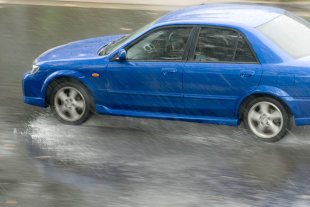
#1 What To Do If Your Car Is Hydroplaning, Or Skidding Out Of Control
 
Verena Mei, Rally America, says:
 
Hydroplaning happens on wet surfaces when water accumulates in front of a car's tires, creating a layer of water between the rubber of the tires and the road's surface that reduces traction and makes it difficult to control the car. 
 
Your first priority is to carefully slow the vehicle down so you can regain control of the car. 
 
As with any driving emergency, keep a firm grip on the steering wheel and stay calm. Ease your foot off the gas and carefully steer your car in the direction of the road. Do this until the car slows and you can feel your tires on the ground again. Avoid sudden acceleration, braking, or steering inputs, which may only cause the car to slip (hydroplane) more.

If the back wheels hydroplane, the car's rear may fishtail or veer sideways into a skid, possibly causing you to spin. Steer in the direction of the skid until the rear tires stop hydroplaning and come in contact with the ground again, and then gently steer in the opposite direction to straighten out your vehicle.

To reduce the chance of hydroplaning, try to drive in the tire tracks left by the cars in front of you. These techniques can also help maintain traction when driving on snowy roads.

What does Verena drive?

On the race course: #335 TrueCar 2011 Ford Fiesta
On the road: Subaru Impreza


#2 What To Do If Your Car Stalls While You’re Driving
 
Shea Holbrook, Pirelli World Challenge, says:
 
It can be frightening if your car stalls while you're driving, as you may lose power steering and braking. Keep in mind these systems DO still function, but you will have to work harder to use them. Stay calm and focused, turn on your flashers, and try to restart the vehicle while the vehicle is still moving.

If it won't restart, use your car's forward momentum to help you roll to the side of the road and park off the shoulder or out of the way of traffic. If you can't make it to the side of the road, stay in your car (you definitely don't want to be out of your car in moving traffic!) and call 911 to get an emergency crew to help block traffic and move you off the road.
 
What does Shea drive?
On the race course: #67 TrueCar 2012 Honda Civic Si
On the road: Audi A4


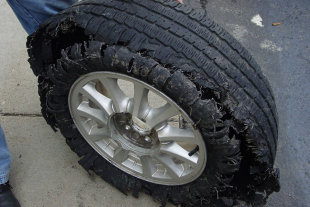
#3 What To Do If The Tread Separates From The Tire
 
Ashley Freiberg, Star Mazda, says:
 
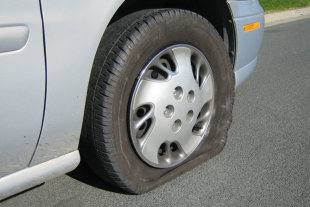
Tire tread separation can be even scarier than a blowout, because the outer belt can become separated from the rubber of the tire and sometimes detach completely from the rest of the tire. You may notice loud thumping and feel the vehicle pulling to the side as the tread pulls off the tire; at high speeds, this flopping tread can damage your wheel well or even drive your car completely out of control. Get a grip -- literally! 
 
Do your best to steer the car straight and gently lift your foot off the gas. Cautiously guide yourself to the side of the road, braking carefully, and then call a tow truck to change the tire. Phew, you made it!

What does Ashley drive?
On the race course: #91 TrueCar Star Mazda
On the road: Toyota Tundra


#4 How To Stop In An Emergency Situation
 
Shannon McIntosh, USF2000, says:
 
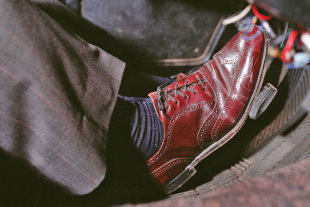
The other day, a dog ran out in front of my car. I just gripped the wheel and stood on my brakes. I could feel the ABS pulse as the car came to a stop, and thankfully the dog escaped injury. If you have a chance to try this in an empty parking lot you'll discover that your ABS also allows you to safely steer around obstacles while in full-brake mode. Just keep your foot stomped down; don’t lift off the brake until your car comes to a complete stop. 
 
Most of today's modern vehicles are equipped with anti-lock braking systems that help drivers maintain control of the car by preventing the wheels from locking up, and as of 2012, NHTSA requires all passenger vehicles to be equipped with electronic stability control systems (which are operated by the ABS). This could prevent from 5,000 to 9,000 fatalities a year!

If you don't have ABS, panic braking takes a little more skill. You have to be able to push the brake pedal down hard, but not so hard that you lock up and skid the tires. It takes a lot of finesse to do this well, so this is another skill you could practice in an empty parking lot, to help you learn how to do it in an emergency.

If your brakes don't work at all, try to steer yourself away from traffic and people. Turn on your emergency blinkers. Use your gear selector to downshift into lower gears and, if you have room on either side of you, steer the car sharply from side-to-side to slow you down. If that doesn't work, sideswipe your car against the guardrail until you are going slow enough to use the hand or foot brake to bring you to a standstill.

What does Shannon drive?

On the race course: #18 TrueCar Van Diemen DP08 Mazda
On the road: Acura RSX


#5 What To Do If Your Gas Pedal Sticks Or If Your Car Won't Stop Accelerating
 
Emilee Tominovich, Playboy Mazda MX-5 Cup SCAA Pro Series, says:
 
It’s going to sound counter-intuitive, but the first thing you should do if your car won't stop accelerating is to lift your foot off the brake -- you might have accidentally put your foot down on the accelerator by mistake! 
 
If the pedal sticks, reach down to see if something (like floor mats, or in my case, water bottles) might be wedged under there. Be sure to stay calm! The next step is to put the car into neutral (or press down the clutch). Don't worry about damaging the transmission; putting the car into neutral just takes the power from the engine away from the wheels, and lets you use the brakes to stop the car from rolling. In the worst-case scenario, you can even shut off the engine completely; just turn the key to OFF. 
 
Your steering and brakes will be harder to use, but they will still WORK! 
 
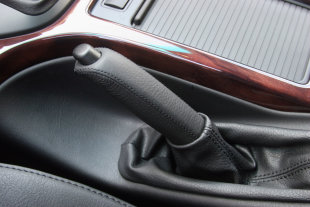
Coast to the side of the road, and use your emergency brake if you need extra help stopping. You can always practice doing this in parking lots, so you'll feel more confident if such an emergency ever arises.

What does Emilee drive?
On the race course: #19 TrueCar Mazda MX-5
On the road: Acura MDX


#6 What To Do If Your Tire Blows Out
 
Katherine Legge, IZOD IndyCar Series, says:
 
A tire blowout can pretty much happen to anyone anytime, but it's more likely to occur if your tires are low on tread, improperly inflated, or if you hit sharp debris on the roadway. It has happened to me on the track at speeds as fast as 200 mph, and trust me, the most important thing is not to panic! You might have heard a loud boom from under the car, but don't worry. Keep a firm hold on the steering wheel and avoid hard braking. Gently lift your foot off the gas, and coast until you have control; THEN you may brake carefully. 
 
Be sure to use your emergency flashers to warn the cars behind you, but stay focused on steering the car as straight as you can while you slow down the vehicle, and guide yourself to the side of the road. Your ability to steer may be harder if you blow a front tire, and depends on how much of the rubber is left on the wheel. 
 
Call a tow truck after you get to the side of the road; if you had to roll very far before you stopped, you will probably need to replace the metal wheel in addition to the tire.

What does Katherine drive?

On the race course: #6 TrueCar Lotus Dallara DW12
On the road: Lotus Evora from her engine provider, Lotus.

You can follow the TrueCar racing team at: www.truecar.com/racing

Writing Character: 5 unexpected female turn-ons

5 unexpected female turn-ons


By Bob Strauss

Perhaps you studied him in school, and perhaps you didn’t — but in either case, allow me to introduce you to (or refresh your memory about) the French existentialist philosopher Jean-Paul Sartre. In intellectual circles, Sartre is best known for suavely documenting the rootless disaffection of post-war bourgeois society, and in political circles, he’s famous (or infamous) for staunchly defending Communism against the cold-war jingoists of the 1950s. 

For the purposes of this article, though, the important thing about Jean-Paul Sartre is that he was spectacularly ugly — even his friends described him as looking like a squat, bug-eyed, bespectacled frog — as well as short (just a shade over five feet tall). And wouldn’t you know it? Women fell all over the guy; Sartre had more torrid love affairs than most university professors have had hot meals.

What’s going on with him that makes him so attractive, then? According to Eric Weisholtz, cofounder of GetOnTheCouch.com, it’s not unusual for women to date guys on the “low end of the hot scale,” saying: “It’s interesting, it gets people talking, it makes the woman feel extremely good-looking by comparison and sometimes having a sexual relationship with an ugly person can feel naughty, taboo or perverse. 

[Actor] Willem Dafoe is a good example. It’s not because he’s rich and famous; it’s because his variety of unattractiveness is, for some reason, quite attractive.” Sure, it’d be nice to think all those French mademoiselles were attracted to Sartre for his high IQ, but you have to admit that Weisholtz has a point.

The reason I’ve gone into this whole Jean-Paul Sartre thing in such depth is to show that attractiveness is, really, subjective — and it might cheer you up to know that what you consider to be a tragic, insurmountable physical or behavioral flaw can actually be catnip to the right woman. 

Here are five unexpected things women are turned on by in men:

1. Body odor.
“Double pits to chesty” (the worst slogan in advertising history) aside, not all women appreciate guys who mask their natural scent. Jolene Hanson, the curator of Venice, CA’s G2 Gallery, is one such example, saying, “What turns me on? Natural body odor — I love a guy who smells like a guy should smell.” Perhaps not coincidentally, Hanson says she also likes men who pick up other peoples’ discarded trash on the street: “This is something I do myself, and I love it when a guy shares my passion for the environment.” 

If you decide to stop covering up your natural musk, though, bathe often, especially before a date. (Your smell shouldn’t overwhelm strangers at the next table or distract your date from getting to know you better.)

2. Scars and blemishes.
You don’t need to procure a genuine, aristocratic Heidelberg dueling scar to win the hearts of ladies; rather, any “interesting” blemish will do the trick — an oddly shaped birthmark, a distinctive mole on your neck, or that gouge on your cheek from when you fell on your toy fire truck as a toddler. Says Lisa Steadman, author of If He’s Not the One, Who Is?, “Many women are attracted to a man who has scars — partly because scars give the illusion of a dark past, and partly because scars tell a story, and women love a good story about their guy.” 

That said, active, festering wounds still going through the healing process should be kept under wraps until you’re well on your way to a committed relationship.

3. Stereotypically “feminine” traits.
For every woman who demands tough, manly, roughly callused hands (and equally firm handshakes), there’s another who prefers the long, slender, lovingly delicate hands of an artiste who’s never so much as twisted a Phillips-head screwdriver — and so on down the list of “feminine” traits, like shy smiles, long eyelashes and piercing giggles. 

Oh, yes, and a fondness for cats. Helen, 52, from Australia, says, “What really gets me is a guy who loves cats. If he’ll sit for an hour on the sofa in an awkward position so as not to disturb the cat, it’s the cutest thing — a tough guy with a soft heart.” 

You don’t have to be the Brawny man to win over a lady, it seems.

4. Vulnerability.
Sometimes, being a man’s man can actually turn women off. An increasing number of women appreciate a guy who will cop to his limitations instead of blustering, bluffing and bullying his way through something he knows absolutely nothing about. Says Carrie, 39, from Ontario: “Personally, I find it attractive for a guy to not get all upset if I do something better than he does — for example, if I’m a better shot at pool, faster at rappelling up a cliff, more knowledgeable about trivia, etc. 

I’m not saying he should be an underachiever, just someone who can accept he isn’t ‘the best’ at everything.” So men, know when to say when and ask for help if you need it; it doesn’t make you look weak, it makes you look human.

5. Awkwardness.
A woman posting to the About.com dating site shares this story: “I met a man years ago at a radio station where I worked. He was a small, nebbishy guy, kinda nerdy and very awkward. He had these big, soulful eyes and a sad, twisted face. The moment I met him, my heart leapt!” Vanessa, 28, from Iowa, also testifies to the “Woody Allen” effect: “My best guy friend (OK, I’m madly in love with him, too) is a paleontologist, and it makes me melt just to listen to him talk about dinosaurs and rocks. I don’t always understand exactly what he’s even talking about, of course, but I love the passion he has for it and I always get him to explain it to me.” 

So, men, if your guy friends tease you mercilessly about something they’d consider to be a weakness, don’t assume women feel the same way. You might be surprised at how charming your meek, unassuming nature is to ladies!

Women, get the men’s perspective on this issue by reading Five unusual turn-ons for men.

Bob Strauss is a freelance writer and children’s book author who lives in New York City. He’s also written the Dinosaur guide on About.com, the online information network owned by the
New York Times.


Article courtesy of Happen magazine, www.happenmag.com.

Writing Character: Five unusual turn-ons for men

Five unusual turn-ons for men

Five unusual turn-ons for men
Marcel Proust wrote, “Let us leave the beautiful women to men with no imagination” — and if you’re loath to take dating advice from a French author who wrote a 10,000-page novel about a guy eating a cookie, well, you’ve clearly been brainwashed by decades of movies, TV shows and magazine ads. Me? I empathize more with all those less-than-perfect single women out there. I’m talking about those ladies who may not know that most ordinary guys are attracted to the quirks and so-called “flaws” they’re terrified will doom them to a lifetime of singlehood.

Now that I’ve opened that door, there’s no way to avoid the one supposed “imperfection” that keeps women awake at night above all others — their weight. Allow yourselves to be reassured by Dr. Judy Kuriansky, author of The Complete Idiot’s Guide to Dating, who says that “many men like plus-sized women with soft bellies. This often happens when they had a mother or nanny who had that kind of body and they felt comforted and enveloped by the mother figure — protected from the world or the insults of other children. Also, men like women with large hips for anthropological reasons — it used to mean that the woman was fertile.” 
And in my own experience, the vast majority of guys (at least, the ones who aren’t on TV shows or in movies) don’t care much about a few — or even 20 or 30 — extra pounds.

1. Glasses.
Says Jeff, posting on the Yelp.com message boards: “Every guy loves a girl in glasses, but women never seem to know that. It’s not like we’re keeping it a secret — why would we? It’d mean fewer girls in glasses! Some glasses-lover needs to infiltrate Cosmopolitan magazine and get the word out!” For some guys (mostly the lazy ones who grew up watching teen gross-out comedies), glasses connote a nerdy personality and a high IQ, which can have their own intrinsic appeal; others appreciate them as fashion accessories, while still others have a natural affinity for them because spectacle-wearing women remind them of their mothers or early childhood crushes.

2. Freckles.
Just as the deodorant-producing industrial complex has created legions of denatured, pheromone-free men (it turns out that plenty of women like guys with an earthy, musky scent), the powers-that-be in the cosmetics industry have convinced women that their natural freckles need to be buried under thick slabs of spackle and bronzer. Tonja Weimer, writer of the syndicated “Savvy Dating” column, says this is all based on a huge misunderstanding: “Freckles represent being unaffected, natural and relaxed. To some men, they also make a woman appear somewhat ‘innocent’ and less jaded.” 

If you don’t have freckles, try wearing less makeup, which many men also appreciate.

3. An independent streak.
In my own experience, the worst thing a woman can do — whether it’s on a first date or after 20 years of marriage — is subsume her naturally ebullient personality in an effort to be more “accommodating” to her partner and avoid making waves. Most guys like a brisk, good-natured argument, and if you nip this possibility in the bud by constantly replying “I agree” or “Yes, you’re right,” the relationship (not to mention the conversation) will go absolutely nowhere. 

On the other hand, though, playing devil’s advocate in every conversation just makes you seem combative. So if you find yourself disagreeing more than not with your date, maybe it’s time to look for someone that’s a better fit for you, personality-wise.

4. Plain Janes.
Standards of beauty in today’s media-saturated world have become so artificially elevated that many otherwise attractive women are convinced they’re “homely” because of a slightly bigger nose or a crooked smile. The good news is that most guys don’t care about this stuff; the bad news is that a small minority of men have self-esteem issues of their own and will take advantage of yours when given the opportunity. Eric Weisholtz, cofounder of GetOnTheCouch.com, says that “a man may see a woman who is kind of attractive, a bit awkward, unrefined and — whether she knows it or not — in dire need of someone to coach her toward virtue. It’s like finding a ‘make your own girlfriend’ kit.” 

Don’t feel like being part of a science experiment? Find a guy who likes you for who you are, not what he can make you change about yourself.

5. Assorted quirks.
Fran Drescher, star of The Nanny, had a piercing, snorting, abrasive laugh — and all it did was send the ratings of her show through the roof and make her a millionaire many times over. That laugh also unmasked a secret crush that most guys didn’t even know they had: the hot girl with an unexpected quirk. Says Lisa Steadman, author of If He’s Not the One, Who Is?: “You know you’ve met someone who’s a keeper when he or she compliments your quirks. Whether it’s the snort in your laugh or the way you twirl your hair when you’re thinking about something — or the fact that you have to double-check that you hit the alarm button on the car when you get home at night — the right person will think your quirks are adorable.” 

Remember this the next time you’re feeling self-conscious about slurping your straw three times as you finish your iced latte. You might just have the guy next to you entranced instead of annoyed!

Men, get the women’s perspective on this issue by reading 5 unexpected female turn-ons.

Bob Strauss is a freelance writer and children’s book author who lives in New York City. He’s also written the Dinosaur guide on About.com, the online information network owned by the
New York Times.


Article courtesy of Happen magazine, www.happenmag.com.

Keeping the 'Noraholics' Happy [Nora Roberts/ J D Robb]

Keeping the 'Noraholics' Happy [Nora Roberts / J D Robb]


Next Tuesday, the prolific romance novelist Nora Roberts will release her 200th novel--a landmark she celebrated by immediately starting the 201st, which is already finished. Eben Shapiro has details on Lunch Break. Photo: Getty Images

Romance writer Nora Roberts didn't bother to celebrate when she finished her 200th book, "The Witness."

"I don't really count," says Ms. Roberts, a 61-year-old grandmother with red hair and a gravelly smoker's voice.

She took a couple of days off to catch up on chores and gardening. Then she launched into her 201st, "Celebrity in Death," the next installment of a futuristic romantic suspense series that she writes under the pen name J.D. Robb. She's since finished her 202nd, a romance novel set near her home in Maryland, and her 203rd, "Delusion in Death," another J.D. Robb book. She's now writing her 204th, "Whiskey Beach," a romantic suspense novel set in coastal Massachusetts.

[ARENA] Bruce Wilder


'If I wasn't talking to you, I would be working,' Ms. Roberts says.

Ms. Roberts's legendary output has helped her become one of America's biggest commercial authors, with close to 450 million copies of her books in print. In 2011 alone, she sold nearly 20 million copies.

"If I wasn't talking to you, I would be working," she says. "What else would I do? Putter and do laundry? That's a scary thought."

Ms. Roberts typically publishes five new books a year—a romance trilogy, two J.D. Robb mysteries and what her publisher calls "the Big Nora," a hardcover stand-alone romance. "The Witness," which comes out next week, is this year's Big Nora. It centers on Elizabeth Fitch, a beautiful young computer genius who goes into hiding in a small town after witnessing a murder, and falls for the local police chief.

Ms. Roberts writes for six to eight hours every day, fueled by Diet Pepsi and Winston Filter 100s cigarettes. She doesn't use ghost writers, co-writers or a research assistant. "Then I'd have to talk to somebody, and I'd rather not," she says.

Leslie Gelbman, Ms. Robert's editor and publisher at Berkley Books, keeps a color-coded spreadsheet of Ms. Robert's releases tacked to her wall. Her 2012 publishing schedule lists 23 releases—a mix of hardcovers, mass-market paperbacks and trade paperbacks.

Ms. Roberts was raised in an Irish Catholic family in Maryland. She began writing one day in 1979 during a blizzard, when she was stuck home with her two young sons. Silhouette, a romance imprint, published her debut novel, "Irish Thoroughbred," in 1981. Over the next three years, she published more than 20 novels. 

Her books broke traditional romance conventions: They featured non-virginal, flawed heroines, ensemble casts and snappy dialogue tinged with sarcasm, and were occasionally written from the hero's point of view. Her unconventional stories helped transform the genre, which has exploded into a $1.4 billion industry.

She created her alter-ego, J.D. Robb, in 1995, so she could publish more books. At the time, Ms. Roberts's publisher, Putnam, worried she would cannibalize her sales by releasing so many books a year. Her agent, Amy Berkower, persuaded Putnam to release a new trilogy under a pseudonym. 

Many of her fans, it seems, have no problem keeping up. "People will still say, 'Can't she write faster?' " says Nina Friedman, a "Noraholic" who moderates discussions on Ms. Roberts's fan website. Ms. Friedman, 62, a retired travel agent and bookstore manager who lives in San Diego, has read all 199 of Ms. Roberts's books, some of them 10 times. She has copies of every one. "Even the elusive "Promise Me Tomorrow, " she says, referring to a 1984 romance that Ms. Roberts keeps out of print because she doesn't like it.

Ms. Friedman says she's drawn to the books for their memorable characters, humor, and invariably happy endings. She says she's never found the plots to be repetitive.

"I have never picked up a book and thought, 'Oh, I've read that before," she says. "Never."

Write to Alexandra Alter at alexandra.alter@wsj.com

A version of this article appeared April 13, 2012, on page D6 in some U.S. editions of The Wall Street Journal, with the headline: Keeping the 'Noraholics' Happy.