Sunday, February 24, 2013


Tuesday, February 19, 2013
Neale Sourna Review, "the softer side": Fifty Shades Darker by E.L. James
Neale Sourna Review

Fifty shades DARKER is a misnomer. This story is actually BRIGHTER, LIGHTER. So, if fifty #1 made you squirm too much, read this one instead, it's softer, the lovers are more equal and understand their differences much better. There's more trust based in knowledge and therefore faith, more getting to the center of what his past is about, and less worry about her virgin to sub growth or de-evolvement, as many I've heard were afraid for her about.
She's fine. She's stronger than he is and she's pulling HIM upward. Stop chickening out and try this one, and really read and understand the explanations. We mislabel things in our heads and hearts, Christian does too. What we say about ourselves isn't always the actual us. That's covered here.
And explaining the "lifestyle" and experimenting with "vanilla" with a dash of, well, soft "lifestyle" will be more palatable and a better starter for many.
Then, perhaps, you can backtrack to number one, once you really understand this isn't the abusive, evil stuff that gets you on the news or in jail.
Oh, and not "Mommy Porn" it should be "Daddy Porn." If dad wants to get more and keep his lady wife happier perhaps he should take a few lessons on creativity, trust, and obedience from CG as he tantalizes, pleases, and fully obeys Ana in their most intimate moments. She can say "no" anytime or and he obeys. And when she says "yes," he makes it interesting, creative, explorative, and emotionally fulfilling, not just missionary sex boring.
No wonder I've heard so many women say they loved CG but were not so kind to virginal, sexually ignorant Ana--too close to home?
There are few women who wouldn't want a man who enjoys extended foreplay diddling AND afterglow all night cuddling. Oh, wait, these are FICTIONAL people. But they have much to teach us about our own love giving and emotionally sexual "hard and soft limits."
Monday, February 18, 2013
NEW SHORT STORY, CONTEST, PLEASE VOTE: The Trans / Androgyne Practice by Neale Sourna
http://figment.com/books/545108-The-Trans-Androgyne-Practice
Locked in a coffin for an Initiation practice, Kar is terrified; but Dev is the only one to offer help. And Dev, who all Kar's friends dislike, is the one Kar truly wants. It's gonna be a long three day weekend
Locked in a coffin for an Initiation practice, Kar is terrified; but Dev is the only one to offer help. And Dev, who all Kar's friends dislike, is the one Kar truly wants. It's gonna be a long three day weekend
We lay in my stark coffin, side by side, in pitch black.
Why? ’Cause who wants to lie in their coffin alone the first time?
“You okay?” Devon
queried, cautiously, like I was a baby, who might explode into screeching hysterics
any second. Leg touching mine, Devon’s warm grasp
fumbled for my cold sweaty hand; I clutched, tightly.
“Ouch! Cut your claws, Kar. Or wear olives on your
fingertips.”
“That was fun.”
“Delectable.”
“No food talk, Dev.”
“You could lose some LBs, Kar. Ow! Claws. Make me bleed out and it’s gonna get way messy in three days
of this.”
“Alone. Together.”
Devon gulped, then silence. Devon’s
hand in mine was—http://figment.com/books/545108-The-Trans-Androgyne-PracticeSaturday, February 16, 2013
Love's Bitter End by Neale Sourna [short story published]
Love's Bitter End by Neale Sourna [short story published]
“Is this the end of us?”
“You’re joking? Now? I don’t fucking believe—.”
“Hey. Hey. Okay, baby. It was a bad joke. One in poor taste. Oops. Sorry.”
He can get on a roll, a tasteless roll, sometimes. Pun somewhat intended. I turned around in the hot bath we were sharing to glare at him.
“Stop glaring at me, baby. You really shouldn’t give your honey bunny husband the stink eye.”
He smiled, innocently. Yes. There was a pun joke in there, intentionally. Argh!
“Don’t make a big stink about this. Come clean. You’re curious and the fact you don’t know why I’m so pervertedly interested is a steaming hot pile of—.”

more...http://kinkemagazine.com/issue/february-kinke-magazine-bitter-love-issue-2013/article/loves-bitter-end
http://www.kinkemagazine.com/
“Is this the end of us?”
“You’re joking? Now? I don’t fucking believe—.”
“Hey. Hey. Okay, baby. It was a bad joke. One in poor taste. Oops. Sorry.”
He can get on a roll, a tasteless roll, sometimes. Pun somewhat intended. I turned around in the hot bath we were sharing to glare at him.
“Stop glaring at me, baby. You really shouldn’t give your honey bunny husband the stink eye.”
He smiled, innocently. Yes. There was a pun joke in there, intentionally. Argh!
“Don’t make a big stink about this. Come clean. You’re curious and the fact you don’t know why I’m so pervertedly interested is a steaming hot pile of—.”
more...http://kinkemagazine.com/issue/february-kinke-magazine-bitter-love-issue-2013/article/loves-bitter-end
http://www.kinkemagazine.com/
SHORT STORY, Romantic Erotica: Neale Sourna's Dez at the Silver Pole
 |
03_Silver
Pole
READ
excerpt
Dez is a willful, stubborn hottie, the bisexual top stripper and erotic dancer [exotic dancer] at Max’s club; independent to the bone, she won’t be controlled. But, enter Mr. Dark, a powerful, dangerous, wealthy player, a corporate gangsta with an eye only for sexy Ms. Dez.
He’s certain he can teach this free girl a few things.
In lust and love, what is “control,” what is “danger,” when two headstrong people are in conflict over their mutual desires, at the foot of a stripper’s silver pole. _9587 words Erotic Romance stripper, exotic dancer, bisexual, lesbian, love, heterosexual, forced sex, coerced sex, domination, control |
Silver Pole [excerpt]
...G'd left for a last minute upscale,
bachelor party, when Max, I - Am - An - Ass - And - Completely -
Spineless - Around - Mr. - High - and - Mighty - Dark, said Dark had
finally "requested" I dance for him. Yes, Max made finger quotes.
I'd asked Ginger once if she liked
dancing for Dark. She giggled. Remember, with G, giggling means me…or
money. Translation, she doesn't like men but she'd even fuck him, since
he pays well. He'd better because I can charge more than the others. I
get the patrons to come inside, and bring their friends, and I keep
them all there longer and cumming right here in my hot, little hand.
I really considered not dancing for
that imperiously bossy snot though.
But, maybe I'm stupid, because Dark's
sudden interest in a private dance, after ignoring me, except for my
general dances and to taunt me, had me a smidge…intrigued.
Well, actually, more than a smidge.
* * * *
He didn't want me on his lap, so I and
my delicate, gold Egyptian bracelets gyrated and twisted, and displayed
and fingered and shook my more obvious assets from a distance.
He seemed pleased, while Shadow [his
huge bodyguard] looked on. Minutes later, Shadow put down lots of Mr.
Franklins. I guess, his boss didn't want to get his hands dirty. I was
reaching for the loot.
"Again."
"They're your Bennies," I said.
This close to him, this long, it was
starting to get to me that he never looks at me like anyone else does.
Not like his Shadow, who was trying hard not to
look at me. I know when a man's looking at me, and Shadow'd lost the
battle. The hard proof being the growing precum stain, from his stiff
billy club in his pants, that he tried to modestly shift to a more
comfortable position.
Unless, of course, he had a big thing,
for his boss.
"Come here."
The sahib indicated I may now
approach, and buff his lap, which I did thoroughly. The song ended.
Shadow piled on the Poor Richards.
"Again." Greedy bastard.
He peeled off his long, stylish
jacket. A little warm, I guess. Y'know, others want lots of dances,
too, but they don't have the cash or credit, or they're afraid they'll
cum their slacks. Dark seemed to be holding his cream but his trousers
were becoming less slack the more I rode his very expensive imported,
custom tailored fabric.
Then, he touched me.
"No touching!"
I'd dismounted so fast, I don't think
he'd expected it. The look on his face said touching me was no
overinfatuated mistake. As they always say.
Tiny Natalie'd had some queer lick her
ass just yesterday.
Totally creepzoid.
We do a lot. But, it's a service,
a special service, and it has its limits. Let's
face it; we're vulnerable--naked, outweighed, unarmed, with help far
enough away that we could get seriously damaged or dead before the
bouncers get to us.
So, touching me...us is very much
breaking the law. And, my law.
Most people still like to think we're
wearing pasties or nude plastic or Sally Rand feathers, "if these kinds
of places must exist," they say. But, no, the law says nude's--fine,
opening my legs--fine, touching myself or another performer's anything
is--fine, but…customers touching us...me is forbidden. As I rub my body
against theirs.
I'm on…I am that thin,
fragile line between voyeurism and participation, stripping (Since
I'm naked, I strip your mind, not my clothes.--Good, huhn?)
and prostitution.
"Dez, it was just your waist I
touched."
"It doesn't matter, Dark. You
touch nothing."
"All right. I'll behave. Finish.
Please?"
I didn't like the look in his eyes, I
couldn't read it, and, the pit of my stomach churned. Never a good sign.
"If you want more, Dez.... A penalty
fee?"
Where was Shadow pulling
those bills from?
He never put his hand in a pocket, no
bill fold or wad seemed to be in his huge hand, and then Blam!
He put down ten of them this time, for his master; fanned so I could
count.
"You're not stupid, Dez, you know I
like you. I just momentarily forgot proper decorum."
"Bullshit." He smiled at my anger,
which pissed me good.
"Okay. One last dance. You get paid,
and I'll go. I'll never come back here to Max', unless you give me
permission."
I had to think about that one. The
money was better than great, and there'd be more, he always pays, even
if he only watches for thirty seconds. And, then his royal pain in my
ass would leave...he could dry hump himself.
I wished he'd stop looking like he
knew exactly what I was thinking, which, of course, I knew he did.
So, I Salome'd again, and he asked me
to straddle him, which is not unusual, especially from a high-paying
client. I mounted him and his eyes held mine for a long time, his
prodigious bulge between my legs, throbbing deliciously, making my bare
pussy dampen it's tongueless mouth. I tried to move off the expensive
fabric…before I--.
"Wet it, Dez, I don't care."
How'd he know I was getting so wet? I
thought to disobey; but, I liked the constant throb his cock was
singing to my cunt. I wanted more. He could tell.
"Put your hands on my shoulders, and
lean into me."
I hesitated, but finally did it, and
it felt wonderful; but, I was loosing control, and the position put his
hot lips too close to my breasts. If I'd been flatterchested we would
have stayed within the law, but my tit brushed his hot mouth and he
grabbed me and sucked.
Pulling away made him suck harder,
biting just a bit, and his pants got wetter, at least from my side.
He smiled, mouth full of me, knowing
he had me, knowing he was getting my body, that's controlled by me,
that serves me, to betray me.
I pulled away to dismount, and his
teeth let go but he held me on his hard bulge, pushing it up into me. I
wanted it; but, I wasn't having it, as I shoved to get away. He grabbed
a handful of hair on the back of my head.
Piss me! Tryin' to control
me.
I backhanded him, and, suddenly, he
had a switchblade at my ribs.
"She's thinking whether or not I want
her enough not to slice her beautiful body, or if I'm afraid someone
might hear her call out, and come for her." He pulled my head to his.
"Delectable Dez, who's going to run through that
door and into him? And, if they got past him, who'd
run up on me? Even for you."
"What d'you want?"
"Control of you."
Thought so.
I….
End of Excerpt
Friday, February 15, 2013
Where did Fifty Shades of Grey come from, from The Story of O...
Where did Fifty Shades of Grey come from, from The Story of O
Story of O (French: Histoire d'O, IPA: [istwaʁ do]) is an erotic novel published in 1954 about love, dominance and submission by French author Anne Desclos under the pen name Pauline Réage.
Desclos did not reveal herself as the author for forty years after the initial publication. Desclos claims she wrote the novel as a series of love letters to her lover Jean Paulhan,[1] who had admired the work of the Marquis de Sade.
Published in French by Jean-Jacques Pauvert, Story of O is a tale of female submission about a beautiful Parisian fashion photographer, O, who is blindfolded, chained, whipped, branded, pierced, made to wear a mask, and taught to be constantly available for oral, vaginal, and anal intercourse.
Despite her harsh treatment, O grants permission beforehand for everything that occurs, and her permission is consistently sought.
At the beginning of the story, O's lover, René, brings her to the château of Roissy, where she is trained to serve the men of an elite group. After this first period of training is finished, as a demonstration of their bond and his generosity, René hands O to Sir Stephen, a more dominant master.
René wants O to learn to serve someone whom she does not love, and someone who does not love her. Over the course of this training, O falls in love with Sir Stephen and believes him to be in love with her as well.
While her vain friend and lover, Jacqueline, is repulsed by O's chains and scars, O herself is proud of her condition as a willing slave. During the summer, Sir Stephen decides to move O to Samois, an old mansion solely inhabited by women for advanced training and body modifications related to submission.
There she agrees to receive a branding and a labia piercing with rings marked with Sir Stephen's initials and insignia. At the climax, O appears as a slave, nude but for an owl-like mask, before a large party of guests who treat her solely as an object.
In February 1955, Story of O won the French literature prize Prix des Deux Magots, although this did not prevent the French authorities from bringing obscenity charges against the publisher. The charges were rejected by the courts, but a publicity ban was imposed for a number of years.
The first English edition was published by Olympia Press in 1965. Eliot Fremont-Smith (of The New York Times) called its publishing "a significant event".
A sequel, Retour à Roissy (Return to Roissy, but often translated as Return to the Chateau, Continuing the Story of O), was published in 1969 in French, again with Jean-Jacques Pauvert, éditeur. It was published again in English by Grove Press, Inc., in 1971. It is not known whether this work is by the same author as the original.
Emmanuelle Arsan claimed the Story of O inspired her to write her own erotic novel Emmanuelle.[2]
A critical view of the novel is that it is about the ultimate objectification of a woman. The heroine of the novel has the shortest possible name, consisting solely of the letter O. Although this is in fact a shortening of the name Odile, it could also stand for "object" or "orifice", an O being a symbolic representation of any "hole". The novel was strongly criticised by many feminists, who felt it glorified the abuse of women.[3][4][5]
The book has been the source of various terms that are used in the BDSM subculture such as Samois, the name of the estate belonging to the character Anne-Marie, who brands O.
When the film of The Story Of O was released, L'Express magazine ran a feature on the novel and film. This resulted in L'Express being picketed by feminists from the group Mouvement de libération des femmes, who found the novel and film objectionable.[2] Journalist François Chalais also criticized Story of O, claiming the novel glorified violence; he described the novel as "bringing the Gestapo into the boudoir".[2]
The author used a pen name, then later revealed herself under another pen name, before finally, prior to her death, revealing her true identity. Her lover Jean Paulhan wrote the preface as if the author were unknown to him.
According to an article by Geraldine Bedell,[1] published in The Observer on Sunday 24 July 2004, "Pauline Réage, the author, was a pseudonym, and many people thought that the book could only have been written by a man. The writer's true identity was not revealed until 10 years ago, when, in an interview with John de St Jorre, a British journalist and some-time foreign correspondent of The Observer, an impeccably dressed 86-year-old intellectual called Dominique Aury acknowledged that the fantasies of castles, masks and debauchery were hers."
According to several other sources, however, Dominique Aury was itself a pseudonym of Anne Cécile Desclos, born 23 September 1907 in Rochefort-sur-Mer, France, and deceased 26 April 1998 (at age 90) in Paris, France.
The Grove Press edition (US, 1965) was translated by publisher Richard Seaver (who had lived in France for many years) under the pseudonym Sabine d'Estree.[6]
Jean Paulhan, who was the author's lover and the person to whom she wrote Story of O in the form of love letters, wrote the preface, "Happiness in Slavery". Paulhan admired the Marquis de Sade's writing and told Desclos that a woman could not write in a similar fashion. Desclos interpreted this as a challenge and wrote the book. Paulhan was so impressed that he sent it to a publisher.
Interestingly, in the preface, Paulhan goes out of his way to appear as if he does not know who wrote the book. In one part he says, "But from the beginning to end, the story of O is managed rather like some brilliant feat. It reminds you more of a speech than of a mere effusion; of a letter rather than a secret diary. But to whom is the letter addressed? Whom is the speech trying to convince? Whom can we ask? I don't even know who you are. That you are a woman I have little doubt."[7]
Paulhan also explains his own belief that the themes in the book depict the true nature of women. At times, the preface (when read with the knowledge of the relationship between Paulhan and the author), seems to be a continuation of the conversation between them.
Discussing the ending, Paulhan states, "I too was surprised by the end. And nothing you can say will convince me that it is the real end. That in reality (so to speak) your heroine convinces Sir Stephen to consent to her death."[citation needed]
One critic has seen Paulhan's essay as consistent with other themes in his work, including Paulhan's interest in erotica, his "mystification" of love and sexual relationships, and a view of women that is arguably sexist.[8]
French director Henri-Georges Clouzot wanted to adapt the novel to film for many years. It was eventually adapted by director Just Jaeckin in 1975 as Histoire d'O (Story of O), starring Corinne Cléry and Udo Kier. The film met with far less acclaim than the book. It was banned in the United Kingdom by the British Board of Film Censors until February 2000.
In 1975, American director Gerard Damiano, well known for Deep Throat (1972) and The Devil in Miss Jones (1973) created the movie The Story of Joanna, highly influenced by the Story of O, by combining the motifs from one of the book's chapters and from Jean-Paul Sartre's No Exit.
In 1979, Danish director Lars von Trier made the short movie entitled Menthe—la bienheureuse, as an homage to Story of O. His 2005 film Manderlay was also inspired by the book, particularly Paulhan's introduction.[9]
Five years later, in 1984, actress Sandra Wey starred as "O" in The Story of O: Part 2.
In 2002 another version of O was released, called The Story of O: Untold Pleasures, with Danielle Ciardi playing the title character.
A Brazilian miniseries in 10 episodes with Claudia Cepeda was made in 1992 by director Eric Rochat, who was the producer of the original 1975 movie.
In 1975, it was adapted for comics by the Italian artist Guido Crepax. Both the original and Crepax's adaptation were parodied for comics in 2007 by Charles Alverson and John Linton Roberson.[10]
Writer of O, a 2004 documentary film by Pola Rapaport, mixed interviews with re-enactments of certain scenes from the book. In the documentary, the real author of Histoire d'O, Dominique Aury (also a pen name), talks about the book A Girl in Love. This book was written about how Story of O was written.
A documentary was also made for BBC Radio 4 entitled The Story of O: The Vice Francaise, presented by Rowan Pelling, former editor of the Erotic Review, which looked at the history of the book and Pauline Réage.
The comic book character Orlando is a blend of several fictional characters with the name Orlando as well as being known during the mid-sixties as O while engaged in sexual games with the descendants of the Silling Castle survivors, according to Alan Moore and Kevin O'Neill's The League of Extraordinary Gentlemen series.
On The Dresden Dolls' album Yes, Virginia..., the piece "Mrs. O" includes reference to the Story of O.
The band Oneida has a song "Story of O", on their album Rated O.
In Jacqueline Carey's novel Kushiel's Dart, during a grand ball, the main character — a masochist and submissive — dresses as a naked bird, as in the last scene of O.
Tori Amos's song "Glory of the 80s", on her album To Venus and Back, mentions having "The Story Of O in my bucket seat of my wanna-be Mustang".
In the TV series Frasier (season 5 episode 3 "Halloween"), Roz Doyle appears as O at a Halloween party.
Story of O
From Wikipedia, the free encyclopedia
This article is about the erotic novel. For the film, see Story of O (film).
| Story of O | |
|---|---|
 Cover of a French edition of Histoire d'O featuring Corinne Cléry |
|
| Author(s) | Pauline Réage |
| Country | France |
| Language | French |
| Genre(s) | Erotic novel |
| Publisher | Jean-Jacques Pauvert |
| Publication date | 1954 |
| Media type | |
Story of O (French: Histoire d'O, IPA: [istwaʁ do]) is an erotic novel published in 1954 about love, dominance and submission by French author Anne Desclos under the pen name Pauline Réage.
Desclos did not reveal herself as the author for forty years after the initial publication. Desclos claims she wrote the novel as a series of love letters to her lover Jean Paulhan,[1] who had admired the work of the Marquis de Sade.
Contents |
Plot
Published in French by Jean-Jacques Pauvert, Story of O is a tale of female submission about a beautiful Parisian fashion photographer, O, who is blindfolded, chained, whipped, branded, pierced, made to wear a mask, and taught to be constantly available for oral, vaginal, and anal intercourse.
Despite her harsh treatment, O grants permission beforehand for everything that occurs, and her permission is consistently sought.
At the beginning of the story, O's lover, René, brings her to the château of Roissy, where she is trained to serve the men of an elite group. After this first period of training is finished, as a demonstration of their bond and his generosity, René hands O to Sir Stephen, a more dominant master.
René wants O to learn to serve someone whom she does not love, and someone who does not love her. Over the course of this training, O falls in love with Sir Stephen and believes him to be in love with her as well.
While her vain friend and lover, Jacqueline, is repulsed by O's chains and scars, O herself is proud of her condition as a willing slave. During the summer, Sir Stephen decides to move O to Samois, an old mansion solely inhabited by women for advanced training and body modifications related to submission.
There she agrees to receive a branding and a labia piercing with rings marked with Sir Stephen's initials and insignia. At the climax, O appears as a slave, nude but for an owl-like mask, before a large party of guests who treat her solely as an object.


Publishing history
In February 1955, Story of O won the French literature prize Prix des Deux Magots, although this did not prevent the French authorities from bringing obscenity charges against the publisher. The charges were rejected by the courts, but a publicity ban was imposed for a number of years.
The first English edition was published by Olympia Press in 1965. Eliot Fremont-Smith (of The New York Times) called its publishing "a significant event".
A sequel, Retour à Roissy (Return to Roissy, but often translated as Return to the Chateau, Continuing the Story of O), was published in 1969 in French, again with Jean-Jacques Pauvert, éditeur. It was published again in English by Grove Press, Inc., in 1971. It is not known whether this work is by the same author as the original.
Emmanuelle Arsan claimed the Story of O inspired her to write her own erotic novel Emmanuelle.[2]
A critical view of the novel is that it is about the ultimate objectification of a woman. The heroine of the novel has the shortest possible name, consisting solely of the letter O. Although this is in fact a shortening of the name Odile, it could also stand for "object" or "orifice", an O being a symbolic representation of any "hole". The novel was strongly criticised by many feminists, who felt it glorified the abuse of women.[3][4][5]
The book has been the source of various terms that are used in the BDSM subculture such as Samois, the name of the estate belonging to the character Anne-Marie, who brands O.
When the film of The Story Of O was released, L'Express magazine ran a feature on the novel and film. This resulted in L'Express being picketed by feminists from the group Mouvement de libération des femmes, who found the novel and film objectionable.[2] Journalist François Chalais also criticized Story of O, claiming the novel glorified violence; he described the novel as "bringing the Gestapo into the boudoir".[2]
Hidden identities
The author used a pen name, then later revealed herself under another pen name, before finally, prior to her death, revealing her true identity. Her lover Jean Paulhan wrote the preface as if the author were unknown to him.
According to an article by Geraldine Bedell,[1] published in The Observer on Sunday 24 July 2004, "Pauline Réage, the author, was a pseudonym, and many people thought that the book could only have been written by a man. The writer's true identity was not revealed until 10 years ago, when, in an interview with John de St Jorre, a British journalist and some-time foreign correspondent of The Observer, an impeccably dressed 86-year-old intellectual called Dominique Aury acknowledged that the fantasies of castles, masks and debauchery were hers."
According to several other sources, however, Dominique Aury was itself a pseudonym of Anne Cécile Desclos, born 23 September 1907 in Rochefort-sur-Mer, France, and deceased 26 April 1998 (at age 90) in Paris, France.
The Grove Press edition (US, 1965) was translated by publisher Richard Seaver (who had lived in France for many years) under the pseudonym Sabine d'Estree.[6]
Jean Paulhan
Jean Paulhan, who was the author's lover and the person to whom she wrote Story of O in the form of love letters, wrote the preface, "Happiness in Slavery". Paulhan admired the Marquis de Sade's writing and told Desclos that a woman could not write in a similar fashion. Desclos interpreted this as a challenge and wrote the book. Paulhan was so impressed that he sent it to a publisher.
Interestingly, in the preface, Paulhan goes out of his way to appear as if he does not know who wrote the book. In one part he says, "But from the beginning to end, the story of O is managed rather like some brilliant feat. It reminds you more of a speech than of a mere effusion; of a letter rather than a secret diary. But to whom is the letter addressed? Whom is the speech trying to convince? Whom can we ask? I don't even know who you are. That you are a woman I have little doubt."[7]
Paulhan also explains his own belief that the themes in the book depict the true nature of women. At times, the preface (when read with the knowledge of the relationship between Paulhan and the author), seems to be a continuation of the conversation between them.
Discussing the ending, Paulhan states, "I too was surprised by the end. And nothing you can say will convince me that it is the real end. That in reality (so to speak) your heroine convinces Sir Stephen to consent to her death."[citation needed]
One critic has seen Paulhan's essay as consistent with other themes in his work, including Paulhan's interest in erotica, his "mystification" of love and sexual relationships, and a view of women that is arguably sexist.[8]
Adaptations
Mainstream
French director Henri-Georges Clouzot wanted to adapt the novel to film for many years. It was eventually adapted by director Just Jaeckin in 1975 as Histoire d'O (Story of O), starring Corinne Cléry and Udo Kier. The film met with far less acclaim than the book. It was banned in the United Kingdom by the British Board of Film Censors until February 2000.
In 1975, American director Gerard Damiano, well known for Deep Throat (1972) and The Devil in Miss Jones (1973) created the movie The Story of Joanna, highly influenced by the Story of O, by combining the motifs from one of the book's chapters and from Jean-Paul Sartre's No Exit.
In 1979, Danish director Lars von Trier made the short movie entitled Menthe—la bienheureuse, as an homage to Story of O. His 2005 film Manderlay was also inspired by the book, particularly Paulhan's introduction.[9]
Five years later, in 1984, actress Sandra Wey starred as "O" in The Story of O: Part 2.
In 2002 another version of O was released, called The Story of O: Untold Pleasures, with Danielle Ciardi playing the title character.
A Brazilian miniseries in 10 episodes with Claudia Cepeda was made in 1992 by director Eric Rochat, who was the producer of the original 1975 movie.
In 1975, it was adapted for comics by the Italian artist Guido Crepax. Both the original and Crepax's adaptation were parodied for comics in 2007 by Charles Alverson and John Linton Roberson.[10]
Documentaries
Writer of O, a 2004 documentary film by Pola Rapaport, mixed interviews with re-enactments of certain scenes from the book. In the documentary, the real author of Histoire d'O, Dominique Aury (also a pen name), talks about the book A Girl in Love. This book was written about how Story of O was written.
A documentary was also made for BBC Radio 4 entitled The Story of O: The Vice Francaise, presented by Rowan Pelling, former editor of the Erotic Review, which looked at the history of the book and Pauline Réage.
In popular culture
The comic book character Orlando is a blend of several fictional characters with the name Orlando as well as being known during the mid-sixties as O while engaged in sexual games with the descendants of the Silling Castle survivors, according to Alan Moore and Kevin O'Neill's The League of Extraordinary Gentlemen series.
On The Dresden Dolls' album Yes, Virginia..., the piece "Mrs. O" includes reference to the Story of O.
The band Oneida has a song "Story of O", on their album Rated O.
In Jacqueline Carey's novel Kushiel's Dart, during a grand ball, the main character — a masochist and submissive — dresses as a naked bird, as in the last scene of O.
Tori Amos's song "Glory of the 80s", on her album To Venus and Back, mentions having "The Story Of O in my bucket seat of my wanna-be Mustang".
In the TV series Frasier (season 5 episode 3 "Halloween"), Roz Doyle appears as O at a Halloween party.
See also
References
- ^ a b Bedell, Geraldine (24 July 2004). "I wrote the story of O". The Guardian. Archived from the original on 24 March 2008.
- ^ a b c Destais, Alexandra (2006). "Réage, Pauline". In Brulotte, Gaétan; Philips, John. The Encyclopedia of Erotic Literature. London: Routledge. pp. 1080–1086. ISBN 978-1-57958-441-2.
- ^ Dworkin, Andrea (1974). Woman Hating: A Radical Look at Sexuality. New York: Dutton. ISBN 0-452-26827-3.
- ^ Griffin, Susan (1982). "Sadomasochism and the Erosion of Self: A Critical Reading of Story of O". In Linden, R. R.. Against Sadomasochism: A Radical Feminist Analysis. East Palo Alto.
- ^ Smith, Joan (1998). Different for Girls: How Culture Creates Women. London.
- ^ "The True Story of 'The Story of O' by Pauline Reage". h2g2. 3 Novovember 2006 [13 November 2001]. Retrieved 2012-11-15.[unreliable source?]
- ^ Story of O. Ballantine Books. p. xxiv.
- ^ Syrotinski, Michael (1998). Defying Gravity: Jean Paulhan's Interventions in Twentieth-Century French Intellectual History. SUNY Press. pp. 74–75.
- ^ Bell, Emma (10 October 2005). "Lars von Trier: Anti-American? Me?". The Independent. Retrieved 2011-06-05.[dead link]
- ^ Alverson, Charles; Roberson, John (2007). "Story of OH!". Retrieved 2012-11-15.
External links
- The complete 'Story of O' website: all about Histoire d'O and Dominique Aury
- Histoire d'O at the Internet Movie Database
- Story of O, the Series at the Internet Movie Database
- The Story of O: Untold Pleasures at the Internet Movie Database
- Writer of O at the Internet Movie Database
Thursday, February 07, 2013
Character stuff: The 21-Minute Secret to a Happier Marriage By Elise Solé, Shine

In
the time it takes to shower, get a manicure, or run to the post office,
you could have a happier marriage. According to the results of an
upcoming study in the journal Psychological Science, just three seven-minute writing exercises over a one-year period could drastically improve your bond.
More on Yahoo! Shine: Is Distance the Key to a Happy Marriage?
The two-year study included 120 married couples, ranging from 20-somethings to 70-somethings who had on average been married for 11 years. During the first year, the couples were asked to sit down every four months and write about their biggest recent conflict such as tiffs about cleaning or sex-related gripes.
For the second year, the researchers switched things up: They had one group of couples continue recording their conflicts and a second group write them from the perspective of a third party who wanted the best for them, such as a mutual friend. That way, the couples couldn't write things like, "It made me so angry when he was late" but rather "Chris was two hours late coming home."
The results were surprising: Although the second group's arguments were just as frequent and severe as the first group's, the couples who wrote from a neutral perspective felt less angry toward their partners, experienced more sexual attraction for each other, and their happiness levels stabilized rather than declined.
More on Yahoo! 10 Money Mistakes That Can Ruin a Marriage
"Previous research shows that relationship satisfaction decreases over the course of a marriage but these writing exercises act as a buffer for unhappiness," says Eli Finkel, Ph.D., lead author of the study and professor of psychology at Northwestern University. "The trick is to get outside your own head. By processing conflict from a neutral perspective, you better understand where your partner is coming from and are able to let go of grudges."
Easy, right? Try these other tricks for a happier relationship in 21 minutes or less.
Exercise together: Going for a quick run or walk around the block with your partner will do more than keep you shape; it'll make you feel happier and sexier. Exercise releases feel-good neurotransmitters called endorphins and breaking a sweat increases blood flow straight to your nether regions.
Conjure up a romantic memory: Research published in the journal Personality and Individual Differences found that extraverts owe their happy outlook to their habit of getting nostalgic. So daydream about the first time you met or your wedding day. Bonus points for swapping memories.
Exchange back rubs: No surprise that massage feels luxurious but it can also enhance romantic feelings. That's because physical contact stimulates the production of the happy hormone oxytocin. Ahhh….
More on Yahoo! Shine:
5 Secrets to a Happy Marriage: Revealed by Divorce
How to Have a Happy Marriage
The 10 Habits That Keep Marriages Strong
Wednesday, February 06, 2013
Les Misérables: The strength and longevity and spiritual usefulness of fiction....
The strength and longevity and spiritual usefulness of fiction....
... set forth the purpose of Les Misérables, "one of the half-dozen greatest novels of the world," in the Preface:[2]
"So long as there shall exist, by reason of law and custom, a social condemnation, which, in the face of civilization, artificially creates hells on earth, and complicates a destiny that is divine with human fatality; so long as the three problems of the age—the degradation of man by poverty, the ruin of women by starvation, and the dwarfing of childhood by physical and spiritual night—are not solved; so long as, in certain regions, social asphyxia shall be possible; in other words, and from a yet more extended point of view, so long as ignorance and misery remain on earth, books like this cannot be useless."
Toward the end of the novel, Victor Hugo explains the work's overarching structure:[3]
"The book which the reader has before him at this moment is, from one end to the other, in its entirety and details ... a progress from evil to good, from injustice to justice, from falsehood to truth, from night to day, from appetite to conscience, from corruption to life; from bestiality to duty, from hell to heaven, from nothingness to God. The starting point: matter, destination: the soul. The hydra at the beginning, the angel at the end."
The novel contains many subplots, but the main thread is the story of ex-convict Jean Valjean, who becomes a force for good in the world but cannot escape his dark past. The novel is divided into five volumes, each volume divided into several books, and subdivided into chapters, for a total of 48 books and 365 chapters. Each chapter is relatively short, usually no longer than a few pages. The novel as a whole is quite lengthy by modern standards, having approximately 1,500 pages in unabridged English-language editions,[4] and 1900 pages in French.[5][6][7] It is considered one of the longest novels ever written.[8]
Hugo explained his ambitions for the novel to his Italian publisher:[9]
"I don't know whether it will be read by everyone, but it is meant for everyone. It addresses England as well as Spain, Italy as well as France, Germany as well as Ireland, the republics that harbour slaves as well as empires that have serfs. Social problems go beyond frontiers. Humankind's wounds, those huge sores that litter the world, do not stop at the blue and red lines drawn on maps. Wherever men go in ignorance or despair, wherever women sell themselves for bread, wherever children lack a book to learn from or a warm hearth, Les Miserables knocks at the door and says: 'open up, I am here for you'."
http://en.wikipedia.org/wiki/Les_Mis%C3%A9rables#Novel_form
... set forth the purpose of Les Misérables, "one of the half-dozen greatest novels of the world," in the Preface:[2]
"So long as there shall exist, by reason of law and custom, a social condemnation, which, in the face of civilization, artificially creates hells on earth, and complicates a destiny that is divine with human fatality; so long as the three problems of the age—the degradation of man by poverty, the ruin of women by starvation, and the dwarfing of childhood by physical and spiritual night—are not solved; so long as, in certain regions, social asphyxia shall be possible; in other words, and from a yet more extended point of view, so long as ignorance and misery remain on earth, books like this cannot be useless."
Toward the end of the novel, Victor Hugo explains the work's overarching structure:[3]
"The book which the reader has before him at this moment is, from one end to the other, in its entirety and details ... a progress from evil to good, from injustice to justice, from falsehood to truth, from night to day, from appetite to conscience, from corruption to life; from bestiality to duty, from hell to heaven, from nothingness to God. The starting point: matter, destination: the soul. The hydra at the beginning, the angel at the end."
The novel contains many subplots, but the main thread is the story of ex-convict Jean Valjean, who becomes a force for good in the world but cannot escape his dark past. The novel is divided into five volumes, each volume divided into several books, and subdivided into chapters, for a total of 48 books and 365 chapters. Each chapter is relatively short, usually no longer than a few pages. The novel as a whole is quite lengthy by modern standards, having approximately 1,500 pages in unabridged English-language editions,[4] and 1900 pages in French.[5][6][7] It is considered one of the longest novels ever written.[8]
Hugo explained his ambitions for the novel to his Italian publisher:[9]
"I don't know whether it will be read by everyone, but it is meant for everyone. It addresses England as well as Spain, Italy as well as France, Germany as well as Ireland, the republics that harbour slaves as well as empires that have serfs. Social problems go beyond frontiers. Humankind's wounds, those huge sores that litter the world, do not stop at the blue and red lines drawn on maps. Wherever men go in ignorance or despair, wherever women sell themselves for bread, wherever children lack a book to learn from or a warm hearth, Les Miserables knocks at the door and says: 'open up, I am here for you'."
http://en.wikipedia.org/wiki/Les_Mis%C3%A9rables#Novel_form
Wednesday, January 30, 2013
NEW EXTENDED SHORT STORY: Dia's Team Bang (3)_ON SALE Everywhere and Kindle
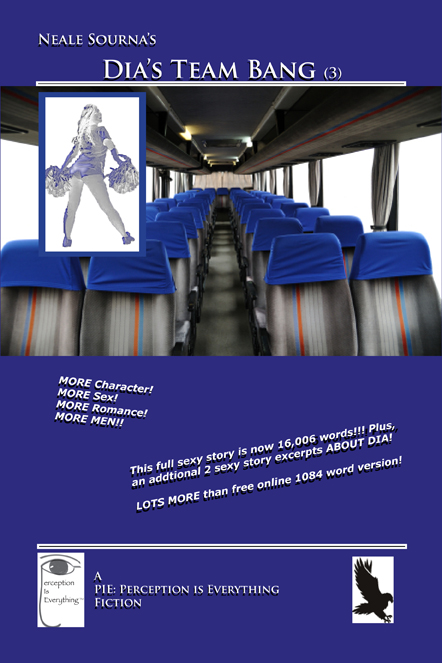
Dia’s the only cheerleader on the team bus filled with excited,
champion ball players, managers, a middle-aged co-coach, and Mr. Dean, the one
teacher / coach Dia’d open her lovely thighs wide for, anytime and anywhere,
and secretly already has.
Dia would do ANYTHING for her man’s pleasure. So, Mr. D will
test his girl’s trust and love for him, because the man has a banging hot
surprise for her AND his teenaged athletes, on the long ride home after their
championship win.
There will be slippery hot fun for all, as sweet Dia opens wide
for her first willing gangbang. “Gentlemen, get in line.”
NEW, extended story!
16,006
words!! That's a long sexy trip.
Erotica, Teen, Lolita, Heterosexual, Lesbian, Bisexual / Gay, Fellatio, Cunnilingus, Assfuck, Gangbang / Gang Bang, School, Sports, Team, Rape Fantasy, Fantasy Rape, Sexy Cheerleader
READ SAMPLE_Dia's Team Gang Bang (3) [Free online version, only 1084+ words]
TABLE OF CONTENTS:Falcons’ Team Bus—Night, Post Game
Team Bus—Her First Man - Coach Dean
_Dia Strips for Coach
_Dia Fellates Coach
_Dia’s Throatfuck Fun
_Dia Swallows Coach’s Cum
_Dia’s Cunnilingus Fun
_Dia Fucks Coach
Team Bus—Mr. Dean’s Fuck Laws
Team Bus—Who Fucks Her Next?
Team Bus—Side Games
Team Bus—Good Friend Stevie’s Turn
Team Bus—More Men
Team Bus—Gay Mr. Jones Assfucks Dia
Team Bus—Lesbian Ms. Smith Fingerfucks Dia
Team Bus—Co-Captain Yune, the Lover
Team Bus—Mr. Cross, the Roughneck
Team Bus—Dia Gets Rough Used
Team Bus—Co-Coach Carlson and More Boys
Empty Team Bus—School Parking & a Driver
Empty Team Bus—Mr. Dean Takes a Second Fuck
_____________
[excerpt, Full Short Story ON SALE] Dia’s Coach (1)
Synopsis_Dia’s Coach (1)
Mr. Dean’s House—Late Friday Night
_____________
[excerpt, Work in Progress] Dia’s Weekend with Coach (2)
Synopsis_Dia’s Weekend with Coach (2)
Mr. Dean’s Bed—Saturday Morning
Mr. Dean’s Bed—Late Saturday Morning Breakfast
Monday, January 28, 2013
 Two hundred years. But there seemed little chance, two hundred years
ago, that many people would remember either the novel or its author by
now. The draft that she produced at twenty-one was rejected by a London
publisher sight unseen. Other disappointments followed, and after a
series of personal upheavals, she gave up writing altogether.
Two hundred years. But there seemed little chance, two hundred years
ago, that many people would remember either the novel or its author by
now. The draft that she produced at twenty-one was rejected by a London
publisher sight unseen. Other disappointments followed, and after a
series of personal upheavals, she gave up writing altogether. Saturday, January 26, 2013
Wednesday, January 23, 2013
AP sources: Panetta opens combat roles to women By LOLITA C. BALDOR | Associated Press
AP sources: Panetta opens combat roles to women
By | Associated Press- View PhotoAssociated Press/Jacquelyn Martin, File - FILE - This Jan. 19, 2013 file photo shows Defense Secretary Leon Panetta speaking during a news conference in London. Panetta has removed US military ban on women

WASHINGTON (AP) — Senior defense officials say Pentagon
chief Leon Panetta is removing the military's ban on women serving in
combat, opening hundreds of thousands of front-line positions and
potentially elite commando jobs after more than a decade at war.
The groundbreaking move recommended by the Joint Chiefs of Staff overturns a 1994 rule prohibiting women from being assigned to smaller ground combat units. Panetta's decision gives the military services until January 2016 to seek special exceptions if they believe any positions must remain closed to women.
A senior military official says the services will develop plans for allowing women to seek the combat positions. Some jobs may open as soon as this year. Assessments for others, such as special operations forces, including Navy SEALS and the Army's Delta Force, may take longer.
The official said the military chiefs must report back to Panetta with their initial implementation plans by May 15. The announcement on Panetta's decision is not expected until Thursday, so the official spoke on condition of anonymity.
Panetta's move expands the Pentagon's action nearly a year ago to open about 14,500 combat positions to women, nearly all of them in the Army. This decision could open more than 230,000 jobs, many in Army and Marine infantry units, to women.
In recent years the necessities of war propelled women into jobs as medics, military police and intelligence officers that were sometimes attached — but not formally assigned — to units on the front lines.
Women comprise 14 percent of the 1.4 million active military personnel.
Subscribe to:
Posts (Atom)