
Showing posts with label game writing. Show all posts

Monday, January 03, 2022

Reprint_Inspiring adventures on the high seas through Sailwind's realistic take on sailing

 https://www.gamedeveloper.com/design/adventures-in-emergent-storytelling-from-sailwind-s-realistic-take-on-sailing

"In a game with no enemies or combat of any kind, the possibility of getting lost adds an element of risk and challenge. The risk of failure is what makes success meaningful, and it's one of the necessary elements of any game."

Sailwind is a physics-based sailing simulator, largely made by one person. Your character is onboard a boat, and operates it by pulling ropes and spinning the wheel. There is a map (in your inventory), but it doesn’t tell your exact location. Instead you have to use other means to discover where you are and where you’re headed, and it’s up to you to figure out how to get to your destination.

Sailing isn't only about controlling a ship on the the open seas, however. Along the way, you are faced with survival and trading elements that help to create emergent tales of exploration and adventure. Of course, opposed to those meager trading efforts are the forces of wave and wind, storm and starvation as meaningful accomplishment can't truly be felt without a little risk thrown into the mix.

Coming from a background of VR development and immersive experiences, developer Raw Lion Workshop calls Sailwind their most ambitious project to-date. The dev explores that complexity in this chat with Game Developer, digging into what brought about this open-world sailing simulator, its realistic sailing physics, and the elements of survival, trading, and adventure that define this journey across the sea.

Game Developer: Sailwind is a full 3D sailing simulation made primarily by one person! How long have you been going, and what technology do you use to put it together? How do you handle creating the game's content?

Raw Lion Workshop: It's been close to three years since I started the project, though only the last two years were full time work. The game is made in Unity, using the Crest ocean asset for rendering the ocean and basic boat physics. Most of the other features I have developed on my own. The models and textures are made in Blender, and for sound effects I use creative commons and public domain sounds available online, often heavily edited to fit into the game.

All games that simulate some real-world activity must do so through some degree of representation, but Sailwind does a good job of exposing players to the details of how sailing works. Most nautical-themed games take a more game-ish approach to this subject, while Sailwind almost seems like it wants to teach players how to actually sail a boat. What caused you to think about going in this direction with the development, focusing on the kinds of details that triple-A games would strive to eliminate?

The project started as a simple prototype - I was just having some fun playing with a realistic sailing physics model. At this stage, I didn't really consider any game design or player experience aspects. As I played with my prototype, I realized that it was actually quite fun and satisfying to handle the sail, watch how it reacts to the wind and how it affects the boat and its movement, and that's when I decided to build a full game around it.
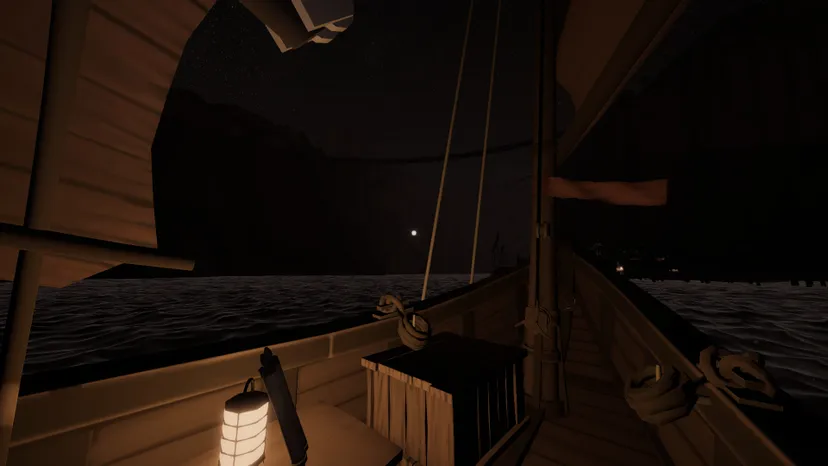
A Sailwind screenshot. The player looks out on the sea at night from aboard their small sailboat.

It was only after the game was released that I discovered how challenging this realistic sailing model was for many players. To be honest, it was quite a big surprise to find out just how much people struggled with it. After all, I thought, sailing really isn't that complicated, compared to, say, flying a plane in a flight simulator. If anything, I was worried the game would be too simple, and I was considering adding more complexity to the controls to make it more interesting and engaging. After many complaints about the steep learning curve (and a relatively high refund rate), I understood why the triple-A game studios often have to simplify their games so much. Big studios have to appeal to the widest possible audience in order to make a good return on their investment, and that means the barrier to entry for new players has to be as low as possible and the learning curve very forgiving. Unfortunately, such design generally makes the game less appealing for those who are looking for a deeper and more challenging experience.

I'm still trying to find the happy medium between making the game approachable and pleasant for new players with no sailing experience, and keeping the complexity, realism, and integrity. There is certainly a lot of satisfaction to be had when you master the techniques of sailing and navigation, and the learning and struggles can add to the experience and make it more meaningful. Games that hold your hand, give you lots of hints at every step, and pretty much play themselves don't provide that same sense of accomplishment and satisfaction. However, if faced with too much challenge at the start, many players will just quit in frustration.

Sailing is complicated. How does Sailwind go about helping players get their feet wet, so to speak, in learning to operate a boat?

Currently, the tutorial is quite basic - there's a scroll on your boat which contains text and pictures describing the basics of gameplay and sailing.

Improving the tutorial is definitely something I'm working on. It's all about finding the balance between smoothing out the learning curve to avoid the initial frustration, while still challenging the player to figure things out and learn by themselves. I've recently added a new tutorial feature which visually shows you the no go zone when trying to sail upwind, which is a very important concept when learning to sail. This new addition was controversial in the community for a good reason - features like this can diminish the sense of accomplishment and make the game feel too cheap and easy, so I am very cautious not to move too far in that direction.

Actually operating and manipulating a boat is just part of sailing of course. Some other games find it challenging to enable the player to find his position and get oriented in the world, even with the use of UI aids, but Sailwind don't use those on purpose! The possibility of getting lost, as in real life, is another part of the game. How does a player handle navigation, getting bearings and figuring out the best direction to head in?

Getting lost is fun! That's often when the real adventure starts, and it's a great opportunity for emergent challenges and organic stories to develop. Also, in a game with no enemies or combat of any kind, the possibility of getting lost adds an element of risk and challenge. The risk of failure is what makes success meaningful, and it's one of the necessary elements of any game.

In Sailwind, there are many ways to navigate, and you'll have to choose between them depending on your current situation. There is of course the compass, but if you accidentally drop it overboard (which does happen to many players, apparently!), you can also use the sun, or even the stars in the night sky, to find the cardinal directions. 

There is also the quadrant (a simpler version of the sextant), which you can use to determine your latitude, and the chronocompass, a rather complicated tool which uses the sun and its shadow to find the latitude and longitude. More instruments will be added later on. Skilled use of these instruments is necessary in order to successfully complete long ocean voyages (which can take many hours in real time!).

It's easy to focus just on the sailing and neglect talking about the non-sailing aspects of the game. There's survival elements, and a basic trade simulation where the player takes on delivery jobs, and attempts to complete them for money while keeping his reputation up. How much of the game do these aspects make up? Are you considering deeping these elements of play, like, are there plans in the offing to require that players carry limes to prevent scurvy?

I actually don't consider those features as separate from the sailing aspect. For me, sailing is more than just controlling a boat. When I think of sailing, I think of adventure, travel, exploration. I think of brave men confronting the forces of nature on an epic journey towards the unknown. Without these aspects, sailing is reduced to just pulling ropes, turning the wheel, and steering the boat towards no particular goal. Those things aren't all that fun by themselves, it's exactly that context of the epic adventure that makes sailing so appealing. 

The survival and trading elements in Sailwind serve that goal, they are there because without them the sailing wouldn't be "real" in some sense. The need to stock up on food and other supplies adds an element of risk and strategy, the trading and delivery missions mean you have a destination, a goal which is a part of a bigger story. 

In Sailwind, you're not just sitting there watching your boat move through the water - you're on an epic voyage across a vast ocean, battling storms and overcoming challenges to deliver vital goods to people living in distant settlements. That's what sailing is really about!

This is also one of the main areas I want to develop further. Expanding the trading system is a high priority item on the roadmap at the moment, and there are also plans to expand food and drink systems, such as introducing the need for balanced nutrition and adding food spoilage.
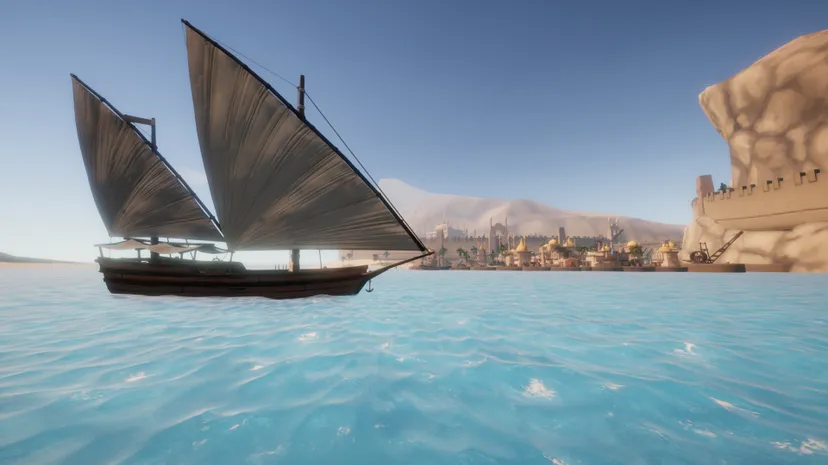
A ship with two sails approaches a city along the shoreline.

One of the interesting design decisions you're made is to enforce the need to sleep. It's amazing really how many games handwave sleep away. A one-person vessel on the ocean has unique strategic requirements. The boat doesn't stay still while the player's character is unconscious, but continues to travel. What would you say this brings to the game?

As with most features of Sailwind, I didn't consciously think about the game design implications of the sleep system. It is simply something that just... made sense. After all, that's how sleeping works in the real world! As it turned out, it fits in the game quite well, but this is more of a happy accident than a planned decision. 

First, it adds another layer to the challenge and decision making aspects, which is pretty important in a relatively simple game like Sailwind. Second, it gives players an opportunity to take a short break, maybe stretch a bit, shift their attention away from the game for a moment, which is probably a healthy thing to do in a long gaming session.

A concession it seems Sailwind must make to physical reality is the nature of the time scale compared to player's life. 24 game hours cannot equal 24 real hours if the game is to progress at a reasonable rate. How does Sailwind handle this? Does it make day lengths shorter, distances shorter, or speeds greater than in real life?

Sailwind takes place on a planet which is significantly smaller than Earth, and the distances and time are scaled down accordingly, but I've tried to keep this scaling somewhat consistent. That is, sailing around the globe in the game (not possible currently, by the way) might take a similar amount of days as it would in the real world on Earth.

The boats are generally slightly faster than they would be in real life, but not nearly as much as in most other sailing games. This slightly faster speed is purely a game design decision - realism is good and all, but going very slow can often feel frustrating and just not very fun.

Sailwind is a fascinating game even at this early stage. Part of what I find personally exciting about it is, it feels like a simulation of an ancient real-world activity that used to inspire a whole genre of literature. Sandbox games are kind of like a self-told storytelling device, a way to have imaginary adventures that can actually be affected by the player's actions, and Sailwind's concept is unusually powerful here. But that's just me; why did you decide to make this, what is it about the idea that pushes you to work on Sailwind every day?

I think the biggest advantage video games have over other media is precisely this potential to create dynamic and unique stories. These stories can be important and meaningful, they're more than just "fun". For me, it's these stories that can make playing a game a worthwhile experience, and that's why these are the types of games I'm interested in. I'm not really into games that try to capture your attention with highly engaging visuals, instant gratification or cheap rewards. That type of entertainment feels good in the moment, and can be highly addictive, but it leaves you drained, tired, and often feeling like you've just wasted your time doing nothing productive. 

On the other hand, when you create and experience a meaningful story during your gaming session, it feels fulfilling - the time is not wasted, it was well spent. That's always my goal when making games. To provide more than just entertainment. I want the player to feel like they've spent their time well, and experienced something meaningful.

Tuesday, January 12, 2021

Neale Sourna Writing Services / Editing Services at Guru.com (Games Narrative, Novels, etc.)


Monday, December 28, 2015

Sunless Sea, 80 Days and the rise of modular storytelling

The last few years have seen the rise of modular storytelling, which offers players something akin to a collection of short stories tied together with character or theme. They offer a wealth of self-contained vignettes for players to interact with, and new ones can be continually added, increasing the breadth and richness of the narrative.

Inkle's 80 Days is the most prominent example of this, casting players as Phileas Fogg’s personal valet, Passepartout, as the two make their way around a steampunk Victorian globe. Each city on the trip offers its own self-contained story, occasionally spilling out into other locations, but by and large limited by geography to something that you discover and leave behind as you circumnavigate.

Failbetter Games’ Sunless Sea adopts a similar approach, casting you as the captain of a vessel in the game’s ‘Unterzee’, ranging out of a mostly submerged London to discover the islands of its unlit ocean, each with its own history and events.


This story-telling approach fundamentally alters the structure of the development process, both before and after release. “The main reason to build the game this way was because we didn’t know how big it was going to be” Jon Ingold of Inkle tells me. “To be frank, we didn’t know if Meg [Jayanth, 80 Days’ writer] would give up halfway! We needed to make sure that, whatever happened, we could pull the game together and deliver it. But it also meant that we could be very flexible about adding diversions, side-content and additional routes.”

"This story-telling approach fundamentally alters the structure of the development process, both before and after release."
Alexis Kennedy, the Creative Director on Sunless Sea, has similarly positive things to say about how modular storytelling impacted scope-management. 

“It gave us a natural pattern for production. We developed the game through Early Access, we pushed out monthly-ish updates, and each update had 3-5 islands on it, until the whole sea was populated. That’s much easier for players to understand than story-line based announcements.”

What this also means is that players are less likely to see the ‘seams’, so to speak. Often in a standard linear narrative there are difficulties including everything that was initially planned, leading to scenes, plot points and sometimes whole characters being cut from the final game. 

With a modular approach, those ‘missing’ pieces are almost completely isolated from the other pieces of the story, leading to their absence being very hard to feel, as a player moves through the game.

Talking about the iteration process with both developers, it’s clear that modular storytelling helped immensely when it came to playtesting and iteration, too. For 80 Days, all Inkle had to do was get one trip around the world complete and they essentially had a working prototype. From there, it was just about adding cities that branched out from that already established route, and the game grew from there. A complete experience that just became broader and richer as content accumulated. 

Similarly, Sunless Sea’s islands ‘worked’ as soon as there was one of them thrusting out of its Unterzee. “We had much more informed ideas on how island stories should work by the end of the process than we did at the beginning,” Kennedy tells me “We didn’t have to commit to one form from day one.”

This was an important point, especially for Failbetter, but also for Inkle; both companies brought in freelancers to help write their games, and while Jayanth for 80 Days played a very central role, Sunless Sea had fully 30% of its islands written by freelancers. But when those freelancers don’t have to worry about maintaining absolute consistency with an already established story, they can produce much more interesting work.


“The Fallen London universe is big, sprawling and complex in the way that only worlds built by thoroughgoing nerds are complex.” Kennedy continues. “By isolating stories on different islands, we allowed our freelancers much more liberty to experiment, to add new odd lore, and above all to use a voice that was very different from our well-established house voice. The polyphony of different voices - I think – really added to the sense of exploring foreign spaces in Sunless Sea, and gave us a range and breadth of perspectives that would have been impossible if we’d had to squeeze everyone into the same approach.

"The benefits of the approach extend past release, too, as both games have proven. Taken today, 80 Days and Sunless Sea are far more expansive than they were when they originally launched. In the case of the former, each new platform (Android and PC), gave the team at Inkle a good excuse to add a big chunk of new locations and stories, each more outlandish and unique than the last.

“The post-release updates were an unexpected benefit, and not something we had planned for in earnest.” Ingold tells me. “But when we came to do it, it was just like continuing our development process from where we left off. It’s been particularly satisfying to weave extended new storylines into the existing framework, such as the jewel thief plot that, once activated, follows you around the world wherever you go.”

Similarly, Sunless Sea has been receiving regular new geography to its eponymous body of water, but despite the already well-established lore that they created with their browser based Fallen London, writing a new island didn’t require an absurd amount of research; instead they just had to reacquaint themselves with one element, and then the isolation of the sea did the rest.

None of this is to say that modular storytelling is a cure-all for games’ narrative woes. It’s difficult to argue that having isolated vignettes is more emotionally rewarding than wholly bespoke cinematic experiences, but that is also not to say that they can’t deliver a satisfying narrative arc. Both 80 Days and Sunless Sea have created their own ways of delivering that arc, and they’ve both managed it, with varying degrees of success.


“The level of drama [is] proportional to longitude.” Ingold tells me. “So the soup is too hot in Europe, the soup is on fire in India, and the soup is talking to you about your death in South America.” This, combined with the natural drama that comes out of dwindling resources and health states, means that on the average trip in 80 Days, you’re running out of money and time by the time you’ve crossed the Pacific. 

That the stories themselves then escalate in drama and stakes means that the final leg of your journey should feel like a third act, so to speak.

Sunless Sea is less rigorously structured, so it can’t rely on the same tricks. “One of the things we got right was the strength of the core loops.” Kennedy explains. 

“You leave port; you cross the darkness; you find the lights on the far side, which you’ve been anticipating during your time in the darkness. You do that again and again. And then, in aggregate, you complete a much larger loop, where you leave London for the unknown; explore a series of ports, and then return home. That outgoing-homecoming loop, with the relevant music and visuals to signal your departure and return, is the heart of the game.”

This structure also has a knock-on effect that I hadn’t considered until Kennedy pointed it out to me; player choice, when framed as a choice of where to go rather than explicitly what to do, becomes something that’s both very interesting and exceedingly manageable on the part of the developer. 

Instead of having to limit choices to the world of morality, and all the design headaches that that naturally leads to, you instead need only to provide a fork in the road, and the player will feel the weight of that choice bereft of the trappings of ethics that often present a choice that’s barely a choice at all.


“For the player to feel that the journey has meaning,” Kennedy says. “They have to be free to decide where they’re going; for them to be free to decide where they’re going, the ports have to be untethered and modular. Players long for the opportunity for self-expression. Anything that validates and extends that self-expression is welcomed, and plays to the medium’s strengths. 

"At Failbetter, we talk about ‘fires in the desert’ as a model for our variety of storytelling. Imagine a desert, seen from above. Paths lead between the villages in the desert. When travelers cross the desert, you can clearly see the route they take, where they stop off, and so on. But what if night has fallen? Then, all you can see are the little fires in the village. Occasionally, travelers emerge from the darkness and sit by the fires for a while, and then move on. But the routes they take between those fires belong to them alone.”

In other words, the player provides the context, and the game provides the stories. While the developer can provide certain elements that influence the order with which the stories are experienced, ultimately the final call is with the player. Especially in Sunless Sea, there’s no guaranteeing that a player will go to this island or this island first. In 80 Days, the only constant is Paris; everything else is up for grabs.

“Just as in a film the story is told through the edit, [here] the story is told through the darkened paths between the fires.” Kennedy finishes his conversation with me by saying. “In cinematic terms, it’s a montage; we provide the shots, the player does the arrangement. In comic terms, Scott McCloud calls it ‘the blood in the gutters’ – the creative space that exists for the audience to instantiate the potential between specific events. There’s not much space in a traditional told story for that."

Friday, September 04, 2015

A Practical Guide to Game Writing By Darby McDevitt

A Practical Guide to Game Writing

By Darby McDevitt

[In this detailed Gamasutra feature, veteran game writer McDevitt (Assassin's Creed: Bloodlines, Where the Wild Things Are) outlines useful processes for collaboration between design, production and writing staff, from pre-production through production of a game.]

Video game writers are a frequently misunderstood sort. Even in the most ideal situations, we are often relegated to the status of mortar to the designers' bricks, slipping between the cracks to paste fun moments of gameplay together with a few lines of snappy, expository dialog.

Writers can be further marginalized by a lingering sense among our team members that we want nothing more than to stuff our games full of melodramatic, Metal Gear-sized cutscenes, burdened by a cast of dozens sputtering flowery lines from our 450 page script.

I'd like to steer us clear of this idea, one likely sustained by the apparent misconception that writing is fundamentally about arranging words into meaningful strings.

Clearly this isn't the case, but somehow a large contingent of the game industry has institutionalized this attitude anyway, and its effects can be found in an upsetting number of games released in the past few decades.

Just count the uneasy puns and strained moralizing spilling from your favorite avatar's mouth -- when a writer is hired to write a game, and is subsequently barred from having input into its pacing, its setting, the motivations of its characters, and its mood and tone, writers resort to the only weapons they have left: wry witticisms and declarative pop-philosophy.

The spirit of collaboration games are supposed to embody often seems well outside the writer's reach.

But the truth is, we don't want to hijack your game with pointless soliloquies, and we don't want to write a posturing Hollywood-style epic. Game writers simply want to help designers craft an immersive, interactive narrative experience. With or without dialog, with or without characters, we simply want the game to start somewhere interesting, climb its way over a few emotional peaks, and end somewhere even more interesting. We're good at that sort of thing too.

Not all games require a narrative arc, of course, but it's a rather common feature of quite a few mainstream console titles, and these days if an actual writer is going to pen the script of one of these games -- as opposed to the lead designer or the producer -- some Very Important People probably have a Very High Opinion of the property.

But this doesn't happen as frequently as you might think. Consider yourself blessed if you have actually seen a game writer in the wild, for they remain one of those elusive, added-expense luxuries that many game producers -- their eyes always on their margins -- believe they can do without. And in many cases, it humbles me to say, they're right.

The average game-playing public will suffer a deluge of poor storytelling if a game is knock-down, drag-out fun. But a great story with terrible gameplay will die a fast and lonely death on the shelf. I respect and support this pecking order. Gameplay must come first -- this is the golden rule.

However, if some form of narrative happens to play a design-critical role in your proposed game, it is vitally important to treat it exactly as you would any other design element, not as a separate discipline. So if your team has taken that bold extra step to build a narrative-driven game, there are a number of precautions you can take to accommodate the writer and prevent the story (and your writer) from getting buried beneath endless revisions of your GDD.

First and foremost among these is to make one simple conceptual change: treat your writer as an associate designer. Involve her in the design process from the outset. Even if she is not an experienced technical designer, a good writer can be instrumental in helping inspire unique moment-to-moment experiences that provide gameplay variety while integrating seamlessly into the narrative.

Again, writing is not just about clever sentences -- it can also be about narrative shape, motivation, and pacing, i.e. what you do, why you do, and when you do.
Most of my favorite narrative-driven games contain very little dialog in them at all -- Ico, Shadow of the Colossus, Flashback, Out of this World -- but even these titles are "written" in the sense that they have a clear set of emotional shifts, tonal changes, and meaningful moment-to-moment events that compound into emotional pay-offs.

When writers and designers band together and discuss a game's story, characters, dramatic set-pieces, and settings in parallel with ideas about the game mechanics and levels, the team will begin to find exciting and creative ways of conjoining the two disciplines into a more unified experience.

Unfortunately, this synergy can be difficult to find, especially in the trenches of third-party development where the average dev cycle is less than a year. When schedules are tight, producers and designers often maintain a slight distance from writers, imagining we are off "doing our thing" while they do theirs.

But our thing is their thing too. Writing is design. We are both building a world from scratch, after all. So if you empower a writer to absorb and occasionally contribute design ideas, she will carry on with a solid understanding of how the narrative elements contribute to (or detract from) the overall game experience.

Before Writing Begins

For a clearer picture of this process, let's pinpoint a game writer's most critical early-milestone tasks, beginning with a few pre-production goals. In these early weeks, it's easy to get drunk on a thousand and one ephemeral ideas -- by all means do -- but you'll need to conclude this reverie with a few tangible results:

High Level Narrative Summary. During preproduction, the design team should work directly with the writer to concoct a brief (one to four pages) high-level summary of the primary story. Think of it as your elevator pitch: make it succinct and snappy. This short piece is probably the only story document most of the team will ever read, so it should be clear and compelling.

Do this early, and get the client to sign off on it as soon as humanly possible. Read that previous sentence again. Get quick client sign-off every step of the way. Failure to guide your client to a swift agreement on the story may result in endless misery for the remainder of the project.

Major Locations / Levels. This is one area where writers can really get sore if they are left out of the conception process. Designers frequently forge ahead with level concepts and designs without consulting the writer, not taking into account the huge role that setting plays in crafting an interesting narrative.

In video games, place is often more important than character, so this is doubly important. If the writer, designers, and artists band together to nail down the scope of the game's environments, and get a rough idea of how much is needed and how much is feasible, everyone will walk away happy.

This cuts all ways: writers need to know that they'll have the locations they need to tell a good story, while the artists and designers will want to make sure the writer is asking for content that is relevant to gameplay.

Obviously this "relevance threshold" varies with the size of the project, but on small projects with short schedules getting this right can mean the difference between environment artists going home at 6 pm or 6 am the next morning.

Once production begins, the writers work ramps up. This is the point where the entire design team needs to function as a single unstoppable force (for good):

A Detailed Story Outline. With the narrative arc complete, it's time to produce an exquisitely detailed story document, complete with scene descriptions and gameplay objectives. The amount of detail in this doc will vary according to how much the story influences the design, but it should be as thorough as possible. In any case, generating a detailed outline will give you an early understanding of just what sort of game you're making, and how reliant on the writer you will be for design iteration down the road.

In the case of heavily plot-driven games, the design challenges will stem directly from the story -- e.g. rescue a prisoner, assassinate a guard, courier a package. For non-linear games like RPGs this document should be incredibly dense and detailed. For less structured games, the writer's direct impact on the design may be minimal. Understanding this balance ahead of time is critical.

Story Presentation Plan. How, exactly, is the game's story being told, and who is responsible for telling it? Do you have pre-rendered cutscenes or in-engine cutscenes? Who will be putting these scenes together? Perhaps you have no cutscenes whatsoever, and would like to tell your story on-the-fly. Is this feasible? Possible?

Figure it out early.

Nothing is more frustrating for a writer than seeing a project scoot forward without anyone having a firm understanding about how the story will be told, since this will affect what she intends to write.

Estimated Cut-Scene Breakdown. If your game does contain cutscenes or animated in-game sequences of any kind, it is crucial to estimate their number very early on to get a good sense of the work to come. If you have a detailed story outline, this should be easy. On tight projects it also helps to determine ahead of time what the expected intricacy and quality of each scene is so your teams can allocate their resources appropriately.

Characters. As you generate your detailed story arc, you'll need to make a clear list of the number of characters needed. Who are these people, and what roles do they play in both the narrative and the gameplay? Which are simple NPCs? Which are robust, interactive characters? Which are bosses? Mission givers? Shop keepers? Tutorial mentors? Et cetera.

The artists will be generating all character models and animations, and they'll want to know the scope as soon as possible. If you spring 15 new NPCs on your artists halfway through the project, they will shank you in the break room -- believe it. Getting the character scope nailed down early will also help you determine how much "incidental dialog" the game will require, for these throwaway lines frequently take up as much space in the script as the main story dialog. This is no trivial amount, so keep close track of it.

Sort Out Your Text Database. This can be a tedious task, but it is crucial to sort out your text pipeline very early, and get your tools up and running. The longer you wait, the more you will hate yourself. Some games have complex or esoteric text requirements -- non-linear conversation systems, for instance -- so it is critical that you organize your data cleanly and clearly.

Also, take a moment to decide how the script will be delivered. Not all writers are familiar with the esoteric architecture of your text database, so if your writer is delivering the script in Word or Final Draft, you're going to need a pipeline to handle its transfer.

When Writing Begins

Once your game's foundation has been laid and the team is ready to start production, the actual writing can begin. This is the fun part. Writers love to write, but without constant contact with the design team, they run the risk of giving you more script than you need, or a script you don't need at all. This wastes everyone's time and makes the writer sad when you have to tell him, "as beautiful as they are, your 100 part limerick-cycle has no place in Chaz Dastard's Intergalactic Star Safari 2: Misremembered Legacy".

Nip your writer's graphomania in the bud by establishing clear boundaries. This should be simple if the writer has been involved in the design from the beginning, since all parties involved will understand the extent of the game's writing needs. Keep track of everything before it needs to be written, as it is being written, and after it has been written. A game writer without defined boundaries or direction -- especially an off-site, contracted writer -- runs the risk of writing something as sensible and useful to your game as Andre Breton's Soluble Fish.

Script, First Draft. Between the greenlight and first milestone, the writer should be busy as hell. On short projects, ideally she should have a finished first draft of the script by the first production milestone, as this will help the level design process move smoothly.

On longer projects, the writer and level designers will be working back and forth quite a bit to make sure neither one lets a detail slip, edging ever closer to a first draft.

Demand Story and Script Sign-Off, Again. Be crystal clear with your client: the script needs to be read and comments forthcoming as soon as possible. Of all the client-side headaches I have ever encountered, this is the most painful.

Many clients make the mistake of believing the script is the single most important aspect of their game, and therefore spend months and months poring over details that contribute very little to the final game experience. Delays of this sort can hold up level designers and cutscene artists in the most asinine ways imaginable, wasting time that cannot be easily recovered.

One little discussed benefit to hiring an experienced writer is the fact that, relative to coders and artists, good writers work incredibly fast. Text is cheap and takes very little time to edit and revise. But this advantage is of no use to anyone if writers aren't aware that anything needs revising.

I have lost count off the number of times a seemingly innocuous level design change or map layout has rendered a chunk of my dialog obsolete. When I have not been made aware of this chance, the resulting headache cannot be cured by earthly medicine.

Darby: Listen to this gem, guys: "Sally forth to yonder Black Forest, stalwart Wayfarer, for there you shall find a crystal dagger of such rare-"

Producer Person: Ah, Darby, sorry... the Black Forest was scrapped and replaced by a Walmart. We should have told you.

Darby: Ah... okay, hold on. Where's my pen?

Woe betide the team that discovers this incongruity only after the actors have recorded all of their dialog. Again, keep the writers and designers partnered at all times.

Into Production

Now you're well into production, and the heavy lifting has begun. If you have nailed all the earlier tasks, the rest of production should proceed smoothly, barring any client interference. This is supposed to happen only if you've been naughty, but the unfortunate truth is not so black and white.

There are more than a few imposing clients out there who, for understandable if not always sensible reasons, believe the story can be endlessly revised up until Beta. So be wary, keep calm, and carry on.
At some point during production, the script will be finished and the writer will feel like she is nearing the finish line far before the rest of the team. Don't let this illusion persist. There is still a bit of work your writer can help you with:

Casting. If you are recording with actors (and who isn't, these days?) now is the time to figure out who will be making your characters speak. On small projects that don't have an official story director, the writer can be of immense help. It's crucial to get your casting done well in advance of your recording date. Actors have hectic schedules and you'll find all the best ones rather busy if you try to snag a few the week of your recording session.

Final Script. As difficult as it is, the writer will have to stop tweaking her dialog and settle on something. Of course, it's a good idea to encourage the writer to streamline what she can. The script may be laden with timely wit and wisdom, but it is still, above all else, a game script and if it tests a player's patience, that can be a problem.

More to the point: the longer the script, the more time it will take the cinematics team to craft the cutscenes or scripted sequences. So when the writer buckles down and kills her darlings early, it keeps everyone from doing superfluous work.


Voice-Over Recording Sessions. Some writers make great VO directors; some don't. But all good ones should be able to re-write their dialog on-the-fly, so make sure your scrivener is available for the recording sessions. When she hears her dialog spoken aloud for the first time, she's probably going to want to change it. Allow some leeway, but don't let her get carried away. Try to limit changes only to what is egregious or erroneous.

Once you hit Alpha, the writer's job gets a lot easier. But there are still a number of good reasons to keep one around, locked in a cabinet somewhere, just in case.

Proofreading. Writers should never copyedit and proofread their own work, it's true. This is a fact that holds doubly true in the game industry where the volume of text written is often comparable to that of a novel. On the other hand, it's rare to find excellent proofreaders hiding in the QA department, so make sure as many eyes are on the text as possible, including the writer's.

Non-Dialog Text Revisions. It can take a long time to nail down all that tutorial, database, and menu text your game has accrued slowly but consistently over the span of the production. Lucky for you, text is cheap to implement and fix, and is quite safe to alter even up to the last minute (provided you're still proofreading).

And with that, your writer's job is finished and your game is nearly complete. Well done, folks. Take a breath and clean your white board. The whole process starts again in five... four... three... two... one...
Return to the full version of this article
Copyright © 2015 UBM Tech, All rights reserved

Thursday, January 29, 2015

On Becoming a Game Writer / Gamasutra Columns by Richard Dansky | Central Clancy Writer | on October 10, 2013

http://blog.ubi.com/the-write-stuff-on-becoming-a-game-writer/


On Becoming a Game Writer
One of the questions I get asked most frequently is How do I get into game writing? Now, this isn’t the same as How did you get into game writing? Ask ten game writers that question and you’ll get twelve different answers. No, what people are looking for is the clear and well-manicured path into the profession – a certain set of steps to follow that, once completed, will yield a position as a game writer.

This is a perfectly reasonable question to ask, and in a just and fair and logical world, it would have a simple and concise answer. Unfortunately, we are not living in that world. There’s a reason every game writer’s journey is different, and that’s because different companies are looking for different things in a writer. Some embrace the role and smooth the path, some have very specific needs and wants, and some aren’t quite sure what exactly they’re going to do with a writer, but they’re pretty sure someone needs to be generating some text assets for their game right about now. There is no one true way, and anyone who tells you there is, is most likely trying to sell you something they’ve written about how to become a game writer.
On Becoming a Game WriterThat being said – and bearing in mind that I am not, in fact, trying to sell you anything – there are a few things you can do to advance toward game writing. They’re not hard and fast, there’s no achievement unlocked after accomplishing them, and they may seem a little counter-intuitive in places. But in 14 years of doing this, I haven’t found anything better. So, if you want to be a game writer, here’s what you’ve got to do:

Check Your Ego

If you believe that you are going to walk in the door as a writer, elucidate your grandiose vision for the story you want to tell and have the development team magically transmogrify into Oompa-Loompas who are there to actualize that vision, you may find yourself sadly disappointed. A writer is part of a team, there to mesh harmoniously with folks from other disciplines in order to create the player experience. Fail to understand that you are part of a team – that you are creating assets and providing deliverables, not cavorting through the fields of the Swiss Alps in a smock whilst declaiming Romantic poetry that the rest of us are privileged to hear – and you will probably also fail to understand why nobody wants to work with you.

Play Games

If you want to write games, play games. To write for any medium, you need to understand that medium’s unique form and demands. The best way to acquire that knowledge is to consume that medium, and by consuming that medium – or as we call it, “sitting your butt on the damn couch and playing some games” – gain both experiential and instinctive knowledge of what works.

It’s not the only thing, of course. You don’t sit through twelve hours of Dynasty Warriors 8 and emerge with the knowledge of how to write meaningful systemic dialog chewing its way out of your head like a particularly hungry Athena.On Becoming a Game Writer You do, however, walk away with a pretty decent sample size of things that worked and things that didn’t work, and you can start putting that knowledge to use in your own work.

Observe Games

Of course, when I say “play games” I don’t just mean “play games.” Racking up body count in adversarial is cool, but if you’re focused exclusively on optimizing your play, you’re missing the chance to observe game writing in its natural habitat.

So play as a player, but also play as a writer. Listen to the dialog. Observe the visual storytelling. Look at the text that gets used, and ask yourself why those choices might have been made. See if you can reverse engineer – and thus understand – the narrative design.

Do this, and you’ll get a better grasp of how game writing works when the rubber hits the road. It’s not just the words, it’s when the words get used, and how many, and to what end, and where there are no words at all. Watch the game as you play it, and learn.

Make Games

The best way to learn what works as writing in a game is to get your writing in a game. Luckily, we’re in a place in the evolution of the industry when it’s possible to get your writing in a game even if you’re not working for a game company.

Go find yourself a Game Jam, or haunt a local college’s CS department bulletin boards to find groups that are making games on their own. Offer your services as a writer, even if all they need is menu text. Grab a tool kit and make something with your words in it. Get your stuff in a game and see how it plays.
On Becoming a Game Writer
And I’ll be honest here – odds are your first few cracks at it aren’t going to be great. That’s OK. This is the space where you can learn, and you can get better without your employment being on the line. Because the more games you write for, the better you’ll get at recognizing what does and doesn’t work, and the quicker you’ll build the habits of good work you’re going to need.

Besides, it doesn’t hurt to have actual, honest-to-Murgatroyd games in your portfolio.

Tweet

And by tweet, I don’t mean HAW HAW CAT VIDEO LOL. One of the things Twitter does is force you to phrase complete thoughts in a constrained space. This is entirely akin to writing for games, where you must on occasion phrase a complete thought in a space that is entirely constrained by the number of characters the German localization is going to require. Or, more likely, constrained by the fact that you don’t want your dialog to ramble, potentially interrupting gameplay in the process.

So tweet, and tweet smart. Learn how to write short, pithy sentences that communicate a point. And lay off the cat videos.

Talk With Game Writers

The best way to learn about the job is to talk to people who have done the job. This is not a surprise, nor is it unique to game writing. So, if you’re interested in the role, find ways to interact with people who are doing it. Go to conferences where game writers are speaking. Follow them on social media and engage – respectfully. I was wondering if I could ask you a few questions goes a lot further than Why did you make that incredibly stupid decision in your last game? Look to the IGDA Game Writing Special Interest Group and get on their mailing list. Make a reputation for yourself as someone who can engage cogently and professionally, and who has interesting things to say about the subject matter.
On Becoming a Game Writer
Also, don’t be a jerk.

If you do these things there’s a better shot that when someone has an opening and your name gets floated as a possibility, you’ll get a positive response. As opposed to, say, slagging a writer on your blog and then turning around and asking them for work. Because that always goes so well.

Taking the Next Steps

Will doing all these things get you a job as a game writer? No. Knocking on doors, sending out resumes, applying for gigs and presenting good work in your portfolio will actually get you the job. But if you do these things, you’re in a better position to be ready to knock on doors – and to be prepared to seize the opportunity when somebody answers.

For more of Dansky’s advice for writers, check out this post:

Tips for Writers
the author

Perhaps best known for his brief stint as the world’s leading authority on Denebian Slime Devils, Richard Dansky has been with Red Storm/Ubisoft since 1999. His first game was Shadow Watch and his most recent one is Splinter Cell Blacklist. In between he’s served on the advisory board for GDC’s Game Narrative Summit, helped found and develop the IGDA Game Writing SIG, and appeared on Gamasutra’s list of the top 20 game writers in 2009. He has also published six novels, one short fiction collection and a ton of tabletop RPG sourcebooks, which is why you should never tell him about your character. For a tantalizing taste of Dansky's inimitable insights, read his recurring column on the UbiBlog ("The Write Stuff") and follow him on Twitter: @RDansky

Sunday, June 15, 2014

Game Writing equals Narrative Design

http://www.thefictionengine.com/articles-on-game-narrative.cfm/article/writingequalsdesign


"...there isn’t a line between the design and the writing, especially if you’re doing a narrative-driven game. A lot of what you might call the game design is actually writing in a sense – writing isn’t just words, it’s creating the characters and the world and the actions that might make sense in that world." - Sam Barlow

I grabbed that quote from the following article where Sam Barlow, Rhianna Pratchett and Ragnar Tornquist discuss the closure of Irrational and what it means to AAA storytelling.


 As to Sam Barlow's comment about Writing and Design in video games, I was initially in wholesale agreement with him.  In fact, it's kind of bizarre that we have to call ourselves Writers AND Narrative Designers.  What really is the difference? 
Were I to write I fantasy novel, I'd write 'design documents' about the world, it's people, their culture, politics and economics.  I'd describe the terrain and climate, the cityscapes and landscapes.  I'd produce character profiles.  I'd plan out the narrative in a series of story beats.  Then, and only then, would I get stuck into the writing of the actual words that the reader will consume.
Stephen King once likened writing a novel to digging out a dinosaur skeleton.  You chip and brush away, revealing the dinosaur bone by bone.  Only when you've finished do you know exactly what sort of dinosaur you have.  I tried that once, with my first novel.  Needless to say, it remains unpublished.  Sorry Steve.  Guess I'm not that kind of writer.
I can't just make shit up and expect it all to turn out fine and dandy.  I had to laugh when in Alan Wake Alice surprises Alan with a desk set up nicely with typewriter and a fresh ream of paper.  He freaks out. 


I'd freak out too.  What am I supposed to do with that?  Just sit down and churn out a masterpiece like an infinitely typing monkey?  

I have to plan, map out, structure, formulate the story first.

Moving on from that first disaster of a novel, that's how I do all of my writing now.  I plan out the world, character and story arcs first.  Then I write the scripts.  But guess what?  

That's exactly what most writers have been doing for centuries now.

So why, when it comes to the Video Games industry, do we feel the need to suddenly call ourselves 'Narrative Designers'?

Because it sounds more technical?

More credible?

More professional?

Because it's the only way that we can get across across how much more there is to our job than just writing dialogue and flavour text?

"Writing isn't just words..." says Sam Barlow.

On this Sam and I disagree.  Writing IS just words.  Whether they're going into a script or a development doc, those words are still how we tell our stories.

Sunday, January 08, 2012

A Report on Software Tools for Interactive Storytelling by Richard Rabil, Jr

This report presents an evaluation of four tools used to author stories for video games: articy:draft, Chat Mapper, the Dragon Age Toolset, and Microsoft Excel 2007.


The evaluation involved a literature review, web survey, hours of firsthand experience with each tool, and an extensive scoring process. The report contains visual summaries of results, quantitative scores for each tool, a detailed discussion (along with relevant screenshots), recommendations, and an in-depth commentary.

Friday, May 21, 2010

Human Character: Perceived Overconfidence in Competencies in Writing by Nonwriters

From LI-Game Writing Group:
Voicing concerns: the problem with video game acting
http://www.guardian.co.uk/technology/gamesblog/2010/mar/16/games-controversy

Why are modern video games still having problems with voice acting? And what can be done to solve them? Gamesblog investigates...

"Although the videogame industry loves to compare itself with the movie business, and clearly has ambitions to become the story-telling medium of the 21st century, poor vocal performances are common, even among Triple A titles. In the last few months Aliens vs Predator, Army of Two: 40th Day and even Final Fantasy XIII have drawn criticism in the areas of scripting and performance. So what's going on?..."

http://www.guardian.co.uk/technology/gamesblog/2010/mar/16/games-controversy
====================

Programmers think they can write a great narrative or at least a good one, but it's much harder than they can do. Much like me, or most writers, learning the mind-numbing, confusing bits of code (months and years' worth) that go into background scripting.

Hiring out at Elance and Guru, I've done the Heartwild Solitaire and Margrave Manor story, character, and dialog parts. There is a skill to it, to visualize the many layers past a few smart-assed things to say. To put a kernel seed of intrigue that juices a gamer to hurry to the next story development.

And sometimes the character's most important narrative is to say nothing.

Programmers don't know that, or can't do it skillfully, many beginning writers or even older writers can't--I've seen their films, games, and novels.

Comics are pretty but can't tell the involved subtlety within stories Spidey, Superman, and the rest tell, without Stan Lee and all those who write and design the narrative.

A professional journalist hired me recently to develop and polish a fiction synopsis of some life events because writing important facts we need to know in an information article isn't the same as writing intriguing, depth-filled fiction.

Those who don't do what we've trained for years and do everyday, and are still learning to perfect better and better believe wrong, and believe the narrative is simple, and can be--if written well. And well-edited by the writer.

Most who aren't writers can't write well nor can stand to edit until it's layered, and deeper, and clearer. We do.

You need an artist to make great art, so why does everyone who's ever read one stanza of Shakespeare, five thousand comic books, and watched a lifetime of TV and film actually think and believe they can crank out the next stunning story? Even producers, directors, and actors can't. They do what they, let us do what we do, sooner and better, instead of making us come late to the party and do patch up?

It's amazing, stultifying, and bad for business. TV's Lost proves that people can handle a great deal of subtle info and character detail. The last WGA writer's strike proved we generate mega money and can kill it, if we aren't in the game.

We're in the game, let us write it.

--Neale Sourna

Wednesday, May 05, 2010

LinkedIn Question: How to start as a game writer & story crafter in the games industry?

Keep writing. Look for chances to write for game techs without your skills of character dialog and deep storytelling.

When a Polish programmer--Hi, Darek!--was looking at writers online, he found my author site and liked how I opened with character feeling and action; we've done the Heartwild Solitaire series from that.

I got another break by having a sound set of writing and getting a few game writing jobs at Guru; the Margrave Manor series and an RPG script still waiting to be published.

We all want thee huge AAA narrative we can quit our other many writing and nonwriting jobs for, but that may never happen. We're like movie actors and writers, always looking for another job, hoping we didn't just do our last.

Then again, we may need to start hiring or bartering with programmers to get OUR stories done.

Check the jobs section here, pitch some bids, stay open to writing short stories and scripts/screenplays and even novels for you or as hire.

Author publish.

Set up a writing sample site.

Become a member of freelance writing sites.

We're all scrambling, just keep moving and improving--and relax, there seems to be the perception that there are more writers than jobs. But I can tell you, most of those being called writers are programmers slumming and messing up the storyline and dialog.

Perceptions change everyday.

So, eventually better writers will get the call more often and sooner, we still have a while to that.

But that is why we're showing our face at LinkedIn--we game writers are here, ready, and already writing.

--Neale Sourna
Game Writing Exchange @ LinkedIn.com

Sunday, April 04, 2010

LinkedIn Neale Sourna's Game Writer Exchange Group

WANTED: Established writers, rank beginners and working in-betweeners. Share your latest job and career notice finds, give information and advice, or submit education hookups concerning game story writing, interactive fiction, & requests for short to long fiction/scripts for games or comics.

Monday, December 14, 2009

Game Writer Exchange at LinkedIn.com

GAME STORY WRITERS

WANTED: Established game writers, rank beginners and working in-betweeners. Share your latest job and career notice finds, give information and advice, or submit education hookups concerning game story writing and/or requests for short to long fiction for games or comics.

Writers are often THE LAST TO BE CALLED into the game planning and development process, but are expected to pull a gigantic elephant out of the tiny hat.

Just like art graphics and programming code good writing and especially GREAT WRITING needs time to build its understructure and then layer on muscle and flesh.

The more WE WRITERS share and give one another a hand up to get each and every one of us into projects earlier, the better our writing will be and THE BETTER THE GAMES WE WRITE WILL BE, and the sooner we’ll be asked to the party.

No more last minute literary rescues and trying to piece together plots that makes all the already chosen graphics work. Which can be great—if it works—and disastrous and a blame on the writer when it doesn’t.

Let’s all move ahead, together.

--Neale Sourna at GAME WRITER EXCHANGE

*******************************

An open letter:

GAME WRITER EXCHANGE just needs to be simple. It seems there are few writing gigs, or we don't hear about them until late. Or, we're busy and want to pass on something we've found to another, who's qualified.

Some of us are getting fairly regular hits, but if we writers can pool or resources and therefore--like attractive gazelles at a watering hole a women in a women's college attract the interests of power hitters; once they see us here.

Although the women's college thing is better but way too similar to lions hunting gazelles!

If we can gather a decent, solid range of starting, medium, and advanced writers in an easier to find virtual location, I think it will improve our access, our writing, and our marketing and cash flow.

Hopefully, this open approach will encourage the planners, developers, and recruiters to see us. We're here! We need to be added to the planning and the payroll way before all the artists and whomever find they have logic holes.

We game writers just need to be gathered together much as the artists and coding programmers here at LinkedIn; together like them, but highlighted and spotlighted in our own element, away from them.

And if anyone has questions, we can share answers.

I've seen game writer and game comic, etc questions spread out around my other author, scriptwriting, and game groups; but not specialized to it. I see comics, and even script planning art boards, in a similar area as game story narrative.

Also there are narrative articles and blogs at Gamasutra.com and other places, and it wouldn't hurt to gather those. I've been pulling a few into my own character writing blog [http://writing-naked101.blogspot.com/ ] but ... I'm a little lonely, I think.

I'm alone when I write, edit, layout, and publish my works or write or rewrite other peoples scripts, novels, and games.

The programmers I work with are sometimes helpful but busy cranking out their games and my questions are normally only in what they do or do not want, which leaves me with more questions on how to improve, what others skills and game design programs [like Neverwinter Nights] from a writer's approach is best--and EASY and SENSIBLE--for the next step, in writers helping the game from concept to player.

I felt it was a burning idea and I didn't see it repeated anywhere else here, or I would've joined.

So, I've no desire to play dictator or mess up anybody's stuff but writers of every kind need to gather our power and use it to get us more: power, respect, reputation, opportunities, and the cash.

And, as always, I'm open to positive, useful suggestions for our project here in gathering game writing info, news, jobs, etcetera.

Neale

www.Writing-Naked.com
www.Neale-Sourna.com
www.PIE-Percept.com

Neale Sourna Game stories:

"Heartwild Solitaire" 1 & 2 pc games
"Margrave Manor" & "Margrave Manor2: The Lost Ship" pc games
"Berlin'61: The Wall" RPG

Tuesday, September 29, 2009

The Future Role of Agents [excerpted]

September 29, 2009
by Jane Friedman

[more before]

1. KEEPING PACE WITH DIGITAL TECHNOLOGIES AND BUILDING NEW CONTRACTS AND RIGHTS STRUCTURES

...today’s boilerplate contract is inflexible and outdated. One idea put forth by Nash is that contracts become time-based, with potential for renewal, which dodges the sticky “in print” or “out of print” question that now determines the termination of most book contracts.

[more]

2. ESTABLISHING AND GROWING EMPOWERING PARTNERSHIPS AND ONLINE PRESENCES FAR BEYOND BOOK PUBLICATION

...For anyone in this publishing game for the long run, it can’t be about the sale of one book—and this is where sometimes I see a lack of vision across the board. People get so focused on selling a title or in how that title is (or isn’t) supported by a publisher, that they lose sight of the much larger goal of an author’s career.

[more]

...publishers aren’t in the business of producing books, but in the business of building authors’ careers—and connecting writers to readers.

[more]

3. DEVELOPING NEW BUSINESS MODELS FOR HOW AUTHORS PAY AGENTS FOR THEIR EXPERTISE AND PARTNERSHIP

...
One agency has quietly come out with a new model that requires authors to pay a minimum commission—i.e., the agent must earn a minimum amount on a sale no matter what advance the publisher pays, which means authors would “share” a larger part of the advance upfront (or even pay out of pocket in the case of very low advances).

[more]

But, Agents may take projects knowing they will ultimately be paid by authors rather than by publishers.

[more]

...agents, like publishers, will have to survive by specializing, by being distinctive in some way.

[more]

-----
Well, if it's specialization, niche craft is right for writers then it's right for agents, too.