Showing posts with label story. Show all posts

Monday, July 18, 2016

Neale Sourna's HOBBLE Critics' Reviews and Novel Excerpt

Neale Sourna's HOBBLE Critics' Reviews!

"Dipping into several genres from erotica to mystery, even sprinkling a little comedy into the mix, Sourne created a story like no other. This ... tale had me shaking my head in astonishment and I can honestly say I never read anything like Hobble before.

Sourne wrote a novel with such a large supply of twist and turns it'll have you dropping your mouth in shock. But be forewarned, Hobble has a crazy mix of characters.... Some of the sex scenes had me (a person who loves erotica) squirming.

Although the book is racy, it was an interesting read and should be picked up by anyone who enjoys reading something different from the norm."

—Joy Farringdon, Nubian Sistas Review

READ Full Review

* * *

"Hobble is a story of lust and obsessive sex ... I was so moved ... I went back to my (Franklin) dictionary ... hobble means to limp along ... to impede ... to tie-up, shackle or leash ... all of [which] were used in this steamy story, of sex, incest and betrayal!"

—Delores Thornton, BlackRefer.com Reviews

READ Delores' full review

[A BlackRefer.com Review]

* * *

More Reviews

* * *

YB Free - Reviewed By: Jennifer Walford

The YBFree.com review of HOBBLE:

"A dark, strange, and pyschologically violent novel that delved deep into how sex can be used as a vile weapon of manipulation and oppression. HOBBLE had many of the ingredients one expects from a good novel; theme, plot, likeable characters, and characters one just loves to hate. Literally every other sentence in the book is filled with some extremely graphic sexual acts. The characters in this story have sex about 75 percent of the book."

Thursday, June 05, 2014

Game Heartwild Solitaire: Book Two on your tablets and phones! Game Novel Story by Neale Sourna

http://www.orchidgames.com/?ref=2

http://www.orchidgames.com/?ref=2  

http://www.orchidgames.com/heartwild_solitaire_book_two/gallery 
http://www.orchidgames.com/heartwild_solitaire_book_two/gallery

Oh, hello there! :)

This is Darek from Orchid Games, again, bringing good news, again. So, have you been waiting to play...

...Heartwild Solitaire: Book Two on your tablets and phones?

Then I'm happy to report that we have just released the game and it's now running free and careless on the green meadows of App Store and Google Play. Catch it if you can! ;) 


Here are the direct links to help you:

* For iPhone and iPad: App Store link


* For Android: Google Play link
 

Note that the game has a free demo (first two chapters [WRITTEN BY NEALE SOURNA www.neale-sourna.com]) after which, if you want to keep playing, you will be asked to buy an unlock for the whole game.

I have one favor to ask you: when you download the game for iOS or Android and play a little, please make sure to leave a rating in the store. This will help other players to discover the game and it will also make us very happy. Thanks a lot in advance!

What about PC and Mac?
 

We have a great new version ready for desktop machines too. Just like with the first game, this one is updated with a twice as sharp HD graphics, presented in widescreen format. It also comes packaged with 55 extra levels, that were previously a separate download. If you've already purchased the PC/Mac version in the past, then your old activation code will unlock this new version (no need to pay again).
 

You can download it here: http://www.orchidgames.com/heartwild_solitaire_book_two/download
 
Important note for PC and Mac: unfortunately we've had to change the way the game keeps its player profiles, so you will have to start playing from the beginning, your old progress will not carry over. But hey, it's a chance to start from scratch and hit the best score! :)
 

If you have any questions, just reply to this email and I'll be happy to help.
 

Until next time,
 

Darek Rusin
Orchid Games
  Copyright © 2014 Orchid Games, All rights reserved.

Monday, August 05, 2013

Heartwild Solitaire (new HD version) get it FREE today The first solitaire game with a romance story by Neale Sourna.

Heartwild Solitaire banner

The first solitaire game with a romance story.
Now in widescreen HD,
twice as sharp!
Heartwild Solitaire (new HD version) get it FREE today
The first solitaire game with a romance story.

Now in widescreen HD, twice as sharp!
(more about this new version)
   
get it FREE today
FREE until Dec. 31!


    "A beautiful, fun, and challenging solitaire. The best treat after a long day of writing."
- Victoria Smith, Romance Author
---------
Follow a story of Anne, as she leaves her old life behind and sets off to rediscover her true self.

But then a man, dangerous kind, steps onto her path...
---------   
Tarot
Through a Tarot spread see Anne's fate unfolding. Hand painted cards will guide you.

Have fun with a relaxing, card-matching game. Unique bonuses and random card placement will keep you playing for hours.


Romance

Follow a story of Anne, as she leaves her old life behind and sets off to rediscover her true self.
But then a man, dangerous kind, steps onto her path...

Tarot

Through a Tarot spread see Anne's fate unfolding. Hand painted cards will guide you. Tarot cards

Solitaire

Have fun with a relaxing, card-matching game. Unique bonuses and random card placement will keep you playing for hours.
And if you dare, submit your best score to the online chart and compete with others!
And if you dare, submit your best score to the online chart and compete with others! 


http://www.orchidgames.com/heartwild_solitaire


http://www.orchidgames.com/heartwild_solitaire/download

Saturday, April 27, 2013

5 Things You Shouldn’t Do When Writing a Book by Brian A. Klems at Dana Sitar's blog

4-22-13 Brian Klems
by Brian Klems (@BrianKlems)

When writing my book, Oh Boy, You’re Having a GirlA Dad’s Survival Guide to Raising Daughters, I ran into a lot of roadblocks. I’d like to place the blame elsewhere, but the truth is, they were my fault (Okay, I’ll place part of the blame on TBS for airing all those reruns of “Scrubs” — seriously, I just can’t get enough of that show).

Most of the roadblocks, though, were from avoidable mistakes I made during the writing process. Thankfully, now I know better.

To help you out, I’ve pulled together the five things you shouldn’t do when writing a book. These are tips that I wish someone else would have told me before I started writing Oh Boy. To save you a lot of time, do not:

1. Tell Anyone The Plot of Your Book

When you’re writing a book, occasionally someone — like a family member, friend or that loaded guy sitting next to you at the bar — will con you into talking about your book while you’re writing it. Wrong move. They will offer unsolicited pieces of advice like, “You should name your main character Booger.”

While most are honestly trying to be helpful, the majority of them — who have never written a book — will likely be offering bad advice. Best to stay hush-hush about it until it’s finished and you can have it edited or work-shopped by other writers.

2. Get Attached to Any Part of Your Book

Oh-Boy-Youre-Having-A-GirlAs writers, we often fall in love with our own writing and plot points. This happens to me all the time. I write an awesome first paragraph and continue writing a chapter. As I go along, it’s clear that the chapter has taken a decidedly different turn and that first paragraph doesn’t quite fit. But I love that first paragraph. So I spend countless hours rewriting the rest of the chapter, even though deep down I know the only real solution is to cut that first graph.

It’s brutally painful, but not cutting it is a mistake rookie writers make. And if you want to publish your book, you’ll cut anything that doesn’t quite fit — even if it’s a part you love. [Like this idea? Tweet it!]

3. Set Unreasonable Goals

I believe in goals, so no matter what you are writing — a novel, nonfiction book, memoir, poetry chapbook, an article on how to write a blog (which I did) — you need to set some. That being said, don’t set goals that are nearly impossible to reach. Unreasonable goals will only cause you to get mad at yourself and will, in fact, slow your process down rather than speed it up — after all, if you feel like you’re letting yourself down, you’ll be less motivated to write.

I like to set time goals as opposed to word-count goals. For example, if you only have 30 minutes a day to write, just sit down and write as many words as you can in that 30 minutes. Some days you may only walk away with a couple hundred. Others you may knock out a thousand or two. But if you walk away with any words, you’ll feel more confident knowing you worked as hard as you could that day to get that many words out.

And eventually, they will add up.

4. Only Save Your Book in One Place

Like every writer, I have a very love-hate relationship with computers — as in, I love them when they are helping me work more efficiently and I hate them when … well … nearly all the rest of the time. It’s not intuitive to me to continually hit “save” when writing, especially when I’m in the zone. So when I forget to save (which happens all the time) and my computer crashes (which seems to happen every time I’m finally satisfied with my work), I lose everything.

I finally started writing using Google Docs, where it not only automatically saves your work but it saves it online, so you can access it from any computer you want. After writing the first few chapters of Oh Boy, You’re Having a Girl in Word and losing nearly 50% of my writing, I fell in love with Google Docs because they took away the unnecessary stress of worrying about my computer crashing. Now my computer could reboot all it wanted and I’d still have all those wonderful words I worked so hard to write.

5. Take the Fun Out of Writing

Too often writing a book turns into a chore. That can happen for many reasons — stressed over a self-imposed deadline, trouble defining a character, dealing with writer’s block, afraid that the book just isn’t good enough so far, etc.

I once got stuck on one sentence — one sentence – because I didn’t think it was “funny enough” and used it as an excuse to stop writing for days. That’s a true story.

And now, looking back, I see how absurd that is.

The important thing to do is forget all of that — all the worries and stresses and self-induced headaches. Just focus on the reason you wanted to write a book in the first place: Because you’re a storyteller and you have a story to tell. Remind yourself of that every day and you’ll have fewer roadblocks to finishing your book.

What mistakes have you made — and learned from — when writing a book?

brian-klemsBrian A. Klems is the online editor for Writer’s Digest magazine and author of Oh Boy, You’re Having a Girl: A Dad’s Survival Guide to Raising Daughters (Adams 2013).

He’s also the editor of The Writer’s Dig and hosts the popular parenting blog, TheLifeOfDad.com.

You can follow him on Twitter @BrianKlems.

Sunday, September 09, 2012

NEW STORY, NEW SEXY FUN!! Three - By Invitation Only [Kindle Edition]

NEW STORY, NEW SEXY FUN!! By Neale Sourna (me!!)

Three - By Invitation Only [Kindle Edition]

Three - By Invitation Only


Three - By Invitation Only [Kindle Edition]

Neale Sourna

Digital List Price: $3.97 What's this?
Kindle Price: $3.97 includes free wireless delivery via Amazon Whispernet


Book Description

September 8, 2012

A sexy woman, a nameless man; she picks him up, as her husband watches, then she invites the new man to enjoy sex with them in their wealthy suburban home. Swingers, threeway sex, and more. _9078 words

http://stories.neale-sourna.com/three-invitation.html

Table of contents:
  • Three-By Invitation Only_short story [9078 words]
    • I wanted her in the car, but...
    • Our Wedding Sex Story
    • Remember the new man?
    • Sandy’s Shop Window Sex Display
    • But, before I get to correct our new man...
    • My Anal Punishment for Sandy
    • Our present house guest was...

Product Details

  • File Size: 383 KB
  • Publisher: PIE: Perception Is Everything (September 8, 2012)
  • Sold by: Amazon Digital Services, Inc.
  • Language: English
  • ASIN: B00980XY3I
  • Text-to-Speech: Enabled
  • X-Ray: Not Enabled
  • Lending: Enabled

Saturday, January 28, 2012

Your Unique Sexy Valentine's Story: Neale Sourna's "Hobble" [An Adult Fiction]

My baby, HOBBLE [An Adult Novel], has won an award: Best of Year in Romantic Erotica. Yippee and huzzah!!

What a surprise! Thank you so much. It looks "mahhhvelous," don't you think? Thank you, Dolores Thornton, thank you, BlackRefer.com, for this sehr tres cool honor. -- Neale


"Hobble is a book that you must read."--RAWSistaz Reviews

* * *
"...the narrative style is rather appealing...an interesting story...I would read again...it rather intrigued me. The heroine is unique."--Sensual Romance Reviews
* * *
"When's your next one coming out?"--Several Cleveland, Ohio Readers to the author
* * *
"The numerous sex scenes...show...natural spark."--Absinthe Literary Review

Available as Trade Paperback, Adobe Reader, MS Reader, Palm, MobiPocket, Amazon Kindle


Printed Novel eBook
"Dipping into several genres from erotica to mystery, even sprinkling a little comedy into the mix, Sourne created a story like no other. This ... tale had me shaking my head in astonishment and I can honestly say I never read anything like Hobble before. Sourne wrote a novel with such a large supply of twist and turns it'll have you dropping your mouth in shock. But be forewarned, Hobble has a crazy mix of characters.... Some of the sex scenes had me (a person who loves erotica) squirming. Although the book is racy, it was an interesting read and should be picked up by anyone who enjoys reading something different from the norm."
--Joy Farringdon, Nubian Sistas Review
READ Full Review
"Hobble is a story of lust and obsessive sex...I was so moved...I went back to my (Franklin) dictionary...hobble means to limp along ... to impede ... to tie-up, shackle or leash...all of [which] were used in this steamy story, of sex, ... and betrayal!"--Delores Thornton, www.BlackRefer.com Reviews
READ Delores' full review
[A www.BlackRefer.com Review]
INTERVIEWS for you to HEAR and READ at
PIE: Percept.com FREE Audio

READ Jordan Duke of ScriptCLEVELAND'S written informative
INTERVIEW: Jan 2003, Neale Sourna's HOBBLE


Find NEW erotic stories online from YOUR WRITER Neale Sourna, for Kindle, Kobo, IPad, and more.
BUY Neale Sourna erotic literature Books & Ebooks with lots of erotic sex NOW at:
NEW, Sexy and Exciting Ebooks online from YOUR WRITER Neale Sourna.
BUY Adobe Reader (PDF), Kindle-Mobipocket, and Print; epub editions to come.
Find everywhere online! And order offline, too; just ask!
--------------
also Amazon's European (Euro), Canadian, Australia / New Zealand Stores
Neale Sourna at Amazon.com (ebooks & paperback print books) (some items not available _ banned by Amazon)
Amazon Kindle Store (Kindle-Mobi ebooks only) (some items not available _ banned by Amazon)
Amazon A-store aka Neale's Sexy Store (some items not available _ banned by Amazon)
--------------
Mobipocket Store (Mobipocket only) (closes Jan 02, 2012; consolidates all stock to Kindle Store)
Microsoft Reader Store (closed, all MS Reader ebooks out of production, out of stock per Microsoft 2011)
Fictionwise Ebooks ("Hobble" only)
Palm format ("Hobble" only)
and at other quality online and offline independent and chain booksellers you love!!
Just ask your Wholesalers and Retailers to purchase Neale Sourna / PIE: Perception Is Everything books and ebooks through Ingram's /Ingram Content or Lightning Source and Amazon Kindle.


by

Excerpt 1


I literally fell for her; tripped over and fell on her, on the sunny, gritty beach of Virginia Beach. I wasn't spiritually...emotionally lost, I believe; but, what we "believe" is so very often wrong. I suppose I was inactively, instinctively hunting something...something I almost felt, but couldn't as yet begin to verbalize.
Anyway, because of muggers, mad dogs, and badly driven cars, I'm always very aware of everything and everyone around me, when I take my morning run; but, it was late in the day. So, maybe because my flight'd been delayed or because I'd become strangely out-of-synch or...?
My mind was...fixated on a problem, now entirely forgotten, as I turned my head, toward the frightened, anguished cry of a lone sea bird, who sounded...terribly and despairingly lonely to me...and, somehow, devastatingly lost. And, in gazing aside at the bird, for all of two blind seconds, I knocked her down, onto the sand-a brown woman, in a long, potato sack, calico dress.
What a face!
An American face of excellently blended African and Native American genes, with a healthy little dollop of European blood, a terribly agitated face, as she fetally balled up in great pain and wouldn't let me look at her injured ankle.
I explained that she could "trust me", that I knew what I was doing, when I wasn't "knocking defenseless young women to the ground". She didn't laugh, slightly chuckle, or even crack the tiniest of a smile, and from furtive, dark eyes, she gave me a shaky, cursory once over-at the brown skin over hard-angled facial bones, at my black hair and dimly Asian eyes.
I have a lot more than "a healthy dollop of European blood" myself, from Dad's side, which explains the beard [a recent addition] and the general curliness of my hair, which I've let grow to its own rule for months now. But, despite the Old World genes, I look most like my mother's Peruvian-Incan/Mexican-Mayan, New World genes.
I told my hapless victim my name was Benn, Bennet Gillespie.
She took a more thorough, ill-at-ease view of me into her head, which was covered with tousles of...dark brown ringlets, which in the sunlight had auburn streaks, speckled with very premature silver. The sterling was incongruous with her physical youthfulness; but, the heartrending glance from those eyes hinted that it was well earned. Finally, she stared into my eyes, then nominally stopped cringing and gazed downward-as her ("demure" came oddly to mind)...as her demure signal permitting me to have my way with her, so to speak.
I checked her injury.
She had the shapely legs of an athlete or dancer, and wore battered out, lowheeled ankle boots, that were slightly Victorian or Edwardian or one of those old "-ian" styles, laced over soft, thick socks. The ankle moved stiffly, painfully. The footgear was in the way, so, I began unlacing to better ascertain how bad off it was, because sometimes there are hidden breaks and misleading damage.
She abruptly realized I was actually opening her boot and flinched away, shrieking at me; but, the small boot and sock slipped off into my hand. She fell silent, completely mortified, then started crying, wailing, in fact, lying flat back in the sand.
Besides the swelling I'd caused, her ankle had a deep cut. Not an immediately recent cut, that I might have caused her, but a deep, nicely healing, surgical one-and I know this because my mother was a surgeon and she'd made me take "real" medicine classes and be her assistant, to go with the rest of my training.
This cut was nicely, cosmetically stitched; but, I bet you, and I'd win, that the seam was there to repair something grossly traumatic.
She was lying there sobbing actual tears. I know because I pulled her hands away from her face and checked. However, whether the tears were also actually genuine...? I glanced up and down the beach and saw absolutely no one else around for continents. The nearest anything was a lonely looking, one-story beachhouse behind us, that was showing no life or interest in us, and I had a little insight.
She attempted stopping me, as she sat up and wordlessly defended her secret, until finally allowing me, in mute, humiliated resignation, to unlace the other boot-that stiff and pained ankle was also restitched. Both of them were sewn quite a way around, like a can opener makes a cut around a lid, until it's nearly severed. However the original lacerations had been made, it hadn't been by penknife or train wheel-I've seen the resulting cuts of both of those on the human body; these'd been done by something in between.
I asked if she lived nearby, I suggested I call for an ambulance, or I could carry her to my car at the hotel a mile or so back up the beach, and she obviously hated all my ideas. Noisily so. Who'd think so much mournfully, piercing sound could come out of such a perfect mouth. I began considering that she might be completely inarticulate, then, I had another insight-with her ankles this raw, she had to've come from nearby. I asked her, quite specifically, where she lived.
She clammed up like a petulant child and really didn't want to answer that, so I told her if I couldn't take her home, I'd have to take her to a hospital. I couldn't just leave her there, like a beached wha--.
"What are you doing to her, young man?"...[more Hobble at http://hobble.neale-sourna.com]

Thursday, December 15, 2011

"We writers are masturbationists..."

"We writers are masturbationists. We need plenty of quality time alone.

"And when it feels good to us, it should feel good to a reader when they are alone or sharing our story [made from love] with a loved one."

_Neale Sourna

09-20-2011

Monday, October 31, 2011

Low pay and "work for hire" they want ALL RIGHTS crap. In my world, we share...

Remember that if you do a job project that is low rate and or "for hire," make certain the contract says it is for "as is" just like a car, they've bought "for hire" this story and characters as is and can use the story how they like; but--and it sounds cheeky or sneeky but they're not giving you much for hard work they can't do or write--you retain equal use of remodeled, extended story.

Rewrites keep article writers in the money.

I rewrite or extend the stories and publish them myself as ebooks and print books. That's more than the Ten US$ and a copy; which is standard old print magazine stuff, and they don't want to do payroll a bunch of times forever, but higher rates make happier writers.

_Neale Sourna

Wednesday, October 19, 2011

NEW Client Game Script by Neale Sourna


Game Script by Neale Sourna

Be a game detective sleuth following a sexy, cheating bisexual wife, who may be horny for what you've got, too, not to mention a high cash bonus payout for your results.

Or maybe not, if you fail.

Go on a (Seven) "7 Day Quest" with private investigator Jack Wells .

Get your Lesson of Passion and see what the hot ladies and gents in this sexy little town, massage spa, hotel, bar, and other locations swing!


Player comments:

"Good story line,good girls, great graphics 5/5!"

"really fuunny game;) very nice"

"wow, amazing game, one of the best.. hotty girls and good storyline"

"story in the game is awesome, and dead line of 7 days makes it more interesting"

"a great story, a great game, and great graphics"

"the story line is great"

"a great story, a great game, and great graphics"

Tuesday, June 14, 2011

New Summer Prices (Online Everywhere!), New Gay Erotica by Neale Sourna

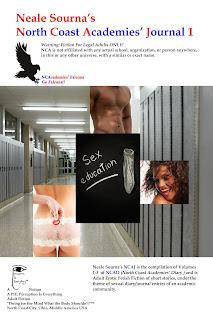
Neale Sourna's North Coast Academies' Diary (NCAD),Vol. 4, Issue 1 [Vol. 4.1]

ISSN 1553-8656
Volume: 4
Number: 1
Neale Sourna’s North Coast Academies’ Diary

Tad: The Switch-hitter, His Twink, and His Teacher--A Lust Novella (M/M/M)


[edit]

“Undress me, Thaddeus.”

Yes!! I screamed within me, because he likes us to be controlled and civil, if not fully civilized, in his presence; I merely nodded, and began.

He has a lean, tight body; well-muscled and fine, and he swims, in the school pool, in Speedos™ swim trunks, and thank God for that sopping, dripping wet, minimal bit of material over his big, fleshy cock and fine, muscular ass.

It’s his best outfit. Fucking yes! And I’m not the only one in school who knows so.
But, I can’t say how many times I’ve imagined nor dreamed of Dr. Hupper coming out of the pool, water streaming heavily down his lean-sculpted, brown body, to stand in front of me, pull his meaty cock out of his clinging wet trunks, and command me to kneel and put its spongy fat mushroom head, into my hot, wet mouth.

His wish is my great eagerness.

After I hungrily taste him my first time, he seizes me by the hair and pushes his full, rigid length down my stretched throat, into my guts.

Then, having had me that way, he’d make me turn around on all fours to present my ass to him, and he’d, with ruthless force, tug down my dressy school trousers—somehow I always have them on, not trunks, or just be naked; huh, the illogic of dreams and even of daydreams full of fucking weird subconscious and emotional subtext.

Dr. Hupper would piss on and into my hole, his lube of choice, and then penetrate me, spear my tan ass wide with his black cock, right there at poolside, as the swim team practices their laps, as he, literally, rides my ass, banging his heavy, great, black balls against my own tan ones, until we both cum to our destinations.
Fuck dreams, this is real.

Dr. Hupper was bare to his dark, six pack waist. He reached up and pushed down on my taller shoulder, a gesture I’ve used with Cassie and other lucky cocksuckers of all sexes and cock - in - ass holders, oh, so many times.

I kneeled my paler, naked self down before him, in this worshipful reality not a fucking, frustrating dream, and undid his trousers, sliding them down, anticipating the dual pleasures of seeing that monster completely undressed and close to my face, in clear light, without a desk over my head, and to palm my fairer-skinned hands over his hard buttocks and down his flat belly and hard thighs, pushing his pants all the way down, as his ass-busting monster sprung out from his deliciously musky and hairy balls to kiss me.

God, it was gorgeous and he smelled great, and sexy. He made my mouth water.

[edit]

Dr. Hupper pushed his body into mine, his fat cock pulsing hot and deep in me, bare and hard, like he was trying to shove his entire slim, dark-skinned, muscular body inside of mine, cock fucking first into my bowels, until they’d burst out my belly with him.

He felt so damn good, too, throbbing hard with the pulse of his heart, squirting and squirting more and more of his lust cream into the center of me, warming my belly from the nether end this time, as my ass sphincter grasped and sucked on him—-the best its ever tasted.

And I should know, that his cum’s the best; since I’ve tasted and swallowed belly’s full of distilled Dr. Hupper love juice—-quarts and quarts.

He loves seeing me do it, too.

Extra credit, under his desk, like a fucking cheap whore, in case the janitor or principal has something to say to him.

[edit]

He blinked at the closest wall mirror, while gazing at me from it, his angry features softening, as if the visual I’d mentioned—of him with me, while I’m with Quen—-had finally just materialized before his mind’s eye and the sensual possibilities of it....

“You and Quen?” He looked at me, directly. “You? Sandwiched? Between us?”

All right. He was intrigued. I went to him, on my knees on his bed, his toy boy, play toy begging Master’s great favor and condescending indulgence.

Iago couldn’t have done better to seduce Othello.

“Sir, I’ll fuck Quen like he’s a wet, horny bitch, which he is, jam it in his pink, puckered shithole, his virgin pink hole between those slim, tight white halves of asscheeks, and stretch him wide, bang the boy, hard tan scrotum to tender pink scrotum, like he’s dreamed it.

“I’ll pound him to jelly, sir, make him cry for joy for the rough trade, right in front of you, for your eyes and pleasure only. And I’ll jerk his rosy cock and balls, so hard, they’ll explode like shrapnel when he blows his load, when I finally permit him to blow his aching load, totally controlling him, like you control me, like you just did; but you’ll .”

He looked over my shoulder and I’m pretty certain he was gazing at my asscheeks still rosy from his pounding, still slick with ass love gel. He smiled just a bit, like he does in class, pleased—-I bet he was thinking that my bowels were filled with his cream, marking his territory inside me.

“You’d be fucking that sweet, young boy, and I’d be fucking you, my cock whore, deep, again, in that snug and willing young ass of yours.”

That’s what I wanted to hear. I waited. Bottoms wait all the time for their Tops to catch the infection of their Bottoms’ desires.

He gazed a long time into my hazel brown eyes, shining bright for him, and I didn’t stare him down nor look away, until he finally jerked his chin at me, a gesture anyone in his class knows well.

It means, “Proceed.”

[edit]

Not more than ten minutes passed before someone knocked softly at the back door, like a cat scratching to get in. I let Quen in; he was rosy red cold and shivering; I’d brought him along with me, since Dr. Hupper’s place was pretty far away from home.

The busses are irregular for most suburbs this late in the evening, and Quen doesn’t have transportation.

I’d left him a few blocks away for our mentor’s safety—-two pretty teen boys slipping into his back door at the same time? That just screams sex.

My inferior, my fellow classmate, slim Quen, warmed to the matter, instantly with delight, to see me so close, completely naked, and smelling of man sex, as I led him through the kitchen into the dining room.

His tight, faux leather pants tented, and then nearly ripped apart at his inseam and zipper when beautiful Dr. Hupper and his naked black rod came into view.

I petted and gently squeezed Quen’s eager offering-—but not too hard a squeeze, I didn’t want him shooting off just yet; especially, if his skinny jeans hid the rocket explosion from view.

I petted the boy all over his body, as I peeled his jacket and tight clothes off his slim body, for Dr. Hupper’s viewing, revealing Quen’s nearly completely untanned, hairless, white skin with the “girl pink” nipples, as we call his nibs in school, where some of the guys find his nipple color “disturbing.”

Oh, yeah, I think that’s pretty funny and indicative of some kind of fear of possible latent homosexuality or latent bisexuality or whatever.

Personally, I always thought his rather large aureoles looked tasty and something I’d love to jack cum on one day, if not today. This evening we had so much to do, in so little time.

I’d tugged down his skintight pants and undies, his white ass even whiter than the rest of his so damn white skin, then took the boy’s stiff pink love toy in hand.
It was already maddened to a soft purple.

And it would be clear to anyone, if they’d been in the room or just outside a window peering in through the heavy and drawn draperies, that nearly swooning Quen was “putty in my hand.”

Hard putty—-a generous amount of it, for such a little guy.

Dr. Hupper came to us and I released Quen and pushed him, stumbling with his clothes tripping him, to our teacher, who slid his large black hand down the boy’s white, hairless belly, the pale skin turning rosy red with easy lust wherever we touched.

Then, Dr. Hupper felt around Quen’s young and eager cock, without touching it, feeling the soft, but firm texture of Quen’s hairless nads, like sweet, young fruit about to give up its tasty juice to anyone lucky enough to take it in warm hand and exploring fingers, squeezing gently, to test its ripenes .

“Ah!” Quen stiffened more, the tension spreading to his body, as if he were about to cum, just from such brief contact with an older man’s hand, our professor’s gentle and black manly hand.

Ah, the power of imagination, anticipation, and desire.

“You’re killing Quen, sir.”

“He’ll rise again, for us, won’t you, sweet, young Quen?”

“Uh-huhn, yesss. Pleesh.”

Already Quen couldn’t talk, as I took a hand to him, too, stroking his rosy rod, as we men both tightened our ruthless grip on the boy, making him rise up on his sneakered toes, tight pants and undies around his calves and ankles, as he went ever more rigid all over, unti—.

[edit, tons more…]

22 horny chapters, 25,139 words total

***Back Issues of “Neale Sourna’s North Coast Academies’ Diary” [NCAD] http://north.neale-sourna.com

[22 horny chapters, 25,139 words]

Gorgeous, biracial rich kid, Tad, gets whoever he wants, male or female, and he has a relentless hard on for his English professor, Dr. Hupper, whose magnificent black cock Tad's stuffed down his eager, tan-white throat and given hand jobs; but, youngster Tad wants serious, naked alone time with his favorite teacher's ebony body.

While fellow student, Quen "the queen," a blonde twink, whose smooth and hairless, boy toy ass virginity is reserved for Top Tad. Bottom boy Quen's in love and dying to be his doormat and cum catcher.

So, do you think delicious Tad will get BOTH of his conquests in one room, in one bed, all completely naked, with himself sandwiched between his Quen's sweet bottom and that masterful black assbuster?

Oh, I know my greedy Switch boy Tad will.
-----------------------------
Mutual handjob masturbation, in classroom, with teacher, after school, with hidden classmate voyeur Quen the queen twink watching; mild humiliation, as a teen Top gives his teen Bottom final permission to whack off, then lick cum off the scuffed class floor-yuck!;

An invitation to a favorite professor's sex hideaway for a little fuck fun, with black cock in biracial (white / black) teen student's tan ass;

A surprise for teach is teen Top bringing his teen twink Bottom, who gets his first ass filling, sucks his Top's tan cock in front of prof and then gets to be bottom layer, on his back, of a three-way male sandwich of white bread ass, thick tan meat, and long, black cock.

Plenty of cocksucking, assfucking, ball banging, and squirting, creamy cum!

These naughty boys put on a great show and are insatiable, even when they're fucked red raw, they want more, in the shower, in the car home, in the garage with the Top, his Twink, and his hard cocked Top Twin.

Plus, a couple of hot, golden showers and a sexy real shower or two.

22 horny chapters, 25,139 words total
All On Sale NOW: MS Reader, Mobipocket / Kindle and other formats coming soon!

Friday, March 11, 2011

'Miral' director Julian Schnabel gets Film's R-rating Overturned

Mar 10 2011

MIRAL

Image Credit: Jose Haro

The MPAA has overturned their R-rating of Julian Schnabel’s March 25 film, Miral. The feature, which stars Freida Pinto and follows the real-life story of a Palestinian girl coping with war while growing up in East Jerusalem, was slapped with an R-rating for “violent content, including a sexual assault.”

Schnabel and producer Jon Kilik argued that younger generations should be able to see such a film about a teenager, particularly one dealing with such a serious issue.

The MPAA listened by changing the rating to PG-13.

“I understand the MPAA is by nature a protective organization, but I felt very strongly that they didn’t need to protect teenagers from my film,” Schnabel said in a press release obtained by EW. “Quite the contrary, teenagers are the intended audience for Miral’s story. I am very happy the MPAA proved to be open minded and ultimately agreed.”

Miral
is based on Rula Jebreal’s semi-autobiographical novel, also named Miral.

Sunday, October 24, 2010

A client's nonpayment is your gain.

Here's the first three (3) of five (5) short fiction titles I did for a client, who hasn't paid, so I'm publishing them to my sight as additive new title content. One day I'll expand them and print/ebook publish them.

http://stories.neale-sourna.com/TheFreelancer.html
NEW! The Freelancer

Annie’s new temp, Ryan, with the fascinating ass, is great at his job, on his first day, but he’s driving her to distraction. She can’t get anything done.

When Annie works late and alone, to catch up on work, gorgeous Ryan returns in order to show her what he’s really freelancing in. 1000 words

----
http://stories.neale-sourna.com/Rough-MeDotCom.html
NEW! Rough-Me Dot Com

Dot com queen, Lara, runs an internet site for rough sex. Her own boring romantic life has her observing the online site communications of a client, named Will. She makes contact with him, as Dennie, one of her aliases, who "works for her."

When he decides he wants to meet "Dennie" in person, Lara puts herself in the perilous position, because rough stud Will make break her company, break her, and bust her cunt to pieces. 1000 words

----
http://stories.neale-sourna.com/TangoWithMe.html
NEW! Tango With Me

Elaine left Cleveland for Buenos Aires, Argentina the home of sultry Argentine Tango to learn from the best—a man, named “K,” she’s only seen in shadow and smoke in a documentary.

He’s not the man on the screen, a fiction; this is a living, dangerous man of sensuality, and a bit of cruelty. So is the Tango he teaches her, until she’s ready and had enough of fiction and the push and shove of dance, to find herself exposed before all and doing the “Horizontal Mambo” upright. 998 words

Neale Sourna's Short and More Storygateway

Monday, November 23, 2009

From Gamasutra--Upping The Craft: Susan O'Connor On Games Writing

Upping The Craft: Susan O'Connor On Games Writing
By Christian Nutt

Veteran video game writer Susan O'Connor believes that there's a lot of room to improve the writing in games -- and she would know; she's been involved in many of the top projects in the industry, from both commercial success and narrative quality standpoints.

Epic's Gears of War takes (some perhaps deserved) dings for its storytelling, but Ubisoft Montreal's Far Cry 2, on the other hand, was experimental and deeply considered from a narrative standpoint -- and O'Connor worked on both games, as well as titles like 2K Boston/Australia's BioShock, which she won a Game Developers Choice Awards for co-writing in 2008.

In this interview with O'Connor , Gamasutra had a chance to discuss not just the intricacies of what game narrative is capable of, but exactly how development studios should handle working with a writer. What is the best possible process for delivering story that enhances the gameplay experience rather than simply interrupting it?

The following in-depth discussion considers both narrative "tricks" to engage the player, alongside the philosophy and craft of storytelling. It's intended to help spark some discussion of precisely what games and developers can, should, and will be doing in the future with regard to game narrative.

How did you get into games writing originally?

Susan O'Connor: Well, it was really through the back door. When I started I knew that I wanted to be -- the goal was -- to get a job being paid to be a writer. I knew from the age of four that I wanted to be a writer. Then I was like, "I don't understand how writers get paid. I can't connect the dots here." It was really confusing to me.

So, I started talking to people in all different areas and tried to decide if should relocate to Los Angeles or New York. What kind of writing? Playwriting? Do I want to do screenwriting? Television? Do I want to write haiku? Do I want to write crap like on the back of cereal boxes? It was like everything was on the table.

Then, I met somebody who worked at a studio here in [Austin] who made kids' games. At the time, just coincidentally, they were making a slumber party game for girls. There are these four little girl avatars that were on screen jibber-jabbering the whole time. So, they had this immense need for writing, which they never did for kids' games.

I was qualified because, A, I'm a girl, B, I'd been to slumber parties. I was an expert in this area. So, that's how I got started. There was so much work that needed to be done that they hired me on. I was like a writer/producer.

I did that for a few years. We're talking six to eight month production cycles, really for kiddos, really simple stuff. But it was great because it was a chance to make a lot of mistakes without a lot of people noticing. Kids are a very forgiving audience. You can screw up, and they don't get on the internet and go berserk [laughs], not when they're five.

It was really good. None of us had any experience making games. All the designers had architecture degrees. I had an art history and English degree. Nobody knew anything. We were all just a bunch of doofuses. There were experienced people at the time who worked in games, but we certainly weren't any of them. So, it was really fun.

It felt like college again, just sort of banging around and making a mess and learning some things and kind of getting some things done. [laughs] They're not award winning stuff, but in a way it was some of the best times I've had in games because it was really fun. I liked that. Anyway, that is how I got started.


Gears of War

Obviously all games have text in them, but there is still a sort of lag on the importance of having a dedicated writer in games, as a role. How do you get studios to take it seriously?

SO: Well, I think that it's tricky. In a way the pressure is on the writer to articulate what it is that they do. In a way one, of the problems can be that you treat it like a black art. I'm just going to go into a room and shut the door. Six months later I'm going to open the door and, "Wham! Check it out! Here is a story."

I think that it really helps if you can talk to people who aren't writers about the writing process in a way that not only do they understand, but it interests them. That is, I think, a huge barrier to appreciating it.

It's really analogous to design. It also sort of gets pulled out of the ether, but there are enough designers in this industry that there is an acknowledgement that that is a craft worth practicing. There are not many writers in the industry, so we don't get that sense of legitimacy.

You can look around and say, "Well, there are 47 million designers. There must be something to this design stuff." It's not just that you are making up stuff. There is actually a methodology.

There is one for writing, as well. It's a bit softer than design. You're trying to work more on the right side of the brain than the left, but I think it really helps if you can work with teams and help every step of the way articulating what it is that you do and how it can help them. How you can take what they're doing and run it through this writing prism.

Usually, what tends to happen is that at the end of games, they say, "Gosh, we wish we'd hired writers sooner." Yes! That is correct! But that is starting to get better. The game I just finished, I came on at the last minute, which is rough. But the game I am about to start, I am coming on at the very beginning. So, that is really starting to change.

I guess your question was, "How do you make that transition?" I think that anyone who writes anything good helps other people. It just helps me as a writer if someone else writes a great game. Look, they did it. How did they do it? Well, they spent a long time on that project.

Valve's got a great process. They run through it. They iterate like crazy on stuff. They throw stuff away when it doesn't work. They find ways to rapidly prototype. I think everything else in games gets iterated a gazillion bazillion times. When I look at these poor level designers and how much of their work gets thrown away, it's heartbreaking. But, it's what you have to do to get a piece of art finished.

It's the same with writing. Once people make that connection, "Oh, good stuff takes time. If I want the writing to be good, I'll have to invest some time in it."

I get the impression that people think that with writing -- maybe you don't have the same opinion -- you sit down and you write the whole thing in order from top to bottom. Then you're done. I think people even think that novels are written from page one through page 300, just linear and then it's done. It is really not true.

SO: I don't think that is true. I've heard stories that there are writers like that in the world, but I have never met one. I've never met someone who works that way. I'm not. I'm totally all over the place. I'm the queen of the four-by-six index cards and the push pins.

Every writer seems to have a different process, but especially with games, it's not possible.

You want to experience the story and there is going to be a beginning, middle, and end to it. But how it gets told in the game, when the ground keeps shifting beneath you, I think having a nonlinear approach to writing is really helpful when you're trying to integrate it with game design. You've got to be willing to let go of stuff all the time, but somehow be able to hang onto some skeleton, some thread.

When I work on stories, I try to just get down to the absolute, the most bare bones concept you're trying to get across. That is what has to get protected. The story has some meaning; everything else is up for grabs.

That one core bit has to stay in place, otherwise you have a meaningless story. That happens in games. You're like, "I care, why?" [laughs] when you are playing the game.

One issue is when the writer gets brought in late and there are already a whole bunch of levels that are well into production. You have to go, "How can I contextualize these?" Do you run into that a lot?

SO: Yeah, that can definitely happen. Sometimes it falls into place, and sometimes it doesn't. That's a good question. Like on Far Cry 2, there wasn't so much of an issue because they had an overarching structure for the whole thing. In a way it was designed to be more sandbox than freeform. But other games they are. Each level has its own distinct personality.

I worked with this guy Danny Manley, who was a writer on one of my recent projects. He's a playwright from New York. I love working with him, he's so great. He thought about each level as having its own little short story, which I think is correct. The overarching story had to be an anthology that held it all together somehow.

So, I think in terms of how you tie everything together, it seems that most of the time the best bet is to use a really light touch. You have to do a bit of hand waving. If you really try to get to get literal with it, then people are like, "What? That doesn't make any sense," which is always a danger in game writing. At some point, it doesn't make any sense. That's right. [laughs]

People have been experimenting with structure. Some games more explicitly deal with this, but the concept is that each one is like an episode. It has its own little self-contained story arc in each chunk of the game.

I think that, certainly, if you're dealing with a development where you're going to get or lose pieces or shift things around or whatever, that is obviously beneficial. It's practical. But do you think that's a good way to work, or do you think that you'd rather plot it all out as best as possible?

SO: Well, that's a good question. I don't know. I mean every project is different. This is a copout answer. I don't mean to give you a copout answer.

It's true; sometimes episodic is the way to go. Sometimes having one driving narrative is the way to go, like God of War. That's right. I love that game. I talk about it a lot. I really do think it worked. It was just deceptively simple.

I think there's a lot to be said for keeping the content of the story really simple while trying to make the emotions complex, like not asking people to remember a lot. People are like, "Okay, I get it. I need to go kill the God of War. Right. I got it." or, "I need to save the princess."

You just don't know how much player... Ken Levine called it "player RAM". How protective do you have to be of that? They only have so much room in their head, in their brain, to hold things.

How often do you have to get them synced back up again? Keeping the content simple and the emotional subtext complex, for me as a writer, is the goal, so that you don't get this wall of words when you play a game. You get a simple story that resonates with you and sticks with you.


BioShock

As regards that, something else he talked about is how they cut a lot of characters from BioShock 1. They took the original ideas, and they condensed them down into way fewer characters. "How can we make these four characters, their story functions, descend into one character?" Ultimately, people on the creative side don't always realize what people are actually capable of following and what they're actually interested in following.

SO: Yes, I know. It's funny because you live with this stuff day and night, and you can recite it all verbatim. It's really easy for me, or for anyone, to forget that when you're playing the game, it's just washing over you. People who work on movies kill themselves, but people watching movies tend to just kick back. It's the same with games.

Just trying to find what's going to stick with the player and really playing to that, instead of giving them a massive dose of stuff and trying to make something epic that then becomes noise, none of which goes through.

If you talk to different people, you get very different approaches on what even game narratives should be. Even games you've worked on, from game to game to game, like Gears of War.

Obviously, it has a very straightforward narrative presentation. It's basically cutscene, mission, cutscene, mission, and then the barks are character-building, but they don't really contain much narrative, everything from just "Shit, yeah!" to a little bit more than that. It's basically about adding tone.

BioShock doesn't stop for cutscenes. There are character interactions, but there are a lot of the recordings that you find. And then you've got Far Cry 2, which is an open world game. It's all different.

SO: I think on Far Cry 2, they tried some really great stuff. One of the things I really loved... They had a narrative designer on that game, Patrick Redding, who's just unbelievable. How does this man's mind work so fast? It's ridiculous.

He and [creative director] Clint [Hocking] really had some smart ideas about trying to change the way we tell stories in games. They developed incredibly complex systems, which I cannot do justice to.

I can give a really simple example. One of the things I really loved was how they talked about... You have one triangle this way and one triangle that way. You can imagine a Star of David, basically, and then you bisect it twice.

The triangle that's going this way is gameplay information, tons at the beginning and very little at the bottom. The opposite is story information. You've got two lines running through it, right?

So when you walk up to an NPC, you're at the top end of the gameplay triangle. He'll say, "Go across the hill. Go in the hut. Shoot the dude." End, right? You've got almost no story there. You've got tons of mechanics. For players who are interested in just that, that's all you needed to know and you could walk away. If you stay and you hit X, then the next thing he says is going to be equal amount of gameplay and story information.


Far Cry 2

So you've got sort of the inverted pyramid, which is how you write news stories. And then on top of that you have the... I've never heard of the "right side up pyramid", but that's how it is.

SO: Yes, so the first, the middle part of that triangle would be like, "Grab the ledger. It's got all the bribes," you know what I mean? So like there's an equal amount of mechanics and meaning. And if you stick around again, what he says is all story. Like, "I don't give a shit if he's my brother, kill him anyway."

And because it's a pull model, the player asked for it, then that is the story he wanted to hear. That's the biggest challenge for games stories. How do you tell it to them when they want to hear it in a way that means something to them? That's huge.

I've been doing a lot of thinking about cutscene-based narrative, because initially when I started going to conferences, I started to hear people say, "Cutscenes suck. Don't use them." I would always go, "But they don't always suck. Sometimes they are good, actually."

Originally, my first thought was then like, "Well, some games just have bad cutscenes. Some have good cutscenes." It's not that simple, either. It's also about pacing. Pacing is probably even more important. Quality is important, but pacing is super important.

SO: Yeah, I totally agree. Yeah, absolutely. And that involves so much more than the writer. That's why it's really great to have an opportunity to have the writer working with the team for an extended period of time. They don't have to be staffers, but just have them around.

First of all, I think it really helps to have a sense of trust with each other. A sense of respect for what the other person brings to the table. When I work with a designer who I really come to really respect and admire, I just want to know what he thinks about things. And we can talk back and forth.

If I can get their respect as well, then you can really do some great stuff together. And you can think about things like pacing, and "How are we going to integrate?" and "What kind of gameplay experience are we talking about having here?"

Is this the level where we take a deep breath, because the story went nuts in the last level? What do we do here? The last level was a flight of fancy -- so are we getting more into reality, with cold water in the face? Because we're almost at the end, and it's like, "Let's get this done"?

And then we can start to get a sense of momentum, how the designer wants to drive the car. And then how you can build a story to really enhance that. And sometimes, in counterpoint to that. What experience is he trying to create, and then, how can I expand on that, make it more meaningful?

When it comes to team structures, you referred to Ubisoft Montreal, where Patrick Redding is a narrative designer. In this structure, he interfaces with the writers and flows the content to the designers. Do you think it's important to have a narrative designer at that nexus point that can interface with the team and manage that process?

SO: Yeah. Yeah, I think so. I think you can have a narrative designer that is more involved with the systems design -- that's huge, especially when you are talking about a game that is as big as Far Cry 2. They can really get immersed in the technical side of things, then translate it back to the writer, and vice versa. It's literally like having a U.N. simultaneous translator. [laughs] I think that's what a narrative designer can be.

Or even just having an editor, who has the band width in their brain to actually go and talk to level designers about the levels, while the writer is in his room sort of noodling on a character. I've worked on projects like that as well and it's great. It's great to be the writer in that position and it's great to be the editor in that position.

Because I think what writers need is a combination of really being integrated with the team, right? Like, that's part of it. The other part of it, is you just sort of need space to do your work. And those don't always work together, because most people on the team are not writers.

So if you sit down and you're like, "I want to talk about writing with you all!" It quickly becomes about programming or about design or about what their expertise is, because that's what they have to offer. It would be as if one level designer walked into a room of writers and want to talk about level design, like how long would you stay on topic?

You wouldn't, because before you know, you would be talking about some HBO show. You would be talking shit about Dexter, because that is what the writers would be interested in. And the level designer is like, "Uh, well guys, you know I got a map here I want to draw." "Dexter is awesome!"

And so, as a writer, how do you find a way to carve out the time and space you need to do your work so you have something good to share with everybody, and also have that work fit with what everyone else is doing.

So to answer your point, I think having a narrative designer, or an editor, or somebody is key. I mean that is it. Because when you try to be both, you fail at both. That has been my experience.

Yeah. I mean it seems to me that it takes a lot of time, and polish, and time to rework bits of writing. And that seems to fall out of the possibility with the way a lot of teams have structured it. "Writing is what we will do when we have time to do it," rather than making time for someone to spend time writing.

SO: Yeah, I know. Yeah, that is true. And I don't think it is willful like, "Screw it." I think it is like, "I got a million things I got to do, so I am going to have to prioritize. I know I need programming. I know I need art."

Someone who is the boss is going to have to be the one to say, "I am going to make writing a priority. We are going to make this happen." Because I do think that... Well for one thing, creating a meaningful story, it takes just as long to get to know fake people as it takes to get to know real people. You [as a writer] really have to spend time with your characters to get to know them.

And it takes time for a story to come to life. It is easy to come up with a clichéd, dumb story. It doesn't take a lot of time. But to make something really like, "My God!" it takes time. And frankly, I think it takes as long to develop a good story for a game as it does to create a good design for a game.

I mean, to me, that is the metric. If it takes two years to do that game design, then you need a writer at least involved in the process. Maybe not on site, but coming in and out those full two years. You know?

Because yeah, waiting to the end is nuts. I think that writers... You get the biggest bang for your buck from your writer if you bring them in right away, for a couple of reasons. One, they have more time to sort of do their work. And they have an opportunity to fail, too. They get to try things, be experimental. Whereas if you come in with like a month to go, they want you to hit the target right away.

So what you do in order to hit a target? You play it really conservative. You don't try anything crazy. So even though what you make is serviceable, it is not great. And sometimes you want to do something great. Every writer wants to do something great. Why else would we do this?

Bringing a writer in early, it gives them a chance to be experimental and play with the story and play with what is possible, because this is a medium where we haven't discovered the full vocabulary yet for telling stories in games. We know a few things that work, but there are probably like 20 more things that would work great. We just haven't had a chance to try them yet, because we don't have a chance to experiment.

So there is that side of it, and there is also this side of getting all the other people on the team feeling like they are part of the storytelling process as well. I mean, not everyone is a trained writer, but everybody understands a good story and everyone wants to create a great experience for the player. So if the writer comes on early, he or she can help give tools to the whole team, to create like a back-and-forth exchange between the game design, the art, and the writing and everything. But that just takes time, right? You've got to trust.

You have to build relationships with the team.

SO: You've got to know who you can jive with and who you can just be like, "Dude, come on. Let's just shut the door for a second and let's talk about this." You know?

See, that is why I think it must be hard to really influence the way things are going if you are working externally. I know you move from project to project and you frequently work externally. But sometimes, you spend time at a studio. How does that work? What do you see as the optimal way to go?

SO: Well, I worked on a project that was unbelievable. Oh my God. I loved it. It was partly chemistry. I just really got along with everyone. And that game got cancelled. And I was like... "Print that out." It was like my absolutely all time favorite game. Cancelled!

But I worked with a designer. His name was Pete Low. He was up at Radical. It wasn't like a showstopper, like the world is waiting for it, game, necessarily, but it just worked brilliantly. It was so successful, I thought. And everyone on the team thought so as well.

We got far enough along in the process that the whole story was done and the script was finished. And the cinematics were being made. And everything was sort of integrated, so we could see what we had done. We all felt good about it, which is unheard of, because everyone in games is so critical.

But we were all like, "I think this might be awesome!" And I think it was really successful because I came on early and Pete really set the tone for trying things. He was very accepting. Like, "Yes, let's try that. Let's see how that works."

And we were able to come up with a process where we would take turns. I would spend some time, come up with my story ideas, and then I would present them. And then they would go away and they would come up with some gameplay concepts and come back. And then I would take it. And we would just do this back and forth for a while.

And it was a huge eye opener for me. I mean I had worked on loads of games up to that point. But that process taught me more about what was possible in a game and what wasn't, and how a game designer looked at a story. I could suddenly see my work through their eyes, which was like, "Whoa," and vice versa.

I remember one day having a discussion about the character and how he was going to change at the end. He was going to have a moment of truth. It was going to be like, "What you do in this final moment is going to be who you are," I was like, well, it's because he's a bad guy. And they were like, "What? He is a good guy! What are you talking about?" I am like, "No. He is a bad guy."

Then we had this great discussion about who we thought this guy was, which I thought was so great because we were still getting to know him. It is like we all had different relationships with this guy. And then we all started thinking about how the player would feel about that. "What if he is bad?"


Gears of War

A lot of times when you play a game and you pull back a level, you realize that these characters are the protagonists, but they are not necessarily good people, or doing good things. Usually the ultimate goal is basically good. But they are just sort of running around killing a lot of people in a borderline amoral way.

So when you sort of pull back a level and you think about this on a higher level, then there is more ambiguity. The game situations and the way you actually participate in the game can affect your interpretation of the story naturalistically, but not in a way that is deliberately written.

SO: Exactly. I agree. And that is why I think having a writer in is so helpful, because I think bringing in more ambiguity is great. Like just have things happen and don't explain it. To me, I respond to that as a player, because then I get really intrigued by it. I am not being told what to think; I am just being shown a world. I am being asked to enter a world.

And I think that is the stuff I would love to see more of. And even structurally. Like, whose story is it? Is it the player's story, or is the player going to tell his own story no matter what you do? Why even fight it? Why not let the player tell his story? Screw it! The protagonist is really going to be this NPC. And since you are trying to beat the game as the player, then maybe you are the antagonist.

And maybe what you do really foils the protagonist. We are all protagonists of our own stories. Satan is the hero of his own story! No one thinks of themselves as bad, is my point. And so if you let the player be the hero of his own story...

I just think we have a lot of different ways to think about the antagonist. An antagonist of a story isn't always the bad one. That's what's interesting too. If you get two people operating in shades of gray...

Sure. It's perspectives, right?

SO: Exactly.

Very often I think that stories -- and it's not just in games, but stories in all popular media -- boil down way too far, and that bores me a great deal.

Obviously, something like Star Wars that is bright white versus pitch black, is super popular; it's not like it's not understandable why people like it like that. But I think that very few stories are honestly doing the bright white versus pitch black thing. So, if you're trying to do something with a little more texture, it should be a little less binary.

SO: Yeah, I agree. You know, it's hard to tell a good story in any medium. If it was easy, every movie would be great; every book would be awesome. It's tough. It's tough to find a good story and then tell it well, especially in games, and I think the trick is just having lots of time to get it right.

I think the ones that have been the most successful have been the ones that have really had the chance to learn from their mistakes during production, instead of shipping something that was a mistake.

I think that a lot of games that I play have bad stories. In the end, it might still be bad, but what's really bothersome to me is not so much that like the story is dumb; it's that it lacks craft. You can tell there weren't many drafts of the dialogue, or it's just jammed together. Just stuff like that. That's what I think is missing actually, is craft.

SO: Well, right. And it's funny. As a writer, you have to find the nerve; you have to steel yourself to sound like a total geek in these meetings. You can talk about exposition and rising action, and all these English terms, that really have to get applied to create great stuff.

You can definitely just write, just [makes quick gibberish noises], but to apply a certain craft to it and structural underpinnings to it, so it works for reasons you don't really see; you're not supposed to see it. It's the scaffolding and it's the foundation and it's the lode-bearing walls. All you know is that the room is bright and sunny. You don't have to think about how they get the windows in. That's the builder's job, right?

I try to take a similar craftsman approach to the work that I do, because I've made that mistake myself. I'm just like, "Well, I'll just write some stuff, and it'll work itself out." No, it's crap. "Why was that crap? I need to learn from that."

And so you're like, "I think I'm not taking craft as seriously as I should be." Because, again, you're not surrounded by other writers, so you don't talk shop very much, right? That's one of the reasons I even started this Game Writers Conference [at GDC Austin]. I wanted to be able to talk to my colleagues about stuff that they would take the ball and run with it.

I think one of the important things about writing is what you leave out. I think that's something that people cannot perceive easily, if you don't know about writing.

SO: Totally agree.

I think people are tempted, if they're not experienced, to just keep shoving things into the narrative. And what you leave out, it could be like what we're talking about with Ken Levine condensing characters, or it can be like, "What does this scene do? Nothing."

SO: Yeah, I think that's right. Especially with games. Because you're building around a void, which is the player. You've got to leave space for the player to insert himself or herself, because they're going to do it anyway. Why fight it, if they're going to take it and make it their own?

And creating a structure that allows that, I think, is really huge. And looking at structure, and finding ways to protect the story from the player. Things like inciting incidents, like "When does the story really start? When does the world get turned upside down?" I think, personally, looking at stories, you really have to have it happen before the game begins. If you do 20 minutes where you're doing your thing, and then suddenly something changed, it wouldn't traumatize you.

You wouldn't be motivated to make it go back the way it was. You'd be like, "Oh, cool, right on. I'm underwater. This is great." Or like, "I'm a bat, sure", you know what I mean? Whereas in a movie, they do that very thing.

Starting in medias res is popular in movies, but usually games are like, "Well, we need to do the tutorial first" or whatever. I've brought this up with other people who work in games before.

I felt like Final Fantasy VII had a really strong start. You know you're going to go blow up the Mako reactor, and then escape. And you go through that part and play the game and it's very easy, and it tells you how to play it, and then it stops. That's like 45 minutes or a half an hour. Then the game grinds to a halt, and starts like a normal game, and it's slow.

But the thing is, you're pretty interested because you had that episode of high-intensity gameplay-focused narrative. The game has built up this good will with you as a player, and then it can slow down again. That's such a really good trick. Tricks like that, I think, are important.

SO: Me too. Did you see Up? I thought, in Up, the story with the wife, not having children, blah blah blah, never living her dreams, was so devastating.

It was the best part of the movie, though.

SO: It was. It was so impactful, so powerful, I think it pinned all the adults in the audience to their seats, because they had to process that. And then, while the adults are stunned, and letting it in and having no influence on what they just saw, the kid story starts. It's like, "Whee, fun!", and it's stuff that normally would have bored an adult. They're too stunned to be bored. They needed that time. The adults needed the time to gather themselves. I had that experience when I watched.

Yeah, it was a very elegant part of the film, really elegant filmmaking.

SO: Gorgeous.

Honestly, I don't think the rest of the film is anywhere near as good as first 15 minutes.

SO: But yes, I think you're totally right. Tricks like that, and just thinking about stuff structurally. And knowing that everything in the game is totally and completely made up -- I would love for us to free ourselves more and not be trying to create hyperrealistic situations, or treat stories as though they're hyperrealistic -- as if they're documentaries? Why? That bullshit is all made up!

I think the characters have to be realistic, but the situations don't have to be realistic at all.

SO: And the structure doesn't have to be realistic. It is not a documentary. You don't have to turn a camera on. Let's speed this up; let's do backwards, Where is the Memento? Where is the game version of Memento? Why don't you mess with us a little bit more? This isn't reality! Tell us at the end of the game that I was 50 feet tall. Reality is really overrated. Let's make it up, here.

That's easy to say. Production realities are crazy. Trying to get a bunch of people on board is crazy. It's hard work. You want to be able to tell a story internally that everybody can understand and get behind.

Return to the full version of this article with comments

Copyright © 2009 Think Services