Showing posts with label diana gabaldon. Show all posts

Tuesday, August 26, 2014

5 Things Outlander Teaches Authors About Persevering Posted by Arthur Gutch on Tue, Aug 26, 2014

http://blog.infinitypublishing.com/bloginfinitypublishingcom/bid/207609/5-things-outlander-teaches-authors-about-persevering?source=Blog_Email_[5%20Things%20Outlander%20T]

When it was first published in 1991, Outlander became a worldwide best seller. This romantic tale of a woman who fell through time and the Scotsman she falls in love with is filled with authentic details of 18th century Highland life. Fans have followed the pair and their lives for well over 20 years, devouring each new book in the series as it's published.
Author Outlander Persevere

The story of Claire and Jamie is one of perseverance. As a modern woman and a distinctly traditional man, they aren't exactly a perfect match. But their love is stronger than any forces that may stand in the way of their happiness.

Whatever life throws at them, Jamie and Claire never give up, stubbornly standing until they reach their goals. Writers have a lot to learn from Claire and Jamie, and some of the most important lessons have to do with sticking to their goals, or perseverance.

Hit the Ground Running

You've got a goal, so gather yourself up and start strong. Claire lands on the ground in the middle of a battle, and literally is running for her life within two minutes. You may not be in danger of being shot by a Redcoat, but a strong start will give your day energy that can help push you closer to your goal.

Accept the Inevitable

The only way Claire can escape the clutches of the evil Black Jack Randall is by marrying Jamie, so she accepts her fate and deals with it. When your job changes and you have fewer hours to write, when your children get out of school for summer, when something happens to your writing situation that you simply can't change, accept the inevitable. And then do what you can to adjust your work around it.

Use Your Knowledge

Claire finds herself living in a castle and has to do something to prove herself useful. She uses her hobby of learning about plants to transform herself into an herb women: someone who can doctor people with medicinal herbs. Use your own knowledge when you need to get through tough parts of your book.

Is your character being chased? Does she have a difficult decision to make? Add a scene or two that only you could write with your own particular knowledge. You'll add a touch of authenticity to the book, as well as getting through a tough scene that was stuck in place.

Learn to Adapt

Claire learns to live 200 years in the past by adjusting and adapting her actions to fit in. She uses her knowledge and skills in ways that would seem natural in the 18th century, and she learns to enjoy the life she's created. You can adapt your lifestyle to accommodate working toward your goal by changing your schedule, changing your favorite hobby from television watching to writing, and even taking advantage of small breaks to get in 100 words at a time.

Never Give Up Your Goal

Claire falls back through time at the end of the first book and comes back to modern life. The second book opens 20 years later with her putting her plans into place to go back to find Jamie again.

In the years between the two books, she's given birth and raised Jamie's daughter. She waited until the daughter was grown before acting, but she never gave up her goal of moving back through time and reuniting with her one true love.

Keep your determination just as strong. If you have to write your book 100 words at a time, that's what you have to do. Life is never perfect, and every project gets hit with at least one or two bumps. Keep your goal in mind every day and you'll eventually reach the finish line, those lovely words: The End.
 
Keep the Faith and may the Force be with You!

Sunday, March 09, 2014

26 Years Ago Today… Posted on March 06, 2014 1:24 PM

http://www.dianagabaldon.com/2014/03/26-years-ago-today/

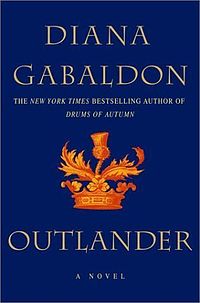
Outlander blue cover
I get the occasional question as to how I came to write OUTLANDER, and given that today is the 26th anniversary of my doing so, thought I’d maybe post this explanatory message—which I wrote a few years ago in thanks to the Compuserve folk who Witnessed the Creation , now updated.

Dear All–

On March 6, 1988, I started writing a novel. I wasn’t going to tell anyone what I was doing, let alone ever try to publish it. I just wanted to learn how to write a novel, and had concluded—having written All Kinds of nonfiction at that point—that the only way to do that was actually to write one. (I was not, btw, wrong in this assumption.)

Now, as a (rather convoluted) side-effect of my day-job, I’d become an “expert” in scientific computation (really easy to be an expert, if there are only six people in the world who do what you do, and that was my position, back in the early ’80′s), and as an even weirder side-effect of that, I became a member of the Compuserve Books and Writers Community (then called the Literary Forum), somewhere in late 1986.

Well, when I decided to learn to write a novel by writing one, I also decided a few other things:

1) I wouldn’t tell anyone what I was doing. Aside from the feeling of sheer effrontery involved in doing so, I didn’t want a lot of people telling me their opinions of what I should be doing, before I’d had a chance to figure things out for myself (as I said, I’d written a lot of non-fiction to this point, and nobody told me how). Also didn’t want a lot of busybodies (in my personal life) putting in their two cents, asking when I’d be done, and when it would be published, etc.—since I had no idea whether I could even finish a book.

2) I would finish the book. No matter how bad I thought it was, I wouldn’t just stop and abandon the effort. I needed to know what it took, in terms of daily discipline, mental commitment, etc. to write something like a novel. (I had written long things before—a 400-page doctoral dissertation entitled “Nest Site Selection in the Pinyon Jay, Gymnorhinus cyanocephalus,” (or, as my husband says, “Why birds build nests where they do, and who cares anyway?”), an 800-page monograph on “The Dietary Habits of the Birds of the Colorado River Valley,” etc.—but I’d never written fiction, other than lame short stories for English classes.) And

3) I’d do the absolute best that I could with the writing, every day. Even though this was a practice book that I’d never show anybody, it didn’t matter. If I wasn’t trying my best, how would I ever know if I was any good, and more importantly, how would I get better?
 
(In this regard, I had some evidence to go on. I’ve read all my life—hugely—and noticed that in most cases, while I’d enjoy all of an author’s books, including the first one, the books got noticeably better as the writer kept on writing. So, I concluded, with perfect logic, writing was like ballet dancing or piano-playing; if you practiced, you got better at it. I was not wrong in this conclusion, either.)

So, anyway, the book I wrote for practice was OUTLANDER, and here we are, 26 years and (almost) 14 books later. I just wanted to acknowledge the role of the Forum and my friends there, in that process.

How did that work, since I’d decided not to tell anybody what I was doing? Well, I stuck to that decision (I didn’t even tell my husband), but about six months into the writing, I was logging on intermittently late at night, picking up messages and posting replies—and found that I was having a argument with a gentleman (named Bill Garland, RIP) about what it feels like to be pregnant.

“Oh, I know what that feels like,” Bill assured me. “My wife’s had three children!” [pause here to allow the ladies to roll on the floor for a moment]

“Yeah, right,” I said. “_I’ve_ had three children, buster.”

So he asked me to describe what that was like.

Rather than try to cram such a description into a thirty-line message slot (all we had back in the old 300-baud dial-up days), I said, “Tell you what—I have this…piece…in which a young woman tells her brother what it’s like to be pregnant. I’ll put it in the data library for you.”

So—with trembling hands and pounding heart—I posted a small chunk (three or four pages, as I recall) of the book I was calling CROSS STITCH. And people liked it. They commented on it. They wanted to see more!

Aside from a few private moments associated with my husband and the birth of my children, this was the most ecstatic experience I’d ever had. And so, still trembling every time I posted something, I—very slowly—began to put up more.

 Now, I don’t write with an outline, and I don’t write in a straight line, so my chunks weren’t chapters, weren’t contiguous, and generally weren’t connected to anything else. 

But they did have the same characters –and people liked those characters.

There were (and are) a lot of very kind and encouraging people who inhabited the Forum—some of them still there: Alex, Janet, Margaret, Marte… and many who aren’t, like Karen Pershing and John Kruszka (RIP), Mac Beckett, Michael Lee West–and Jerry O’Neill, whom I count as my First Fan and head cheerleader; always there to read what I posted and say the most wonderful things about it, one of the kindest people I’ve ever known.

So, over the course of the next year or so, these people kept egging me on. Asking questions, making comments*, urging me—eventually—to try to publish This Thing (it started out as a perfectly straight-forward historical novel, but then Things Happened, and what with the time-travel and the Loch Ness monster and all, I had no idea what it was).

*(Just to clarify—these were not critiques, just interested comments. I’ve never had a critique group nor ever would; nothing against them at all—I just don’t work that way. But regardless, I’d never put up _anything_ for public viewing that I didn’t think was completely ready for human consumption.)

Some of these people were published authors themselves and very kindly shared their own stories, and advice regarding literary agents and the publishing process (thank you, Mike Resnick, and Judy McNaught!), and in the fullness of time, John Stith very kindly introduced me to his own agent—who took me on, on the basis of an unfinished first novel. 

And…I finished it, to the supportive cheers of the Forum. A couple of weeks later, my agent sold it, as part of a three-book contract, to Delacorte, and bing!—I was a novelist.
Not saying I’d never have written a book without y’all—but man, you guys _helped_. 

Thank you!
–Diana

====
I avoided this book until its siren’s call said, Really, just read a few pages, then buy me and read me in full. Did, and have been in love ever since.

There’s more to how she did it. Search online about Jamie Fraser and his inspiration and connection to Doctor Who.

_NS

Wednesday, June 05, 2013

‘Outlander’ Greenlighted To Series By Starz Deadline.com By NELLIE ANDREEVA | Deadline.com – Sat, Jun 1, 2013


I’ve learned that Starz has given a series order to Outlander, a drama based on Diana Gabaldon’s bestselling fantasy/romance/adventure series of books. 

I hear the project, from Battlestar Galactica developer Ron Moore and Sony Pictures TV, has received a 16-episode order, with production slated to begin in October in Scotland where the books are set. I hear Gabaldon let the news of the greenlight slip at Book Expo America 2013. 

The news comes a month after Outlander opened a writers room, with Moore hiring four scribes to work with him — Toni Graphia, Matt Roberts, Ira Behr and Anne Kenney. This marks Sony’s first series for Starz.

Outlander spans the genres of romance, science fiction, history, and adventure. It follows Claire, a married WWII combat nurse, who mistakenly steps back in time to year 1743 where she is immediately thrown into an unknown world of adventure that sends her on the run and threatens her life. 

When Claire is forced to marry Jamie, a chivalrous and romantic young Scottish warrior, it ignites a passionate affair that tears Claire’s heart between two vastly different men in two irreconcilable lives. 

The seven-book series has sold over 20 million copies. An eighth novel is slated to come out this fall. The books have developed passionate fan following, with multiple companies running “Jamie and Claire” tours of Scotland, where they visit locations from the books.


Related stories

Wednesday, May 19, 2010

RE: A Cautionary Tale for the Aspiring Novelist From: warrenadler.com

A Cautionary Tale for the Aspiring Novelist
From: warrenadler.com | May 17, 2010

It has always been difficult for an aspiring novelist to get published by a traditional publisher. By novelist, I mean those who write mainstream novels that do not fall into any genre slot. The revolution in publishing and the b... Read more at warrenadler.com

================================
Traditional publishing is lost, at present. Change is already here, and NYC and other trad publishing centers are cranking boring and poorly executed materials: no proofing, no sense, no drama, bad continuity.

In fiction and nonfiction.

Author publishers can have these errors, too, but they, we, don't claim to be the great leaders, while yet lost, following a form that no longer suits the day, nor can be maintained, as they lay off and fire those who can proof, and find sense, and encourage drama, and notice the gaps of continuity.

The 1930s are over, but the traditional goals of that day are still here, dragging, dragging, dragging.

I make more sales with ebook fiction than paperbacks of the same. I write materials that have too many multi-ethnic characters, too much sex, and characters who are too deeply layered.

Well, I like character. My friends and family have deeply layered characters. I like sex, whether its in action or merely thought. And most everyone else does, too, although they pretend otherwise. I rather have my characters have character-driven sexual action than murder after graphic murder.

But that makes me in my own niche triangulated between Zane and D. Gabaldon and E. Bronte. They don't know what to do with people like us, who aren't writing stereotypes.

Plus, few trads let you have control of your covers, your full story text, its layout style, and like eighty-ninety percent of the income your work generates; the rest folding back into software, marketing, etc.

The trads can give you a huge push, but they also can pull you out of the bookstore and make your book disappear all in the same year, because they have someone else's book product to move. I've seen that.

Is that worth it?

"Eragon," I'm told, was author published, if that's true, that's good. A long shot but a hit just the same.

And plenty of authors who've gone the trad route are generally "unknown" names. Not to be rude but I've heard of the "War of the Roses," but not your name, Warren. But, now I do. Most don't put themselves out there, like S. J. Cannell and J. Patterson.

But what, to me is most important is to it, those of us who actually write, who actually complete a book, and edit it until it gleams like fine silk, and publish it into the minds of world get paid, by income and requests for "more...."

Most actors and musicians don't make enough to live off, perhaps, writers should understand that most of us fall into that, as well. But, while others have steadier incomes, they'll never be able to do what we do, or get into the innermost feelings of others as we do.

--Neale Sourna at LinkedIn, Affiliated Authors

Thursday, October 09, 2008

Best selling author on length/process to physical publishing.

http://www.dianagabaldon.com/

Diana Gabaldon is the New York Times best-selling author of the Outlander series, which tells the story of Jamie Fraser, a Scottish Highlander from the 18th century, and his time-traveling wife, Claire. The latest book in the series, A Breath of Snow and Ashes, is available everywhere.

Excerpted From Diana Gabaldon site letter:

OK, -- on to An Echo in the Bone, which is probably what most people want to know about.

1) An Echo in the Bone is the seventh volume in the main Outlander series.

2) An Echo in the Bone is not the last book in this series!!

3) I am still writing An Echo in the Bone!!!

A) I get a certain amount of idiotic email accusing me of having already finished the book, but “hiding” it from the readers, or keeping it off the market “just to be mean” or (of all insane notions) “to drive the price up.” (It ain’t pork bellies, people; the cover price is the same whenever it comes out, and I don’t set it.) I don’t mean to be impolite here, but…geez, guys.

i) Look. Books are

a) written in order to be read, and

b) published in order to make money.

ii) Publishers do not make money from books that are not in bookstores. Ergo….

iii) Publishers want to sell books as soon as the books are ready.

iv) So do authors. What do you think I live on, while I’m supposedly keeping a book off the market to be mean? And why do you think I’d want to be mean to the people who read my books? Sheesh.

4) Right. Now, I hope to finish writing An Echo in the Bone around the end of this year.

OK, pay close attention now….

5) The book will not—repeat not—REPEAT NOT!!!—be published on December 31st, even if I finish writing it on December 30th. Why not? Well, because…

A) Books don’t go directly from the author to the bookstore.

B) Books go from the author to the Editor, who

i) reads the manuscript

ii) discusses the manuscript with the author, and

iii) suggests minor revisions that may improve the book

C) The book goes back to the author, who

i) re-reads the manuscript

ii) considers the editor’s comments, and

iii) makes whatever revisions, emendments, or clarifications seem right.

D) The book goes back to the editor, who

i) reads it again

ii) asks any questions that seem necessary, and

iii) sends it to

E) The copy-editor. This is a person whose thankless job is to

i) read the manuscript one…word…at…a…time

ii) find typos or errors in grammar, punctuation, or continuity (one heck of a job, considering the size not only of the individual books, but of the overall series), and

iii) write queries to the author regarding anything questionable, whereupon

F) The book comes back to the author—yes, again—who

i) re-reads the manuscript

ii) answers the copy-editor’s queries, and

iii) alters anything that the copy-editor has changed that the author disagrees with. After which, the author sends it back to

G) The editor—yes, again!—who

i) re-re-reads it

ii) checks that all the copy-editor’s queries have been answered, and sends it to

H) The Typesetter, who sets the manuscript in type, according to the format laid out by

I) The Book-Designer, who

i) decides on the layout of the pages (margins, gutters, headers or footers, page number placement)

ii) chooses a suitable and attractive typeface

iii) decides on the size of the font

iv) chooses or commissions any incidental artwork (endpapers, maps, dingbats—these are the little gizmos that divide chunks of text, but that aren’t chapter or section headings)

v) Designs chapter and Section headings, with artwork, and consults with the

J) Cover Artist, who (reasonably enough) designs or draws or paints the cover art, which is then sent to

K) The Printer, who prints the dust-jackets--which include not only the cover art and the author’s photograph and bio, but also “flap copy,” which may be written by either the editor or the author, but is then usually messed about with by

L) The Marketing Department, whose thankless task is to try to figure out how best to sell a book that can’t reasonably be described in terms of any known genre [g], to which end, they

i) try to provide seductive and appealing cover copy to the book

ii) compose advertisements for the book

iii) decide where such advertisements might be most effective (periodicals, newspapers, book-review sections, radio, TV)

iv) try to think up novel and entertaining means of promotion, such as having the author appear on Second Life to do a virtual reading, or sending copies of the book to the armed troops in Iraq, or booking the author to appear on Martha Stewart or Emiril Lagasse’s cooking show to demonstrate recipes for unusual foods mentioned in the book.

vi) kill a pigeon in Times Square and examine the entrails in order to determine the most advantageous publishing date for the book.

M) OK. The manuscript itself comes back from the typesetter, is looked at (again) by the editor, and sent back to the author (again! As my husband says, “to a writer, ‘finished’ is a relative concept.”), who anxiously proof-reads the galleys (these are the typeset sheets of the book; they look just like the printed book’s pages, but are not bound), because this is the very last chance to change anything. Meanwhile

N) A number of copies of the galley-proofs are bound—in very cheap plain covers—and sent to


O) The Reviewers. i.e., the bound galleys are sent (by the marketing people, the editor, and/or the author) to the book editors of all major newspapers and periodicals, and to any specialty publication to whom this book might possibly appeal, in hopes of getting preliminary reviews, from which cover quotes can be culled, and/or drumming up name recognition and excitement prior to publication.

Frankly, they don’t always bother with this step with my books, because they are in a rush to get them into the bookstores, and it takes several months’ lead-time to get reviews sufficiently prior to publication that they can be quoted on the cover.

P) With luck, the author finds 99.99% of all errors in the galleys (you’re never going to find all of them; the process is asymptotic), and returns the corrected manuscript (for the last time, [pant, puff, gasp, wheeze]) to the editor, who sends it to

Q) The Printer, who prints lots of copies (“the print-run” means how many copies) of the “guts” of the book—the actual inside text. These are then shipped to

R) The Bindery, where the guts are bound into their covers, equipped with dust-jackets, and shipped to

S) The Distributors. There are a number of companies—Ingram, and Baker and Taylor, are the largest, but there are a number of smaller ones—whose business is shipping, distributing, and warehousing books. The publisher also ships directly to

T) The Bookstores, but bookstores can only house a limited number of books. Therefore, they draw on distributors’ warehouses to resupply a title that’s selling briskly, because it takes much longer to order directly from the publisher. And at this point, [sigh]…the book finally reaches

U) You, the reader.

And we do hope you like it when you get it—because we sure-God went to a lot of trouble to make it for you. [g]

6) As it happens, Random House (who publishes my books in the US and Canada) prefers to publish my titles in the Fall quarter (between September 1 and December 31). That’s because this is traditionally the biggest sales period in the year, what with the run-up to Christmas, and therefore all the publishers normally release their “big” titles in the Fall. I’m flattered to be among them.

If I do finish the manuscript around the end of this year, Random House (and the UK publisher, Orion, and the German publisher, Blanvalet) will have just about the right amount of time to do all the production steps described above, in order to release the book in Fall of 2009

(The other foreign editions—I think we’re now up to 24 countries, including Israel, Croatia, Russia, and Greece, which is pretty cool—will be out whenever their respective editors and translators finish their production processes, but I’m afraid I can’t predict that at all.)

So—that’s why the English and German-speaking readers will almost certainly get An Echo in the Bone in Fall of 2009.

When I have a specific publication date, rest assured—I’ll tell you.

That’s probably enough information to be dealing with in one go, so I’ll come back a little later and tell you about graphic novels, anthologies, and Other Weird Stuff.

http://www.dianagabaldon.com/